


One Drill That Fixes Swing Rhythm for Piano Students


Swing rhythm on piano means playing eighth notes with a long-short, triplet-based feel rather than an even split, roughly a 2:1 ratio between the first and second note. Start now: say “trip-o-let” over each beat, then play the first two-thirds as one note and the last third as the second, with a metronome clicking quarter notes. That single drill, repeated slowly, is the fastest route into genuine swing piano playing.
TL;DR:
Successful swing playing on piano requires internalizing the triplet-based long-short ratio, which typically relaxes toward even eighths at higher tempos.
Practising the feel involves slow subdivision drills, swing scale exercises, and gradual tempo increases, with emphasis on listening to recordings for authentic timing.
Effective left-hand comping uses simple Charleston patterns with on-beat and off-beat chords, keeping voicings light and rhythmically precise.
The right hand should focus on light, swing-accurate voicings, guide-tone lines, and avoiding clutter to maintain a tight groove.
Achieving consistent swing between both hands depends on slow, independent practice, gradual tempo buildup, and correction from a knowledgeable instructor.
Table of Contents
What is swing rhythm on piano?
Swing rhythm reshapes a pair of eighth notes so the first lasts roughly twice as long as the second. Instead of splitting a beat evenly, you’re dividing it into a triplet and tying the first two triplet notes together, then playing the third one short. That’s what jazz musicians mean when they talk about the triplet feel behind swing rhythms: the first eighth lasts roughly two-thirds of the beat and the second lasts about one-third.
Numbers make this concrete. At a slow 60 beats per minute, straight eighths would each last exactly 0.5 seconds. Swung eighths at the same tempo run closer to 0.66 seconds for the first note and 0.33 seconds for the second, a genuine long-short lilt rather than a mechanical split.
Written jazz scores almost always show even eighth notes on the page, which confuses beginners. Performers are simply expected to know the convention and swing the rhythm regardless of what’s printed. A few things worth holding onto:
The ratio is approximate, not fixed. Faster tempos naturally compress toward something closer to even eighths.
“Swing it” as a verbal instruction assumes the player already knows this convention. Nobody writes triplet brackets over every bar.
The feel comes from the gap before the second note, not from playing louder or shorter notes.
How does swing differ from straight rhythm?
Straight rhythm sits flat and predictable, every eighth note landing at identical spacing, which is exactly what you want in a march or most pop and classical repertoire. Swing rhythm drags slightly behind the beat on that second eighth, creating a rolling, uneven pulse that feels more like speech than metronome ticking.
You’ll hear the difference immediately once you know what to listen for:
Straight eighths sound clipped and even, almost robotic if overdone; swing eighths sound loose, almost lazy, with a rocking quality.
Swing is the default expectation in traditional jazz, blues, and swing-era big band charts, whereas classical and most contemporary pop notation means exactly what it says.
In a swung context the melody often lands slightly behind where a straight reading would place it, while comping chords tend to anticipate or punctuate rather than fill every beat evenly.
Listen to any recording where the rhythm section locks into a groove and you’ll notice the accompaniment isn’t filling space uniformly. It’s leaving gaps, then landing hard on offbeats, which is a large part of why swing sounds relaxed even at a fast tempo.
How do you practise swing rhythm on piano?
Building an authentic swing feel is a matter of repetition, not talent. Here’s a progression that takes a beginner from clapping triplets to comping with both hands in swing time.
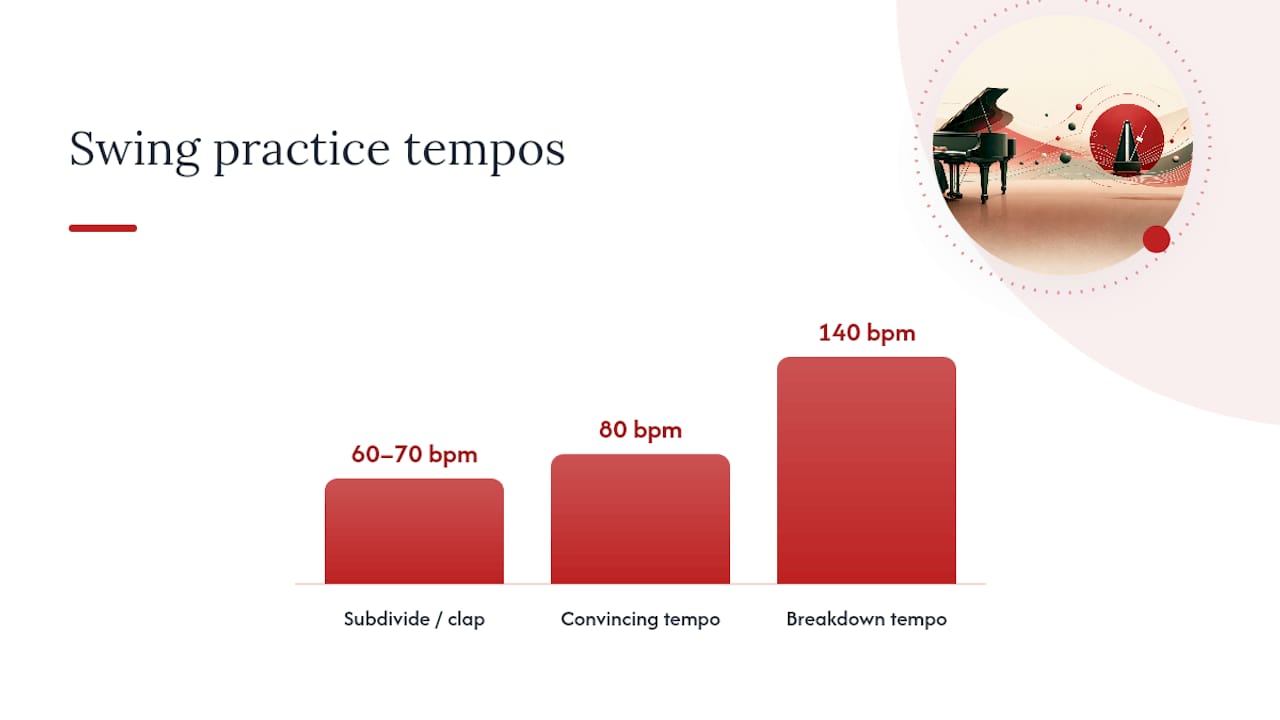
Subdivide out loud first. Set a metronome to a slow, comfortable tempo (60 to 70 bpm) and count “1-trip-let, 2-trip-let” over each beat, clapping on the “1” and the “let.” This trains your ear before your fingers get involved.
Play the long-short drill on one note. Hold down any key and play it twice per beat, long then short, matching the counted triplet. This is the exercise that turns theory into muscle memory, and it’s worth returning to daily even once you feel confident.
Swing the scale. Play a C major scale in eighth notes, but swing every pair, long-short, long-short, ascending and descending. Keep it slow enough that you can hear the ratio clearly rather than rushing into something that just sounds “jazzy.”
Add left-hand comping, hands separate. Practise a simple on/off chord pattern in the left hand alone until it’s steady, then bring in the right-hand swung line only once each hand is confident independently.
Combine hands at a reduced tempo. Play both parts together at roughly 70% of your eventual target tempo, then nudge the metronome up in small increments over several sessions.
Practise against a real recording. Loop a short phrase from a jazz standard using a slow-down and looping tool, matching your triplet feel against the recorded rhythm section.
Push tempo gradually. A student who can swing convincingly at 80 bpm but falls apart at 140 hasn’t actually internalised the feel yet, they’ve memorised a pattern at one speed.
Pro Tip: Record yourself playing the long-short drill at a slow tempo, then listen back. Most students are surprised to hear how uneven or rushed their “swing” actually sounds until they’ve heard it played back to them.
For a broader rhythm routine that extends beyond swing specifically, Danpianostudio’s guide to rhythm training for piano covers a four-week plan worth pairing with these drills.
What left-hand comping patterns work for swing piano?
The classic starting point is the Charleston pattern, an on-beat chord followed by an off-beat chord, named after the rhythm from the 1920s dance of the same name. Play a chord on beat one, then another on the “and” of beat two, leaving space in between. Reverse it (off-beat first, on-beat second) for a different flavour, and once both feel natural, try three-note variants that add a third hit somewhere in the bar for more forward motion.
Voicing matters more than most beginners assume. Effective comping leans on rhythm and placement far more than on harmonic complexity, so simple shell voicings, just the root, third or seventh, and maybe the sixth or ninth on top, will sound more convincing in time than a lush, overcomplicated chord played a fraction late.
A few practical guidelines for choosing and placing those voicings:
Keep the top note of each chord doing something musical: a stepwise line or repeated note works better than random leaps.
If you’re comping over a walking bass line, keep left-hand voicings narrower in the low register to avoid clashing with the bass frequencies.
Don’t repeat the exact same comping pattern for sixteen bars straight, vary it slightly to stay conversational with whoever you’re accompanying.
For a deeper look at specific voicings, Danpianostudio’s piano comping patterns for beginners guide breaks down several playable shapes in more detail.
How do articulation and dynamics shape swing feel?
Articulation choice depends heavily on tempo. At slower tempos, a slightly legato touch on the long note of each pair, with a light separation before the short note, sounds natural and singing. At faster tempos, that same phrasing turns muddy, so a punchier, more detached touch keeps the line clear and rhythmically precise.
Accents do a lot of the storytelling. Placing a small dynamic push on an off-beat, rather than the expected downbeat, is exactly what creates syncopation, the sense that the rhythm is leaning forward rather than sitting square on the beat. Leaving space matters just as much as filling it.
Favour lighter, more detached articulation above roughly 140 bpm; favour smoother legato phrasing below it.
Use small accents on off-beats and syncopated entries rather than uniform volume across every note.
Keep comping voicings simple enough that dynamic shading actually registers, a dense chord buries subtle accents.
Pro Tip: If your swing still sounds stiff, try playing the same phrase with your eyes closed and imagine you’re speaking the rhythm rather than hitting keys. Speech naturally swings; playing rarely does until you consciously loosen it.
Danpianostudio’s guide on fixing staccato and legato touch is a useful companion here if articulation control feels shaky in general, not just in a swing context.
Which recordings should you study to learn swing feel?
Listening is not optional homework, it is the fastest way to calibrate your ear against real timing rather than a metronome’s mechanical approximation. Start with a small, manageable list rather than an overwhelming playlist:
“Autumn Leaves” played by almost any classic trio, useful for hearing comping placement against a simple, memorable melody.
“All Blues” for a slower, loping swing feel that’s easier to isolate bar by bar.
“C Jam Blues” for a repetitive, easy-to-follow riff you can imitate almost immediately.
When you listen, focus specifically on the ride cymbal pattern and the bass line, since these two elements define where the rhythmic “pocket” actually sits, and that’s the cue pianists use to decide exactly how much to delay or anticipate that second eighth note. A curated jazz and blues playlist is a solid place to build a rotating listening list without hunting for tracks yourself. Loop short two or four bar sections with slow-down software until you can sing the comping rhythm back from memory before you attempt to play it.
What right-hand patterns and voicings work in swing accompaniment?
The right hand in swing playing does more than carry melody, it often doubles as a second rhythmic voice, especially in solo or duo settings without a bassist. A common approach is playing simple two-note or three-note voicings, often a sixth or a tenth apart, in a swung rhythm that echoes or answers the left-hand comping pattern rather than competing with it.
Guide-tone lines, moving between the third and seventh of each chord, work particularly well in the right hand because they’re compact and easy to swing convincingly. Rather than playing full block chords on every beat, try landing a two-note voicing on the “and” of a beat, then resolving it into the next chord’s guide tones, which naturally produces the syncopated, forward-leaning quality that defines convincing swing accompaniment.
Octave doubling of a melodic line also works well at faster tempos, since it projects clearly without requiring dense harmony underneath. When playing solo piano, alternate between right-hand melody with light left-hand support and moments where the right hand joins the left in rhythmic comping, filling in behind an imagined soloist. This call-and-response between hands, rather than treating the right hand purely as “the tune” and the left purely as “the rhythm,” is what separates stiff, exercise-book swing from something that actually grooves. Keep voicings light. A cluttered right hand fighting a busy left hand is one of the fastest ways to lose the pocket entirely, regardless of how accurate your triplet ratio is in isolation.
How do you bring swing rhythm into improvisation?
Improvising in swing time means your rhythmic choices matter as much as your note choices. A phrase built entirely from straight, evenly spaced eighth notes will sound wrong over a swinging rhythm section even if every note is harmonically correct, because the rhythmic language doesn’t match the groove underneath it.
Start improvising with rhythmic restriction rather than harmonic freedom. Limit yourself to quarter notes and swung eighth-note pairs for an entire chorus, resisting the urge to add sixteenth notes or triplet turns until the basic swung eighth feels automatic. This forces your ear and hands to internalise the pocket before you complicate things with faster rhythmic values.
Space is your friend during improvisation, arguably more than it is during comping. Leaving a beat or two of silence between phrases, rather than filling every bar with notes, gives the swing feel room to breathe and lets the rhythm section’s groove come through clearly. Many strong improvised lines are built from short, syncopated motifs repeated and varied, rather than long unbroken streams of eighth notes.
Practise improvising over a single chord or a simple two-chord vamp before attempting anything harmonically complex, since your rhythmic feel needs to be secure before you’re also tracking chord changes. Record short improvised choruses at a slow, comfortable tempo and listen back specifically for whether your eighth notes swing consistently or drift back toward an even, straight feel under pressure, which is extremely common when concentration shifts toward note choice.
How do you keep both hands swinging together?
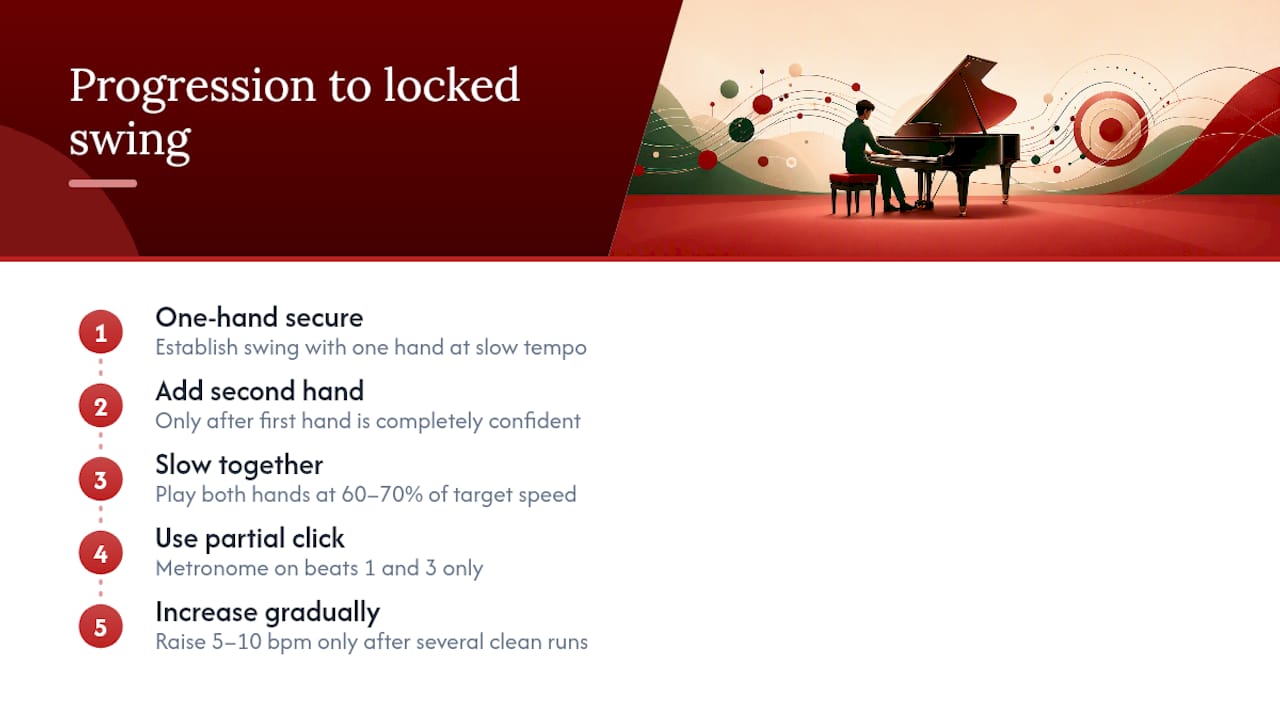
The most common coordination failure isn’t wrong notes, it’s the two hands swinging at slightly different ratios, one hand landing closer to a 2:1 feel while the other drifts toward something closer to even eighths. This mismatch is subtle enough that many students don’t notice it happening in their own playing.
The fix is deceptively simple: always establish the swing feel with one hand alone, completely secure at a slow tempo, before adding the second hand. Trying to swing both hands simultaneously from the very first attempt at a new pattern almost guarantees one hand will compromise to keep up with the other.
Once both hands are independently confident, practise them together at a tempo noticeably slower than your eventual goal, perhaps 60% to 70% of target speed. At that reduced tempo, listen specifically for whether the left-hand comping and right-hand line share the exact same rhythmic lean, not just the same tempo. It’s entirely possible to be rhythmically “together” in terms of timing while still swinging inconsistently between hands.
A metronome clicking only on beats one and three, rather than every beat, is a useful intermediate step once basic coordination is solid, since it forces both hands to maintain the internal subdivision independently rather than leaning on a click for every note. Gradually increase tempo in small increments, five to ten bpm at a time, moving up only once both hands stay locked together at the current speed for several consecutive run-throughs.
Why do dynamics and accents matter for swing?
Swing without dynamic variation sounds flat no matter how accurate the timing ratio is. The rhythmic feel and the dynamic shape work together, a well-placed accent on an off-beat is often what makes a listener perceive swing at all, rather than the underlying triplet subdivision doing the work alone.
Off-beat accents, a slight extra push of volume on the “and” of a beat rather than the downbeat, are one of the clearest markers of authentic swing phrasing. This is true in both the melodic line and the comping pattern underneath it. A comping chord voiced identically every time, played at identical volume, quickly becomes tedious even if the rhythm itself is technically correct.
Dynamics also help distinguish foreground from background. When comping behind a melody or a soloist, chords should generally sit quieter than the melodic line, stepping forward only briefly on accented syncopations before receding again. This dynamic push and pull, rather than a flat, uniform volume across every note, is a large part of what gives swing its conversational, breathing quality rather than a mechanical one.
Practise deliberately exaggerating accents at first, more than will eventually sound natural, since most beginners undershoot dynamic contrast dramatically. It’s far easier to dial back an overdone accent later than to add life to a performance that started out flat.
What mistakes should you avoid with swing rhythm?
The single most common mistake is treating swing as a fixed mathematical ratio applied rigidly at every tempo. A strict 2:1 triplet feel that sounds convincing at 90 bpm will sound exaggerated and awkward at 200 bpm, where the ratio naturally compresses closer to even eighths. Rhythmic feel should flex with tempo, not stay locked to one formula.
Another frequent error is swinging the right hand convincingly while the left-hand comping stays rhythmically stiff, or vice versa. Since both hands need to share the same underlying triplet subdivision, practising them separately without eventually checking they match is a trap many students fall into.
Overcomplicating voicings before rhythm is secure causes problems too. Reaching for dense, colourful chords while the underlying swing feel is still shaky just buries the timing issue under harmonic complexity, it doesn’t fix it. Get the rhythm locked with simple shells first.
Rushing tempo increases before the feel is secure at a slower speed, which almost always causes the swing ratio to collapse toward straight eighths under pressure.
Playing with completely uniform dynamics, which makes even technically accurate swing sound mechanical and lifeless.
Ignoring the recorded rhythm section entirely and swinging in isolation, rather than locking the feel to a bass line or ride cymbal pattern.
Treating written straight eighth notation as an instruction to actually play straight, when the genre convention calls for swing.
Instructor perspective: a realistic four-week path to swing
Most students plateau because they chase tempo before securing feel. A workable four-week structure looks like this: week one is triplet subdivision and the long-short single-note drill only, ten minutes daily, no exceptions. Week two adds the swung scale and basic Charleston comping, hands separate. Week three combines both hands at a reduced tempo. Week four introduces improvisation over one chord, still slow, with weekly tempo increases of no more than ten bpm.
The corrections that come up constantly in lessons: students rush the second eighth instead of delaying it, and they swing the right hand while the left stays mechanically even. Both fix quickly with slower practice and a teacher’s ear catching the drift before it becomes habit, which is exactly the kind of feedback that’s hard to give yourself from a metronome app alone.
— Dan
How lessons can fast-track your swing
Reading about the 2:1 ratio only gets you so far, a teacher listening to your actual playing catches the drift a metronome app never will. Danpianostudio’s jazz piano lessons focus on exactly this kind of rhythmic feedback, alongside improvisation and comping work tailored to whatever standard or style you’re working through, rather than a generic syllabus.
A single trial session is usually enough to spot whether your swing is drifting toward straight eighths under pressure, something surprisingly hard to hear in your own playing without a second pair of ears. Lessons run in Central London, Camden, and King’s Cross, or online if travelling isn’t practical, with each session tailored around your current sticking points rather than a fixed curriculum. If you’re ready to move past reading about swing and start correcting it in real time, book a lesson online and bring whatever tune you’re currently struggling to swing convincingly.
Sources
FAQ
What is a swing rhythm?
Swing rhythm is a long-short interpretation of eighth notes, roughly a 2:1 ratio, based on triplet subdivision rather than an even split. The written notation usually shows plain eighth notes, and the triplet feel is applied by convention in jazz, blues, and swing repertoire.
How do you play a swing rhythm on piano?
Count each beat as a triplet, “1-trip-let,” and tie the first two triplet parts together while playing the third short, giving the classic long-short feel. Practise this slowly with a metronome on one note before applying it to scales, melodies, or comping patterns.
How do you do swing on piano specifically for comping?
Use a simple on-beat, off-beat chord pattern in the left hand, known as a Charleston rhythm, built from basic shell voicings rather than dense chords. Keep the timing between the two chords swung, with the second chord landing slightly late rather than exactly halfway through the bar, and personalised correction from a teacher speeds this up considerably.
What is the difference between swing and straight rhythm?
Straight rhythm splits each beat into two equal parts, while swing rhythm splits it unevenly, roughly 0.66 seconds and 0.33 seconds at 60 bpm rather than two equal 0.5 second notes. Straight rhythm suits classical and pop styles; swing is the expected default in traditional jazz and blues.
Is swing rhythm always exactly two-thirds and one-third?
Not exactly. The 2:1 ratio is a useful approximation and teaching tool, but the actual feel loosens toward even eighths at faster tempos and tightens closer to true triplets at slower ones. Listening to recordings and adjusting by ear matters more than treating the ratio as a fixed rule.
Recommended


Comments