


Play ii V I Fluently: 3 Voicings and a Daily Routine for Jazz Piano


The ii–V–I is the three-chord sequence built on scale degrees 2, 5 and 1. In C major that means Dm7, G7 and Cmaj7, and it underpins more jazz standards than any other single progression. Start here: play Dm7 to G7 to Cmaj7 slowly with your left hand holding roots, then move the whole shape up a fourth and repeat around the cycle of fourths until it feels automatic in every key.
TL;DR:
Mastery of guide-tone voice leading accelerates transposing and improvising smoothly across all twelve keys, especially when practicing by vocalizing the roots aloud.
Using shell, rootless, and guide-tone voicings creates more authentic jazz sound, with the latter providing the clearest harmonic focus for quick recognition.
Recognizing secondary ii–V–I progressions and substitutions like tritone swaps or backdoor turns enhances understanding of jazz harmony beyond basic progressions.
Focused, short daily drills on connecting these progressions in various keys develop fluency faster than infrequent long practice sessions.
Listening for the tension and resolution embedded in dominant chords trains your ear to anticipate harmonic movements and play with genuine jazz feel.
Table of Contents
What the ii V I progression actually is (major vs minor)
Every ii–V–I tells a small story: tension, more tension, resolution. In C major, Dm7 is a minor seventh chord, G7 is a dominant seventh chord, and Cmaj7 is a major seventh chord. That chord quality sequence, minor seventh into dominant seventh into major seventh, is what makes the progression the fundamental harmonic building block in jazz, because each chord’s root sits a fourth above the last.
Minor keys work differently. The ii chord becomes half-diminished, written iiø7, and the tonic turns minor. So in C minor you’d play Dø7 (or Dm7♭5), G7, and Cm7 or Cm6. The dominant chord often picks up alterations too, most commonly a flattened ninth or fifth, which sharpens the pull towards resolution.
What actually glues the progression together is voice leading, specifically the way guide tones move:
The 7th of Dm7 © becomes the 3rd of G7
The 3rd of Dm7 (F) becomes the 7th of G7
The 7th of G7 (F) resolves down a half step to the 3rd of Cmaj7 (E)
The 3rd of G7 (B) resolves up a half step to the root of Cmaj7 ©
Notice how little movement there is. That’s the whole point of this progression.
How to build a ii V I in any key
Once you can do this without thinking, transposing becomes mechanical rather than mysterious. Here’s the three-step method:
Write out the major scale of your target key. For F major: F, G, A, Bb, C, D, E.
Find scale degrees 2, 5 and 1. In F, that’s G (2nd), C (5th), and F (1st, or the octave).
Build a seventh chord on each degree using notes from that scale. G becomes Gm7 (minor seventh, built from the scale), C becomes C7 (dominant), and F becomes Fmaj7 (major seventh).
Try it in G major next: the scale gives you G, A, B, C, D, E, F#. Degree 2 is A, degree 5 is D, degree 1 is G. That gives you Am7, D7, Gmaj7.
You already know C: Dm7, G7, Cmaj7.
Pro Tip: Say the roots aloud as you play them, “D, G, C” or “A, D, G”. Vocalising the numbers speeds up the connection between your ear and the keyboard far faster than silent repetition. This habit of naming intervals as you transpose is one reason aural recognition improves so quickly once learners commit to it.
Piano voicings that actually sound like jazz
Playing root position triads through a ii–V–I sounds correct but stiff. Three voicing families fix that, and each solves a different problem.
Shell voicings strip each chord to its root, 3rd and 7th, leaving out the 5th entirely. They’re the fastest way to internalise the harmonic skeleton before your hands get tangled in extensions, which is exactly why most beginner-friendly teaching leads with them. Left hand plays the root low, right hand plays 3rd and 7th close together.
Rootless voicings drop the root altogether, assuming a bass player (or your own left hand elsewhere) covers it. For Dm7–G7–Cmaj7 in the right hand:
Dm7: F, A, C, E (3rd, 5th, 7th, 9th)
G7: F, A, B, D (7th, 9th, 3rd, 5th)
Cmaj7: E, G, B, D (3rd, 5th, 7th, 9th)
Guide tone voicings track only the 3rd and 7th of each chord, the two notes that actually define its quality and drive the resolution. Playing C and F for Dm7, then F and B for G7, then E and C for Cmaj7, you’ll hear the half-step motion described earlier happen physically under your fingers. This is the clearest, fastest way to hear what a ii–V–I is doing harmonically, and it’s worth practising with nothing else in the right hand for a week before adding notes back. A practical guide to jazz piano voicings covers extended shapes once these three feel comfortable.
A daily routine for learning ii V I in all twelve keys
Fluency across keys comes from short, focused repetition, not marathon sessions. Short daily practice sessions are generally more effective than infrequent long ones; for foundational skills, consider exploring Trumpet Basics | Metapilot Academy to strengthen your general musicianship practice.
Warm-up (2 minutes): play shell voicings for Dm7–G7–Cmaj7 slowly, both hands, no metronome.
Voicing drill (4 minutes): cycle the same progression through the circle of fourths, moving Dm7–G7–Cmaj7 to Gm7–C7–Fmaj7, then Cm7–F7–Bbmaj7, and onward. Say each root aloud before you play it.
Comping patterns (4 minutes): add simple rhythms, quarter notes on beats 1 and 3, then try anticipating the next chord by an eighth note.
Improvisation phrases (4 minutes): play one short melodic idea over each chord using the guide tones as landing points.
Set your tempo target low, around 60 beats per minute for the whole cycle, and only increase speed once every key is clean. Accuracy in connecting guide tones matters more than speed at this stage; rushing just bakes in sloppy transitions.
Pro Tip: Test your progress on a real lead sheet, not just drills. Open any jazz standard and circle every ii–V–I you can find, including short ones that only last a bar. Recognising them on the page is half the skill.
Improvising over ii, V and I: simple scale choices that work
You don’t need exotic scales to start soloing over this progression. Three straightforward choices cover most situations:
Over the ii chord (Dm7): use D Dorian, essentially the C major scale starting on D.
Over the V chord (G7): use G Mixolydian, the C major scale starting on G.
Over the I chord (Cmaj7): use C major (Ionian) or the C major pentatonic for a cleaner sound.
That’s the combination most improvisers reach for first, because all three scales come from the same C major collection, so your fingers barely need to adjust shape as the chords change underneath you.
A simple two-bar lick to transpose: over Dm7, play F, E, D (descending from the 3rd); over G7, play B, A, G (same shape, new key); over Cmaj7, land on E and let it ring. Vary the rhythm each time you repeat it, sometimes straight quarter notes, sometimes with a swung eighth-note skip, and always aim to land on a guide tone as the chord resolves. A piano improvisation guide for beginners has more short licks built this same way.
Tritone subs, the backdoor, and secondary ii V I moves
Standards rarely stick to the plain version once you start reading real charts. Three variations show up constantly:
Tritone substitution replaces the V7 chord with a dominant seventh a tritone away. In C, that means swapping G7 for Db7 before resolving to Cmaj7. Both chords share the same guide tones (B and F are enharmonically equivalent to the 3rd and 7th of Db7), which is why the substitution sounds smooth rather than jarring.
The backdoor progression approaches the I chord from a bVII7 chord instead of V7. In C, that’s Bb7 resolving to Cmaj7, a darker, more surprising cadence than the standard dominant approach.
Secondary ii–V–I movements point briefly at a different key centre inside a tune that’s mostly in another key. Gm7–C7–Fmaj7 appearing inside a piece in C major functions as a ii–V–I in F, a temporary detour called tonicisation. Spotting these inside a lead sheet is often the difference between playing a tune mechanically and actually understanding it.
Comping rhythms that make ii V I sound like jazz, not exercises
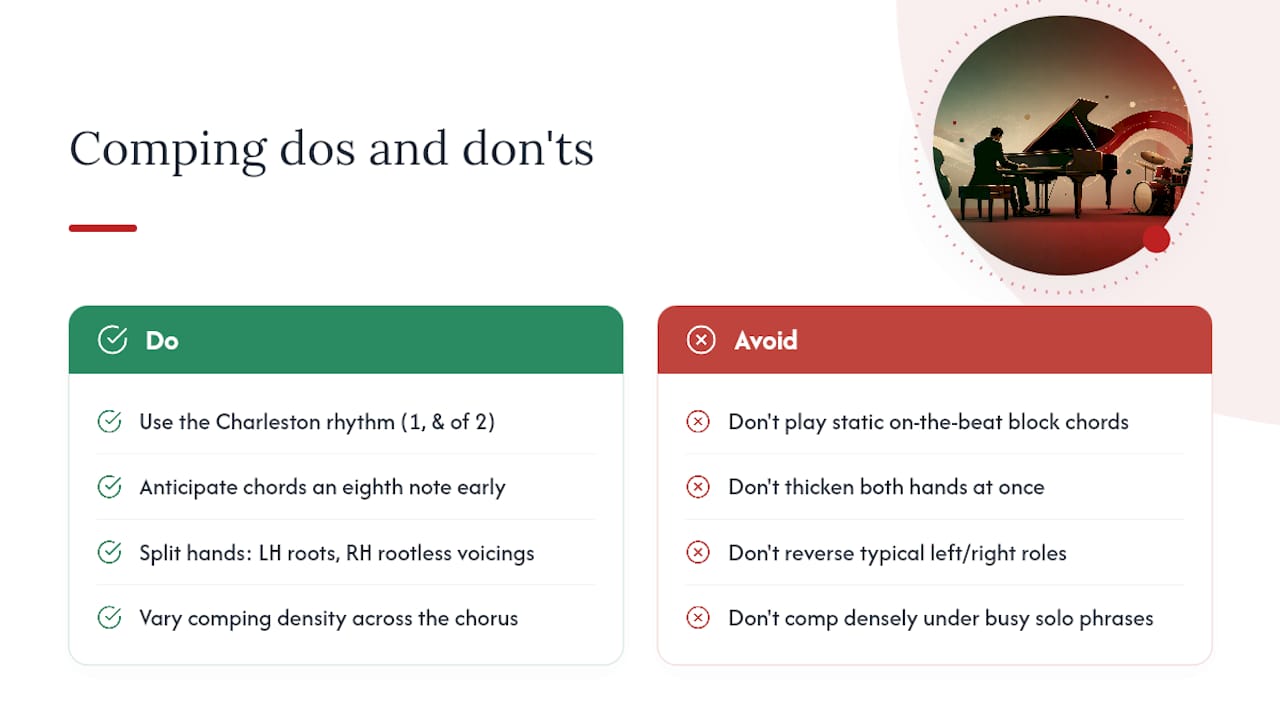
Static, on-the-beat block chords are the single biggest giveaway that someone learned a progression from a book rather than from listening. Real comping breathes.
The simplest useful pattern is the Charleston rhythm: hit the chord on beat 1, then again on the “and” of beat 2, leaving space elsewhere. Applied to Dm7–G7–Cmaj7, this creates a natural push-pull that still leaves room for a bass line or a soloist to breathe.
A second common approach is anticipation, playing the next chord an eighth note early, right before the barline. Instead of waiting until beat 1 of the G7 bar, you land on G7 on the “and” of 4 in the previous bar. This small rhythmic shift is one of the clearest markers separating stiff, classically trained comping from something that swings.
Left-hand and right-hand roles typically split: the left hand handles roots or shell voicings in a low register with sparse rhythm, while the right hand carries rootless voicings with more rhythmic activity. Reversing this, or thickening both hands at once, tends to sound cluttered rather than propulsive.
Vary density deliberately across a chorus. Comp sparsely under a soloist’s busy phrase, then fill more actively when they leave space. This call-and-response instinct, more than any specific rhythm pattern, is what separates mechanical comping from something that actually supports the music around it.
Why tension and resolution make the ii V I work
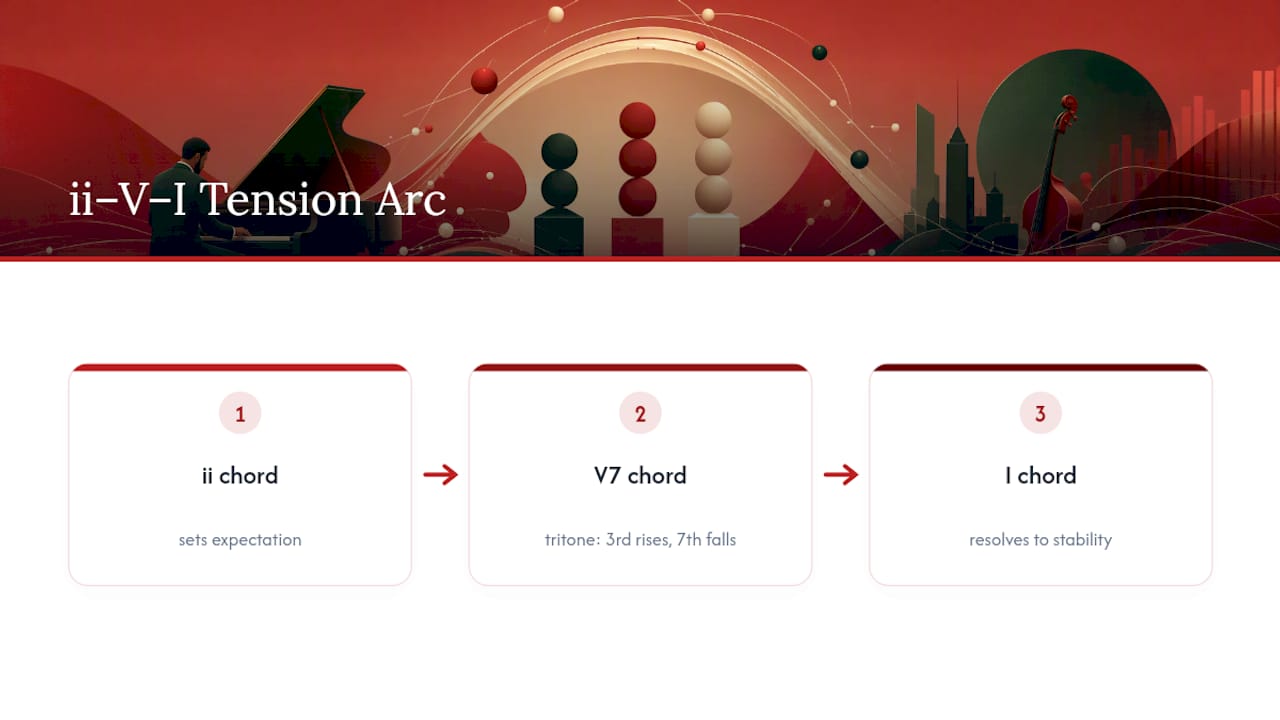
Functional harmony gives every chord a job. The ii chord sets up expectation, the V chord builds tension through the tritone between its 3rd and 7th, and the I chord releases that tension by resolving to stability. This tension-to-resolution arc is the engine behind almost all Western tonal music, and jazz simply compresses it into its most efficient three-chord form.
The dominant chord (V7) is doing the real work. Its tritone, in G7 that’s the interval between B and F, wants to resolve inward: B rises to C, F falls to E. That single interval is why G7 sounds unstable and Cmaj7 sounds like home. Every alteration jazz musicians add to the V chord, flattened ninths, sharpened fifths, extra tensions, exists to intensify that same pull rather than change its direction.
Understanding this changes how you listen to standards. Once you can hear a dominant chord as “wanting” to resolve rather than just naming it, you start predicting where a tune is going before it gets there. That predictive listening is what lets experienced players comp confidently through unfamiliar changes on a first read, because the ii–V–I shape announces itself well before the chord symbols confirm it.
This is also why the progression rewards slow practice. Rushing through Dm7–G7–Cmaj7 at speed teaches your fingers a shape. Playing it slowly, listening for that tritone resolve, teaches your ear the actual mechanism, which transfers to every other key and every tune built the same way.
Linking ii V I progressions across a full jazz standard
Most standards aren’t one ii–V–I in isolation. They’re a chain of them, often moving to different key centres within thirty-two bars, and the skill that separates confident players from hesitant ones is spotting where one progression ends and the next begins.
Start by scanning a lead sheet for every Xm7 to X7 pair a fourth apart. Each one is a ii–V, whether or not it resolves to the tune’s actual home key. A tune in C major that suddenly shows Am7–D7 for two bars is very likely tonicising G major briefly, even if it slides back to C right after.
The connecting trick is guide-tone continuity. If you’re moving from a ii–V–I in C straight into a secondary ii–V targeting F, the 7th of your Cmaj7 (B) often sits a half step from the 3rd of the next ii chord, keeping the melodic line smooth even as the harmony shifts key centre entirely. Practising with your eyes on guide tones, not chord symbols, makes these transitions feel inevitable rather than like separate puzzles stitched together.
Once you can do this at the piano, reading through a new standard stops being a decoding exercise. You start recognising the shape of the harmony in real time, because it’s built from the same three or four moves repeated with different roots.
Teacher’s perspective: how Dan Piano Studio approaches teaching ii V I
Most learners rush to add extensions before their guide-tone voice leading is clean, which is backwards. At Dan Piano Studio, lessons prioritise ear training and slow transposition drills before speed, because one-to-one coaching catches the specific habit that’s slowing each student down, whether that’s weak left-hand roots or guessing at scale choices instead of hearing them.
— Dan
Ready to turn theory into playing?
Reading about guide tones is one thing. Having someone sit beside you and correct your voicing the moment it goes muddy is another entirely. Danpianostudio offers jazz piano lessons and dedicated improvisation coaching built around exactly the kind of transposition and voicing work covered here, tailored to where your playing actually is rather than a fixed syllabus.
A first session typically starts with a quick assessment of your current chord vocabulary and ear, then moves into a practice plan built around your goals, whether that’s comping through standards, passing an ABRSM exam, or simply making ii–V–I sound natural under your fingers. Lessons run in the Camden studio, at home, or online, so location doesn’t need to be a barrier.
If you want structured feedback rather than solo practice, book a lesson directly, or browse the full range of piano lesson formats to see which fits your schedule and level best.
Sources
FAQ
What does “ii V i” mean?
The lower-case roman numerals mark scale degrees and chord quality: ii is a minor chord on the second degree of the scale, V is a dominant chord on the fifth, and i (or I) is the tonic. In C major, that’s Dm7, G7 and Cmaj7.
What is the forbidden note in music?
There’s no single universally “forbidden” note in jazz theory, though the term sometimes refers to the avoid note, typically the 4th degree played against a major seventh chord, because it clashes with the chord’s major 3rd. Over Cmaj7, for example, F can sound unresolved unless it’s used carefully as a passing tone.
What is the ii V I chord progression?
It’s a three-chord sequence moving from a minor seventh chord to a dominant seventh chord to a major seventh chord, built on the 2nd, 5th and 1st degrees of the scale. It’s considered the fundamental harmonic building block in jazz because it establishes a tonal centre so clearly.
What is the I vi ii V progression?
This is a four-chord loop, Imaj7, vi7, iim7, V7, that cycles back to the tonic rather than resolving forward like a standard ii–V–I. It’s common in doo-wop and older jazz standards and shares the same guide-tone logic, just rearranged into a repeating cycle instead of a one-way resolution.
How long does it take to play ii V I confidently in every key?
There’s no fixed timeline since it depends on prior keyboard experience, but consistent short daily practice cycling through the circle of fourths tends to build recognisable fluency faster than occasional long sessions. Guided lessons, such as those offered through Danpianostudio’s jazz piano lessons, can shorten that timeline by catching voicing mistakes early.
Recommended


Comments