


10 to 15 Minute Scales Practice Order for Pianists and Guitarists


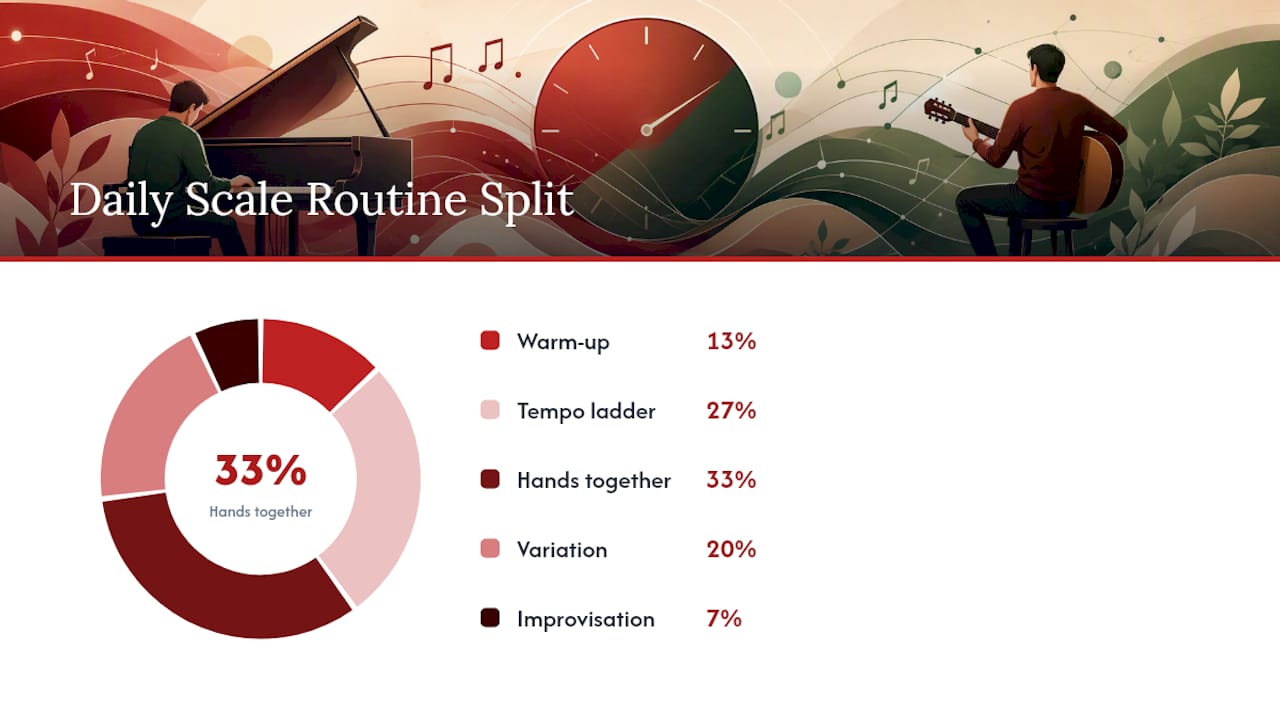
Start with C major and A minor on piano, or the minor pentatonic box on guitar, then move to the major scale, other minor forms, modes, and chromatic patterns last. Run a 10 to 15 minute session: two minutes warm-up, four minutes on a tempo ladder hands separately, five minutes hands together, three minutes on a variation, one minute of improvisation. Today, pick one key, work it hands separately, and don’t touch a second key until this one is clean.
TL;DR:
Starting with C major and A minor for piano or the minor pentatonic box for guitar builds a strong foundation before progressing to more complex scales and modes.
Practice should be structured into short, focused sessions of 10 to 15 minutes, emphasizing slow warm-up, tempo building with a ladder, and gradual speed increase.
Playing hands separately helps identify coordination errors and fix thumb crossings, picking up unevenness before combining both hands.
Begin with keys that are simple to play, such as C major and G major on piano, and A minor pentatonic on guitar, then gradually include more keys using the circle of fifths.
Incorporating variations like dotted rhythms, accents, and dynamic exercises enhances musical control, making scale practice directly applicable to performance.
Table of Contents
Scales practice order: the sequence that actually works
The scales practice order that gets results follows how your hands and ears build patterns, not how a textbook lists key signatures. Start too broad and you learn nothing deeply; start too narrow and you never build transferable skill. The sequence below solves both problems by moving from immediately useful patterns to more abstract ones.
For piano, begin with C major and A minor. No sharps, no flats, and the fingering pattern (1231234 in the right hand ascending) becomes the template you reuse everywhere. From there:
C major and A minor (relative keys, shared fingering logic)
The major scale in a few more keys (G, D, F) to lock in the pattern
Natural, harmonic, and melodic minor forms
Modes (Dorian, Mixolydian, and so on) once major and minor feel automatic
Chromatic and whole-tone scales last, since they’re more about finger independence than key-centre feel
Watch your thumb on the turnarounds. In C major right hand, the thumb tucks under after the third finger; get lazy here and every scale above it inherits the same stumble.
For guitar, the minor pentatonic box comes first, and there’s a good reason teachers converge on this. It’s five notes, one hand position, and it already sounds musical over blues, rock, and pop backing tracks, so you get to apply it the same day you learn it. Master box 1 before you touch box 2. From there:
Minor pentatonic, box 1 (the foundation shape)
Major scale, mapped onto the same fretboard positions
Major pentatonic (relative to the minor shape you already know)
Natural minor, then modes once you’re comfortable moving between positions
This order matters because each step transfers something you already own. Pentatonic teaches you a shape and a sound. The major scale teaches you the extra notes that turn that shape into a full tonal picture. Minor forms and modes are refinements, not new territory, once the foundation is solid. Jumping straight to modes or chromatic runs before this groundwork is the single most common reason scale practice feels pointless.
Your 10 to 15 minute daily scale routine
A focused daily routine beats an unfocused hour, and the reason is simple: unfocused practice repeats mistakes at speed, while a structured short session catches errors before they become habits. Here’s the minute-by-minute template, built for a single key and adaptable to guitar or piano.
Warm-up (0 to 2 minutes) — Play the scale slowly, hands separately, no metronome. You’re checking fingering and tone, not chasing speed.
Tempo ladder, hands separate (2 to 6 minutes) — Start at a comfortable metronome speed. Play four clean repetitions before you move up. Climb in fixed steps, typically 4 to 8 BPM at a time, never bigger jumps.
Hands together (6 to 11 minutes) — Combine hands at roughly 70% of your clean hands-separate tempo, then rebuild speed using the same ladder rule.
Variation (11 to 14 minutes) — Apply one rhythm, articulation, or dynamic pattern to the same scale (more on this below).
Improvisation or application (14 to 15 minutes) — One minute of free playing using only the notes from the scale you just practised.
The tempo ladder rule is where most players go wrong. It’s tempting to jump 20 BPM once something feels okay. Don’t. The rule is four consecutive clean repetitions at a given tempo before you advance, and hands-together tempo generally needs to sit around 30% below your clean hands-separate speed to rebuild properly. Skip that reduction and you’ll just relearn the same mistakes at a slower combined tempo.
Where you place this in your practice session matters too. Scales belong at the start, right after a physical warm-up, while your attention is sharpest and before fatigue creeps into your fingers. Beginners can get real gains from 5 to 15 minutes daily; intermediate players tend to need the fuller 10 to 15 minute version, and advanced players usually fold scale work into longer technical blocks rather than treating it as a separate task.
Pro Tip: Set your metronome app to save tempo presets per key. Watching your own tempo history climb over a fortnight is one of the most motivating things you can do with a five-minute habit.
Hands separately first: drills that actually build coordination
Playing hands separately isn’t a beginner’s crutch you graduate out of. It’s how you isolate which hand is causing a problem before you blend two error sources into one confusing mess. Piano students who skip straight to hands together often can’t tell whether a stumble comes from fingering, coordination, or simply not knowing the notes yet.
Start slow, one hand at a time, and watch two things specifically:
Thumb crossings, especially on the way up in the right hand and down in the left
Evenness between fingers, particularly the weaker third and fourth fingers, which tend to rush or drag
Rebuild speed from there using the same tempo ladder rule from the section above; four clean reps, then a small step up.
When things still fall apart hands together, three fixes solve most problems:
Shrink the range. Practise just the first four notes of the scale until the crossing feels automatic, then extend.
Use dotted rhythms. Long-short patterns force the “long” finger to land accurately and expose which note is actually causing the stumble.
Slow the metronome further than feels necessary. If four clean reps at a tempo feels like a stretch, you’re not slow enough yet. Drop 10 BPM and try again.
Guitarists face a parallel issue between fretting hand and picking hand. The fix is identical in principle: isolate, clean up, then recombine slower than you think you need to.
Which keys to start with, and how to progress sensibly
Starter keys matter more than most players realise, because the wrong first key adds difficulty that has nothing to do with scales themselves. On piano, the common starting sequence is C major, then G, D, and F, each adding just one sharp or flat at a time so the pattern-recognition load stays manageable.
Piano starters: C major, G major, D major, F major, then their relative minors (A, E, B, D minor)
Guitar starters: A minor pentatonic (open position or box 1), then E minor shapes once the first box is solid
Once you’ve got fluency across four or five keys, the circle of fifths becomes your map rather than a theory chart to memorise. Each step around the circle adds one sharp (clockwise) or one flat (anticlockwise), so your fingers learn the shape of the change rather than relearning a key signature from scratch each time.
Align your key choices with what you’re actually playing. If your current piece sits in D major, practise D major scales that week rather than working alphabetically through the circle. The same logic applies directly to exam prep: check your grade’s required keys and rotate through those specifically, rather than practising keys you won’t be tested on. One key per session, rotated with purpose, beats a scattergun approach every time.
Turn scale drills into real musical control
Playing a scale the same way every day trains your fingers but not much else. Variations are what convert a mechanical drill into control you can actually use in music, and they’re also the fastest fix for the unevenness that plain repetition never quite resolves.
A few that solve specific problems:
Dotted rhythms (long-short, then short-long) force accuracy on the notes that tend to rush
Alternating accents (accent every third or fourth note) build independence between fingers or picking strokes
Dynamic passes (play the scale crescendo ascending, decrescendo descending) train control at a level plain repetition never touches
Articulation swaps, alternating legato and staccato on consecutive passes, sharpen the difference between the two touches
Pattern practice, such as playing the scale in thirds or in a repeating “eyeglass” shape (up three, back two), which builds the kind of fluency that shows up directly in repertoire
None of this needs its own separate practice block. Fold one variation into the three-minute slot in your daily routine, rotate which variation you use across the week, and you’ll cover more ground than trying to drill all of them in one sitting. Dotted rhythms, accents, and pattern practice are the standard, tested fixes for uneven playing, and they work precisely because they force your ear and hand to notice inconsistencies plain repetition lets slide.
Making scales musical: improvisation and repertoire links
A scale that never leaves the practice room is a scale you’ll forget under pressure. The one-minute improvisation slot at the end of your session exists specifically to stop that happening: it forces you to use the notes you just drilled in an unstructured, musical way, which is a completely different skill from playing them in order.
Beyond the daily minute, three habits make scale work pay off in your actual playing:
Map scale shapes onto repertoire. If a passage in your current piece sits in G major, practise the G major scale that week and notice how the fingering you’ve drilled shows up inside the piece itself.
Use backing tracks or a click track for guitar and piano alike, to practise placing phrases in time rather than just playing notes in isolation.
Try call-and-response improv, playing a short phrase from the scale, then answering it, which builds the kind of musical thinking exam sight-reading and improvisation sections both reward.
Reading ahead in a score also sharpens how quickly you spot which scale a passage is built on; a quick refresher on reading sheet music pays off here if notation still slows you down.
What ABRSM candidates need to know about scales
ABRSM doesn’t leave scale requirements to guesswork. The current practical grades specification lists the exact scales, arpeggios, articulations, and tempos required at each grade, and examiners mark against that list directly.
A few things to plan around:
Requirements get more demanding by grade: more keys, more articulations (legato, staccato), and faster required tempos as you climb.
Sequence your practice so every key on your grade’s list gets covered well before the exam date, not crammed in the final fortnight.
ABRSM’s own Piano Scales & Arpeggios books are worth owning for your grade; they remove any ambiguity about exactly what’s required.
Cross-check your practice list against ABRSM exam requirements well before booking your exam date.
Why this routine holds up under real practice conditions
This isn’t theory borrowed from a textbook. Dan Piano Studio’s own teaching leans on the same structure: a short, focused warm-up before repertoire work, not a long unfocused block hoping something sticks.
The studio’s octave technique routine uses the same tempo ladder logic described above, applied to a specific technical problem.
The warm-up exercises guidance covers exactly where scale work should sit in a session, and why doing it first matters.
Students working through online lessons, home visits, or a studio trial session all get this structure adapted to where they currently are, whether that’s C major hands separately or grade 6 modal scales at speed.
The point isn’t that any single routine is magic. It’s that a repeatable structure, applied daily in short bursts, beats sporadic long sessions almost every time.
A seven-day scale challenge worth trying
Here’s the rule I won’t budge on: one key per session, hands separately before hands together, every single time. Skipping that step to save five minutes is the single most common reason progress stalls.
Try this for a week. Days 1 to 3, work one key using the full session template above, tracking your clean tempo each day. Day 4, add one variation (dotted rhythms works well). Days 5 to 6, push the tempo ladder as far as four clean reps allow. Day 7, record yourself and listen back for evenness.
Log your starting and ending tempo each day. If a jump feels shaky, drop back rather than pushing through.
— Dan
Book a lesson to fix what a routine alone can’t
A daily routine gets you consistent, but it can’t hear your specific stumble, or tell you whether that thumb crossing is a fingering problem or a listening problem. That’s the gap Dan Piano Studio closes. Rather than working through the tempo ladder alone, guessing at what to fix next, a session gives you a second set of ears watching exactly where your hands separate technique breaks down under speed.

A Camden Studio Trial Piano Lesson is built around whatever you’re stuck on right now, whether that’s a specific key, exam scales, or improvisation confidence. Prefer to work from home? Online Piano Lessons and Home Piano Lessons follow the same structure over video or in person. For candidates working towards a grade, ABRSM-focused lessons map your practice calendar against the exact keys your syllabus requires. Book a trial session and bring whatever key is giving you trouble.
Sources
For the exact scales, arpeggios, and tempos required at your grade, the ABRSM piano practical grades specification is the primary reference, updated for the current syllabus cycle. For the routine and tempo ladder logic behind this article, see the 15-minute daily scale routine breakdown, and for guitar-specific sequencing, the daily guitar scale routine covers pentatonic-first mapping in more depth.
FAQ
What order should you practise scales in?
Start with the most immediately useful pattern (C major and A minor on piano, minor pentatonic box 1 on guitar), then move to full major scales, other minor forms, modes, and chromatic scales last. This order works because each stage builds on a shape or sound you’ve already internalised, rather than introducing something unrelated. Dan Piano Studio structures lesson plans around this exact progression for new students.
What are the seven scales of music, in order?
The seven traditional modes, in order of brightness, are Ionian (major), Dorian, Phrygian, Lydian, Mixolydian, Aeolian (natural minor), and Locrian. Most learners meet Ionian and Aeolian first, since these are the standard major and minor scales, and work through the remaining five modes only once those two feel automatic.
How do you actually practise scales, day to day?
Run a short, structured session: warm up slowly, climb a tempo ladder hands separately, combine hands at roughly 70% of your clean tempo, add one variation like dotted rhythms, then improvise briefly using the scale. A focused 10 to 15 minute daily routine like this outperforms longer, unstructured sessions.
What order do the major scales go in?
Following the circle of fifths, major scales run C, G, D, A, E, B (or its flat equivalent), then continue through the sharp or flat keys. Most learners start at C and work outward one key signature at a time, since each new key adds only a single sharp or flat to what they already know.
How many keys should you practise in one session?
Stick to one key per session. Rotating too many keys in a single sitting produces shallow familiarity rather than the durable fluency you get from staying with one key until it’s genuinely clean, then moving on the next day.
Recommended


Comments