


Play by ear piano: a step-by-step guide for beginners
- Dan Piano Studio
- Aug 3
- 15 min read


You can learn to play piano by ear. Not as a party trick, and not only if you were born with perfect pitch. Playing by ear is a learnable skill built on two things: active listening and pattern recognition. Danpianostudio teaches it to beginners every week in Central London and online, using the same staged approach that underpins ABRSM aural training and the concept of audiation developed by music educator Edwin Gordon, the ability to hear music internally before your fingers move.
Here is a five-step quick start you can try right now:
Match a note. Hum the first note of a familiar song, then find it on the keyboard by trial and error. Middle C is a good anchor.
Hum the melody. Sing the first four bars in your head, then try to reproduce them one note at a time.
Find the bass. Play single low notes until one sounds like “home” under your melody. That is your tonic.
Try a simple progression. In C major, play C, G, Am, F with your left hand (I–V–vi–IV). Most pop songs use this or a close variant.
Add a left-hand pattern. Play root then fifth (C then G) as a simple two-note pulse under your melody.
Pro Tip: Isolate the bass line before you worry about chords. The lowest note in any chord almost always tells you which chord it is, and your ear will confirm it faster than any theory book.
After one or two focused sessions with this approach, you should be able to identify the tonic of a familiar song and play a two-chord accompaniment underneath it. That is a genuine, usable result.
Table of Contents
How do you learn to play piano by ear, step by step?
Learning to play by ear is not a single leap. It is a progression through five distinct stages, each one building the skills the next stage needs.
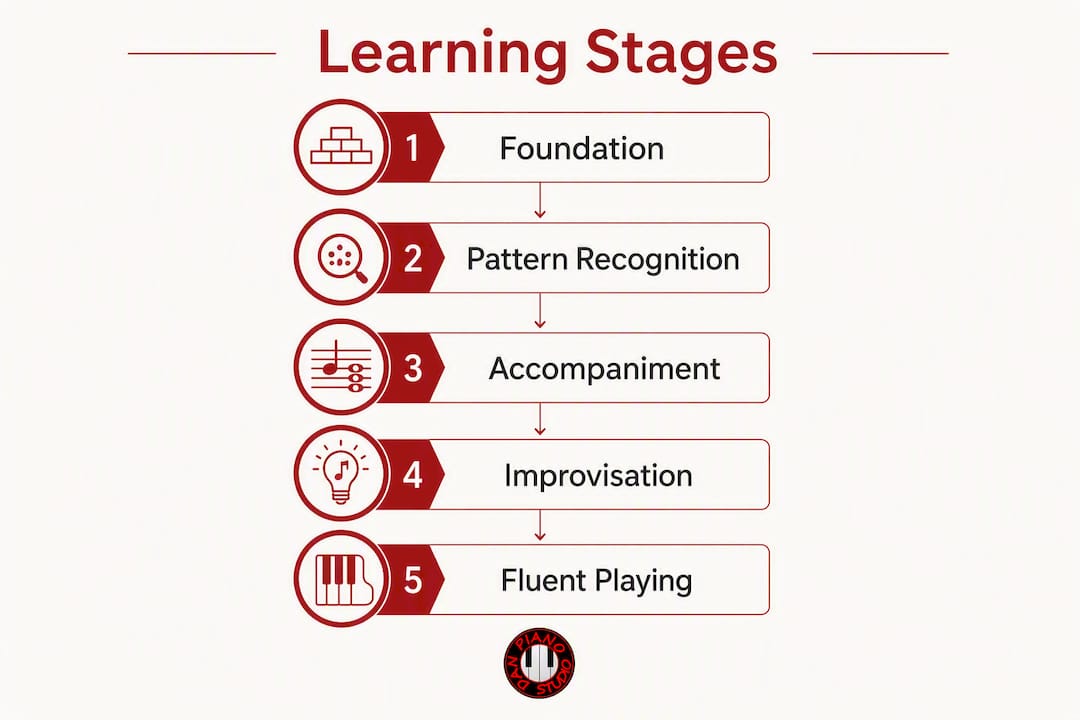
Stage 1: Foundation (listening and pitch matching)
The goal here is simple: train your ear to recognise individual pitches and short melodic phrases. Sit at the piano and hum a melody you know well, then find the starting note. Do not guess; search methodically from C upwards until the note matches what you are humming. Once you have the first note, find the second, then the third.
Practice objectives for this stage:
Match five consecutive notes of a familiar melody without looking at any reference.
Identify whether the next note is higher, lower, or the same.
Sing back a four-note phrase played by a teacher or from a recording.
This is where audiation does its work. Hearing the note in your head before you play it is more useful than perfect pitch for most learners, because it is trainable. Perfect pitch is largely innate; audiation is a habit.
Stage 2: Pattern recognition (intervals and common progressions)
Once you can find individual notes, the next step is recognising the distance between them. A major second sounds like the opening of “Happy Birthday.” A perfect fifth sounds like the opening of “Twinkle Twinkle.” These interval fingerprints let you reconstruct melodies far faster than hunting note by note.
Practice objectives:
Recognise unisons, major seconds, minor thirds, major thirds, perfect fourths, and perfect fifths by ear.
Identify whether a chord sounds major (bright) or minor (darker).
Hear a I–V–vi–IV progression and name the chords in C major.
A small amount of theory accelerates this stage considerably. Understanding scales, intervals, and triads gives your ear a framework to hang patterns on, rather than treating every song as a new puzzle.
Stage 3: Accompaniment (left-hand shapes and basic voicings)
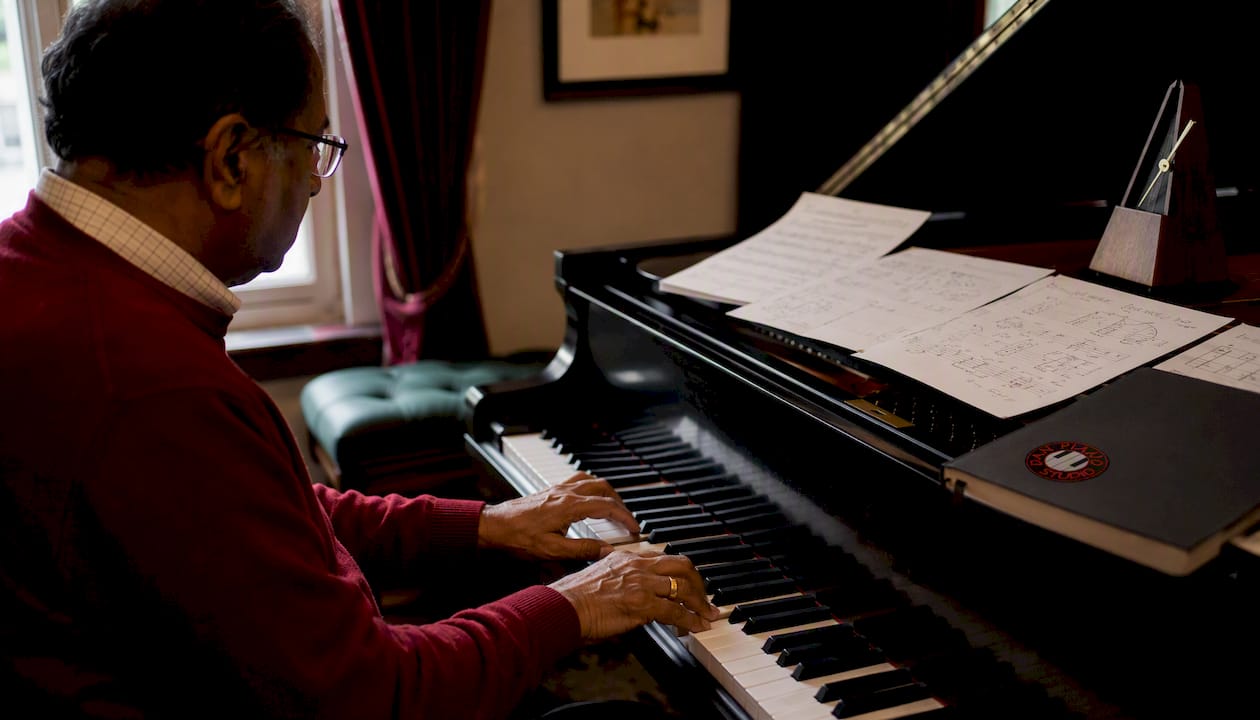
Now you add the left hand. The stepwise approach recommended by most ear-training methods runs: melody first, then bass note, then fill in the chord. Your left hand plays root-fifth or root-third patterns while your right hand carries the tune.
Practice objectives:
Play root-fifth patterns in C, G, and F major without hesitation.
Accompany a simple melody using two chords, switching smoothly.
Identify the bass note of a recorded chord by ear.
Stage 4: Improvisation (simple melodic variations)
With a melody and accompaniment in place, you can start varying the melody. Swap a note for the one above or below. Add a passing note between two chord tones. Repeat a short phrase with a different rhythm. This is the entry point to jazz piano improvisation and it does not require advanced theory.
Practice objectives:
Play a four-bar melody, then play it again with one note changed.
Improvise a two-bar response to a phrase you have just played.
Use a pentatonic scale (C, D, E, G, A) to create a short melodic idea over a I–IV–V progression.
Stage 5: Fluent playing (transposition and reharmonisation)
The final stage is portability. Can you play the same melody in G major? In F? Transposing a melody you know into a new key forces your ear and your fingers to work together rather than relying on muscle memory alone. Simple reharmonisation, swapping a I chord for a vi or a IV for a ii, adds colour and keeps the music interesting.
Practice objectives:
Transpose a four-bar melody into at least three different keys.
Replace one chord in a familiar progression with a substitute chord.
Play a full 12-bar blues in C, then in G.
Suggested session structure: Start with a five-minute warm-up (scales or a familiar melody). Spend ten minutes on a focused drill (interval recognition or a new chord shape). Spend fifteen minutes on song work. Finish with five minutes of free play or improvisation. Thirty-five minutes total is enough for steady progress; daily short sessions beat a single long one at the weekend.
What ear-training drills actually build the skill fastest?
Ear training is not passive listening. It is active, deliberate work on specific listening skills. These drills, drawn from interval recognition methods recommended by music educators, are the ones that transfer most directly to playing by ear.
Interval recognition
Sing a note, then sing the note a major second above it. Find both on the keyboard.
Use reference songs: a perfect fourth sounds like the opening of “Here Comes the Bride”; a minor third sounds like the first two notes of “Smoke on the Water.”
Play two notes simultaneously and decide whether the interval is a third, a fourth, or a fifth. Check yourself.
Work through unison, major second, minor third, major third, perfect fourth, perfect fifth, and octave before moving to more complex intervals.
Melody recall
Play a three-note phrase on the piano, then look away and sing it back. Then find it again on the keyboard. Extend to four notes, then five. This trains the loop between your ear and your hands that is the core of playing by ear.
Transposition drills
Learn a short four-bar melody in C major. Then move it up a tone to D major. Then to G major. Starting in C major is sensible because there are no black keys to navigate, but moving to G and F quickly is what builds real flexibility. The goal is to hear the melody as a set of intervals, not as a fixed set of key positions.
Call-and-response
Play a two-bar phrase. Then answer it with a two-bar phrase of your own. This is the simplest form of improvisation and it trains your ear to think ahead. You can also use a recording: pause after a phrase, sing your response, then play it.
Suggested daily drill schedule:
Minutes 1–5: interval singing (hum and match on keyboard)
Minutes 6–12: melody recall (three to five notes, then extend)
Minutes 13–20: transposition of a short phrase into two new keys
Minutes 21–25: call-and-response (with a recording or a teacher)
For app-based support, the Danpianostudio post on aural training apps covers the best tools available in the UK, including free and subscription options. If you prefer working offline, a simple recording device and a tuner app on your phone are enough.
Which chord patterns unlock the most songs?
The good news is that a surprisingly small number of chord progressions cover a large proportion of pop, folk, and light jazz. Learn these shapes and you can accompany most songs you hear.
The essential progressions
I–V–vi–IV (in C major: C, G, Am, F) is the backbone of hundreds of pop songs. Play it slowly, listen to how each chord wants to move to the next, and you will start hearing it everywhere.
I–vi–IV–V (C, Am, F, G) is the classic 1950s doo-wop progression. It sounds slightly more nostalgic than I–V–vi–IV but uses the same four chords in a different order.
ii–V–I (Dm, G, C in C major) is the foundation of jazz harmony. If you want to move into jazz improvisation, this is the first progression to master.
Left-hand shapes
Three shapes cover most accompaniment needs at the beginner stage:
Root-fifth: Play C in the bass with your fifth finger, then G with your first. This gives a stable, open sound. Try it under a simple melody in C major.

Root-third: Play C with your fifth finger, E with your second. This is warmer and works well for slower songs.
Broken arpeggio: Play C, then G, then the C above, one note at a time in a flowing pattern. This is the “Alberti bass” pattern used in classical music and it works equally well in pop.
To try these in practice: place your left hand in C major position. Play C–G as a two-note pulse while your right hand plays the melody of “Twinkle Twinkle.” Then swap to Am–E (root-fifth) for the vi chord. The transition should feel smooth within a few repetitions.
Pro Tip: Practise the left-hand pattern completely separately until it runs on autopilot. If your left hand needs conscious attention, your ear cannot focus on the melody. Separate hands practice is not a beginner shortcut; it is how professionals learn new material too.
Once you know the basic I–V–vi–IV progression, simple reharmonisation becomes available. Swap the I chord for a iii (Em in C major) for a slightly darker colour. Replace the IV with a ii (Dm) for a jazzier feel. These substitutions do not require advanced theory; they require a trained ear that can hear whether the swap sounds right.
Understanding music theory for pianists accelerates this process, but you do not need to study theory formally before you start experimenting.
What songs should beginners use to practise playing by ear?
The best songs for ear learning are ones you already know well enough to hum from memory. Familiarity is the point: your internal hearing of the melody is the reference your ear trains against.
Progressive song list
“Twinkle Twinkle Little Star” — Start here. The melody uses only five notes (C, D, E, F, G) and the chord progression is I–IV–V–I. Practise the melody with the right hand, then add a root-fifth left-hand pattern. Once comfortable, transpose to G major.
“Happy Birthday” — Slightly more complex because it starts on the fifth degree (G in C major). This teaches you that melodies do not always start on the tonic. Practise finding the starting note by ear before looking it up.
“Let It Be” (verse) — Uses I–V–vi–IV in C major almost throughout. Once you can play the chord progression by ear, add the melody on top. This is the bridge between chord recognition and full arrangement.
“Autumn Leaves” (simplified) — Introduces the ii–V–I progression in a musical context. Play the melody in the right hand and a simple root-fifth pattern in the left. This is your entry point to jazz ear playing.
“Hallelujah” (Leonard Cohen) — Uses I–V–vi–IV with some added colour. The slow tempo gives you time to listen and adjust. Focus on smooth chord transitions rather than speed.
Progressive drill sequence
For each song, work through this order:
Hum the melody all the way through from memory.
Find the starting note on the keyboard.
Learn the melody phrase by phrase, hands separately.
Identify the bass note for each phrase.
Add a simple left-hand pattern (root-fifth or root-third).
Play hands together slowly.
Add one small embellishment (a passing note or a repeated phrase).
Transpose the whole thing into one new key.
The book Piano by Ear: Learn to Play by Ear, Improvise, and Accompany Songs in Simple Steps follows a similar sequence and is a useful printed companion for self-teaching pianists who want structured exercises alongside their instrument practice. It covers melody finding, chord identification, and simple accompaniment in a format that works without a teacher present.
How long does it take, and what does a realistic practice plan look like?
Progress depends on consistency more than session length. Short, focused daily sessions of 15–30 minutes produce steadier gains than a two-hour session once a week.
Typical progress markers
After 2 weeks of daily practice: you can find the starting note of a familiar melody by ear, play a I–V–vi–IV progression in C major, and add a simple root-fifth left-hand pattern.
After 3 months: you can learn a new simple melody by ear within one session, identify major and minor chords by sound, and play in at least three keys (C, G, F).
After 6 months: you can accompany most simple pop songs by ear, improvise short melodic variations over a chord progression, and transpose a melody into any major key with modest effort.
Sample weekly plan
Activity | Sessions per week | Minutes per session |
Interval and melody recall drills | 5 | 10–15 |
Chord progression practice (left hand) | 4 | 10–15 |
Song work (melody + accompaniment) | 4 | 15–20 |
Free improvisation | 3 | 5–10 |
Transposition exercises | 3 | 10 |
Four-week starter plan
Week 1: Interval recognition and pitch matching only. Learn “Twinkle Twinkle” by ear in C major.
Week 2: Add I–V–vi–IV chord progression in C major. Learn “Happy Birthday” by ear.
Week 3: Introduce root-fifth left-hand pattern. Begin “Let It Be” verse by ear.
Week 4: Transpose “Twinkle Twinkle” to G major. Practise call-and-response drills daily.
Using a metronome during chord practice is worth doing from week two onwards. Set it slow enough that every chord change is clean, then increase the tempo only once the transition feels automatic.
What mistakes slow beginners down, and how do you fix them?
Most plateaus in ear playing come from a small number of repeatable errors. Recognise them early and you save weeks of frustration.
Chasing exact pitch instead of intervals. Beginners often spend ten minutes hunting for a single note rather than listening to the relationship between notes. Fix: hum the interval from the previous note and let that guide your search. The distance matters more than the absolute pitch.
Trying full arrangements too soon. Attempting melody, chords, bass, and rhythm simultaneously before any component is secure is the most common beginner error. Fix: isolate one layer at a time. Melody only, then bass only, then both together. Add the left-hand pattern last.
Ignoring the bass line. The bass note is the fastest cue for chord identification, yet most beginners focus entirely on the melody. Fix: listen to a recording and follow only the bass. Hum it. Then find it on the keyboard. Once you have the bass, the chord almost identifies itself.
Inconsistent listening practice. Playing by ear is not only a keyboard skill; it is a listening habit. Fix: listen actively to music you enjoy every day, even for ten minutes. Try to identify the bass note, the chord quality (major or minor), and the progression. This counts as practice.
Avoiding difficult keys. Many beginners stay in C major indefinitely. Fix: start in C major to learn the patterns, then move to G major (one sharp) and F major (one flat) within the first month. If a song sits in a key with many sharps or flats, transpose it into C or G first, learn it there, then move it back.
The 80/20 principle applies directly here. A small set of drills, interval recognition, bass-line identification, and I–V–vi–IV chord practice, produces the majority of progress. Spending most of your practice time on these three activities and less on running through whole songs repeatedly is the most efficient use of thirty minutes a day.
How does a teacher help you learn to play by ear faster?
Self-teaching is possible, and many pianists do it. But a teacher compresses the timeline significantly, for a specific reason: they hear what you cannot yet hear about your own playing.
When you practise alone, a wrong note or a rhythmic slip can become a habit before you notice it. A teacher catches it in the moment and gives you a corrective exercise before the error is reinforced. That feedback loop is the single biggest advantage of lessons over self-study.
At Danpianostudio, a typical ear-training lesson for a beginner follows this structure:
10 minutes: ear drills (interval singing, melody recall, chord quality identification)
15 minutes: pattern work (chord progressions, left-hand shapes, transposition)
20 minutes: song work (learning or refining a piece by ear, hands separately then together)
5–10 minutes: free improvisation or call-and-response
The lesson is structured, but it adapts. If a student is struggling with the transition from I to vi, the teacher spends more time there. If a student is ready to move from C major to G major, the teacher introduces it that session rather than waiting for a fixed schedule.
Combining ear training with a basic theoretical framework, scales, triads, and common progressions, is the most efficient path from simple melody reproduction to confident improvisation. A teacher decides when to introduce each element based on what the student can already hear, not on a fixed syllabus.
For students who want to understand how classical technique and jazz improvisation support each other in ear playing, Danpianostudio covers both in its lesson programmes. Lessons are available in Central London (Camden, King’s Cross) and online. To book a taster session focused on ear training, visit the Danpianostudio home page.
Which apps, books, and resources are worth using in the UK?
The best resources pair with real instrument practice rather than replacing it. An app that trains your ear away from the keyboard is useful; an app that replaces keyboard time is not.
Apps:
Tenuto (free, iOS/Android) covers interval recognition, chord identification, and scale ear training. Clean interface, no subscription required.
EarMaster (subscription, available in the UK) offers structured ear-training courses with call-and-response exercises and interval drills. Works well alongside the daily drill schedule in section 3.
Functional Ear Trainer (free, iOS/Android) focuses specifically on relative pitch and chord function, which maps directly onto playing by ear.
The Danpianostudio post on aural training apps gives a fuller comparison of these and other tools, including pricing for UK users.
Books:
Piano by Ear: Learn to Play by Ear, Improvise, and Accompany Songs in Simple Steps is the most directly relevant printed resource for self-teaching pianists. It covers melody finding, chord identification, and accompaniment in a progressive sequence that mirrors the staged approach in this article. Available from major UK booksellers.
Piano Adventures (Faber) is a method book series that incorporates ear training from the earliest levels, useful if you want a more structured printed curriculum.
Online resources:
The GeniusHub Learning blog covers how active listening and ongoing support between lessons accelerate progress, a useful read for self-teaching pianists who want to understand how to structure their independent practice.
Paul McCartney’s approach to finding melodies and chord shapes by experimenting at the piano is a useful reminder that ear playing is a legitimate creative method, not a workaround for people who cannot read music.
A caution about apps: ear-training apps are excellent for interval and chord recognition drills, but they cannot replace the feedback of a teacher or the physical experience of finding notes on a real keyboard. Use them for the drill portion of your practice (10–15 minutes), not as a substitute for instrument time.
Key takeaways
Playing piano by ear is a learnable skill built on audiation, interval recognition, and a small set of transferable chord patterns, practised daily in short, focused sessions.
Point | Details |
Start with the bass line | The bass note identifies the chord faster than any other cue; isolate it before building the full accompaniment. |
Learn three progressions | I–V–vi–IV, I–vi–IV–V, and ii–V–I cover the majority of pop, folk, and jazz songs you will want to play. |
Daily short sessions win | 15–30 minutes of focused daily practice produces steadier progress than longer, infrequent sessions. |
Transpose early | Moving a melody into G and F major within the first month builds real ear flexibility and prevents over-reliance on C major. |
Danpianostudio accelerates progress | Structured ear-training lessons in Central London and online give you personalised feedback that self-study alone cannot replicate. |
Why ear playing matters more than most teachers admit
Most piano teaching still centres on the score. Read the dots, play the dots, repeat until clean. There is nothing wrong with that approach for building technique and repertoire, but it quietly trains students to distrust their own ears. After years of score-reading, many pianists genuinely cannot play a song they know by heart without the sheet music in front of them.
That is a strange outcome when you think about it. Music is a listening art. The score is a set of instructions, not the music itself.
What ear playing restores is the direct connection between what you hear and what you play. It is not a separate skill from “proper” piano playing; it is the foundation that formal training sometimes buries. Paul McCartney described his own process as repeated experimentation at the instrument, finding chord shapes and melodies by listening and trying, not by reading. That is not a shortcut. It is a different kind of rigour.
The students who progress fastest in ear training at Danpianostudio are not always the ones with the most formal theory knowledge. They are the ones who listen actively outside of lessons, who hum melodies in the shower and try to find them on the keyboard when they get home. That habit, more than any drill or exercise, is what builds the skill.
The practical implication: treat listening as practice. Every time you identify the bass note of a song on the radio, or recognise a I–V–vi–IV progression in a film score, you are training your ear. It does not require a piano. It requires attention.
Lessons at Danpianostudio: learn to play by ear in London or online
Skipping the sheet music and learning to play what you hear is exactly what Danpianostudio is built for. Rather than working through a fixed syllabus, lessons are shaped around what you can already hear and where the gaps are, so progress is faster and more satisfying than generic beginner courses.
Lessons are available in Central London at 23 Purchese Street (Camden, King’s Cross) and online for learners anywhere in the UK. A first lesson focused on ear training typically covers a short interval drill, finding a melody you know by ear, and building a simple left-hand accompaniment around it. You leave with a specific practice task rather than a list of theory to memorise.
For in-person tuition, home piano lessons are available across London. If you prefer to work from home, online piano lessons deliver the same structured ear-training approach via video. New students do not need any prior experience or equipment beyond access to a keyboard or piano.
To book a taster lesson or ask about lesson formats, visit Danpianostudio and get in touch directly.
Further reading and authoritative sources
Danpianostudio: Music theory for pianists that really helps — which theory topics directly support ear playing and improvisation.
Danpianostudio: Best aural training apps — UK-relevant comparison of ear-training apps with pricing and usage notes.
Danpianostudio: Jazz piano instruction that builds real skill — how jazz chord vocabulary and improvisation methods extend ear-playing skills.
Recommended

Comments