


Jazz piano for beginners: start playing a tune today
- Dan Piano Studio
- 15 hours ago
- 9 min read

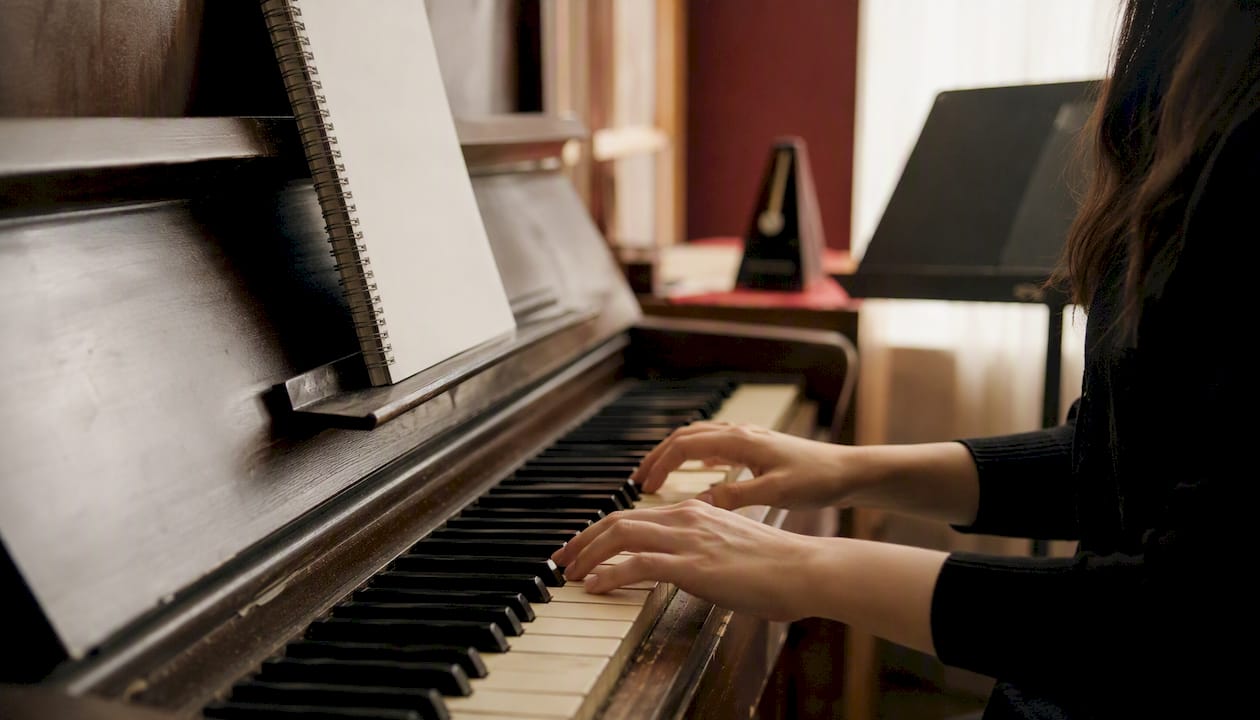
You can play a recognisable jazz tune today. Not in six months, not after you have memorised a hundred scales. Today. Here is the five-step sequence that gets you there:
Listen to a recording of the tune you want to learn. Duke Ellington’s recordings are a superb starting point; the PBS biography of Duke Ellington offers context on which recordings to seek out first.
Sing the melody out loud until you can hum it without the recording.
Find the melody on the piano, one note at a time, using your right hand.
Add simple left-hand chords — a basic Cmaj7 or a two-note guide-tone voicing is enough to start.
Play with a backing track or metronome to feel the groove and lock in the timing.
A jazz standard is the ideal first vehicle: these are well-known tunes with clear melodies and repeating chord progressions that every jazz musician learns. A 12-bar blues or a simple standard like “Autumn Leaves” works perfectly. The approach above mirrors the LIST method (Listen, Internalise, Sing, Transfer) used by many experienced teachers, including at Danpianostudio.
Pro Tip: Before you touch the piano, spend five minutes just listening to the recording with your eyes closed. Sing along. That five minutes does more for your ear than an hour of mechanical practice.
Key takeaways
Starting jazz piano comes down to one decision: begin with a song you love, learn it by ear, and keep sessions short and daily.
Point | Details |
Start with listening | Choose one tune, listen until you can sing the melody, then transfer it to the piano. |
Learn the ii–V–I first | This single chord progression underpins the majority of jazz standards and gives you an immediate harmonic toolkit. |
Keep practice short | A 20-minute daily session structured around ear training, voicings, and melody beats longer irregular sessions. |
Use backing tracks early | Playing with a backing track from week one builds swing feel and timing faster than a metronome alone. |
Danpianostudio lessons | One-to-one tuition in Central London or online accelerates progress at every stage of the 12-week pathway. |
Table of Contents
What does a 90-day beginner jazz piano pathway look like?
A clear roadmap removes the guesswork. Here is a 12-week plan split into three four-week blocks.
Weeks 1–4: Foundations
Learn the melody of one simple standard by ear (no sheet music yet).
Practise the melody hands-separately for two sessions of 10 minutes each day.
Add a basic left-hand chord on beat one of each bar (Cmaj7, Dm7, G7).
Listen to at least one jazz recording every day, even for five minutes.
By week four you should be able to play the melody with your right hand while holding simple chord shapes in your left, and recognise the sound of a major seventh chord.
Weeks 5–8: Harmony
Introduce the ii–V–I progression in one or two keys.
Learn two-note guide-tone voicings (the third and seventh of each chord).
Begin reading a lead sheet: melody on top, chord symbols below.
Aim for 15–20 minutes of focused practice daily, split between voicings and melody.
By week eight you should be able to comp through the chord changes of your first tune using guide tones and play the melody cleanly over the top.
Weeks 9–12: Improvisation basics and integration
Introduce the major pentatonic or blues scale over a simple chord progression.
Practise short two-bar improvised phrases, then extend to four bars.
Combine left-hand comping with right-hand improvisation for the first time.
Record yourself once a week to track progress.
By week twelve you should be able to play through a full chorus of a simple standard, improvise a short phrase or two, and hear the difference between a major seventh and a dominant seventh chord.
One-to-one lessons accelerate every block. A teacher spots technical habits early, adjusts your voicings, and gives you the kind of specific feedback that a video course cannot replicate. If you are working through this pathway alone, booking even one lesson at the end of each four-week block is enough to correct course before habits set in.
Core concepts every beginner needs to understand
Jazz theory sounds intimidating. It is not, once you strip it to the handful of ideas that actually produce results quickly. The table below covers each concept, what it means in plain English, and one practice tip you can apply today.
Concept | Plain-English definition | Practice tip |
Lead sheet | A page showing melody and chord symbols, no full arrangement | Sing the melody while reading the chord symbols aloud |
Major 7 chord (maj7) | A chord with a warm, open sound; e.g. Cmaj7 = C, E, G, B | Play it with your left hand and listen for the “jazzy” colour |
Minor 7 chord (min7) | A softer, slightly melancholic chord; e.g. Dm7 = D, F, A, C | Compare it to Cmaj7 to hear the difference immediately |
Dominant 7 chord (dom7) | A tense chord that wants to resolve; e.g. G7 = G, B, D, F | Notice how it pulls toward Cmaj7 when you play them in sequence |
ii–V–I progression | The most common chord sequence in jazz (e.g. Dm7–G7–Cmaj7) | Practise this in C major until it feels automatic |
Guide tones | The third and seventh of a chord — the notes that define its sound | Play just the guide tones of each chord in a ii–V–I |
Swing rhythm | A lilting, uneven feel where pairs of notes are played long-short | Clap the rhythm before playing it on the piano |
Comping | Playing chords rhythmically to support a melody or soloist | Comp with your left hand while humming the melody |
Jazz piano chords explained for beginners goes deeper on voicings if you want to build on this table. The key insight from experienced teachers is that beginners do not need advanced theory to sound good; a small set of concepts plus song-based practice gets audible results fast.
How to structure your daily practice as a complete beginner
Short, focused sessions beat long, unfocused ones every time. A 20-minute daily practice is more effective than a two-hour weekend session, especially in the first three months.
Here is a repeatable daily template:
Warm-up (3 minutes): Play a simple five-finger exercise or a slow scale to loosen your hands. The 8 best piano exercises for beginners gives you a ready-made warm-up sequence.
Ear training (5 minutes): Listen to a short passage of your chosen tune, then sing it back. Sing the bass notes too before you play them.
Voicing exercise (5 minutes): Play the ii–V–I progression in one key, using guide tones in your left hand. Repeat slowly until it is smooth.
Comping and melody (5 minutes): Play the melody with your right hand while comping simple chords with your left. Hands together, slowly.
Short improvisation (2 minutes): Play four bars of a blues scale over a backing track. Do not worry about perfection; just listen to what you play.
For progress checks, record yourself on your phone at the end of each week. Play the same 16 bars every time. After four weeks, the difference is usually striking enough to be motivating. You can also count how many melodic phrases you complete without stopping, or ask a teacher to listen and give specific feedback.
Pro Tip: Practise each element at a tempo where you make zero mistakes. If you make a mistake, slow down further. Speed comes from repetition at the right tempo, not from pushing through errors.
A practical beginner routine combines a simple left-hand pattern, guide-tone comping, and a melody or short improvisation on top. That combination is exactly what the template above builds toward.
What instrument and gear do you actually need in the UK?
You do not need an acoustic grand piano to start. A good digital keyboard is perfectly adequate for the first year, and often more practical for home practice in a flat or shared house.
Minimum features to look for:
88 weighted or semi-weighted keys: Touch sensitivity matters for developing dynamics and expression. Avoid unweighted “synth action” keys if you plan to progress to an acoustic piano or take ABRSM or Trinity exams.
Touch sensitivity (velocity sensitivity): The keyboard must respond to how hard you press each key.
Built-in metronome or MIDI/USB output: MIDI connectivity lets you use apps and recording software later.
Sustain pedal input: A sustain pedal is not optional; buy one with the keyboard.
Acoustic piano vs digital keyboard: An acoustic piano offers superior touch and tone, but a quality digital keyboard is quieter, requires no tuning, and costs far less to maintain. For a beginner in England, a mid-range digital keyboard from a reputable music retailer (Yamaha, Roland, and Kawai all produce solid beginner models) is the practical starting point. Try before you buy at a shop such as Yamaha Music London or a local music retailer; play a few notes and check that the keys feel responsive.
Essential accessories:
Sustain pedal (often sold separately)
Adjustable stand and bench at the correct height
Headphones for quiet practice
A free metronome app (such as Pro Metronome on iOS or Android)
A simple recording device or smartphone for weekly self-assessment
If you are working toward ABRSM or Trinity exams, confirm that your keyboard’s touch response and pedal setup match what examiners expect. A teacher can advise on this before you invest.
Where should you learn next: lessons, apps, and online tools
The three main learning formats each suit a different situation.
One-to-one lessons give the fastest, most personalised progress. A teacher hears exactly what you are doing wrong, corrects it in the moment, and adapts the lesson to your pace. As The New York Times noted, online resources have expanded access to jazz tuition significantly, but teacher feedback remains the most reliable driver of steady progress for absolute beginners.
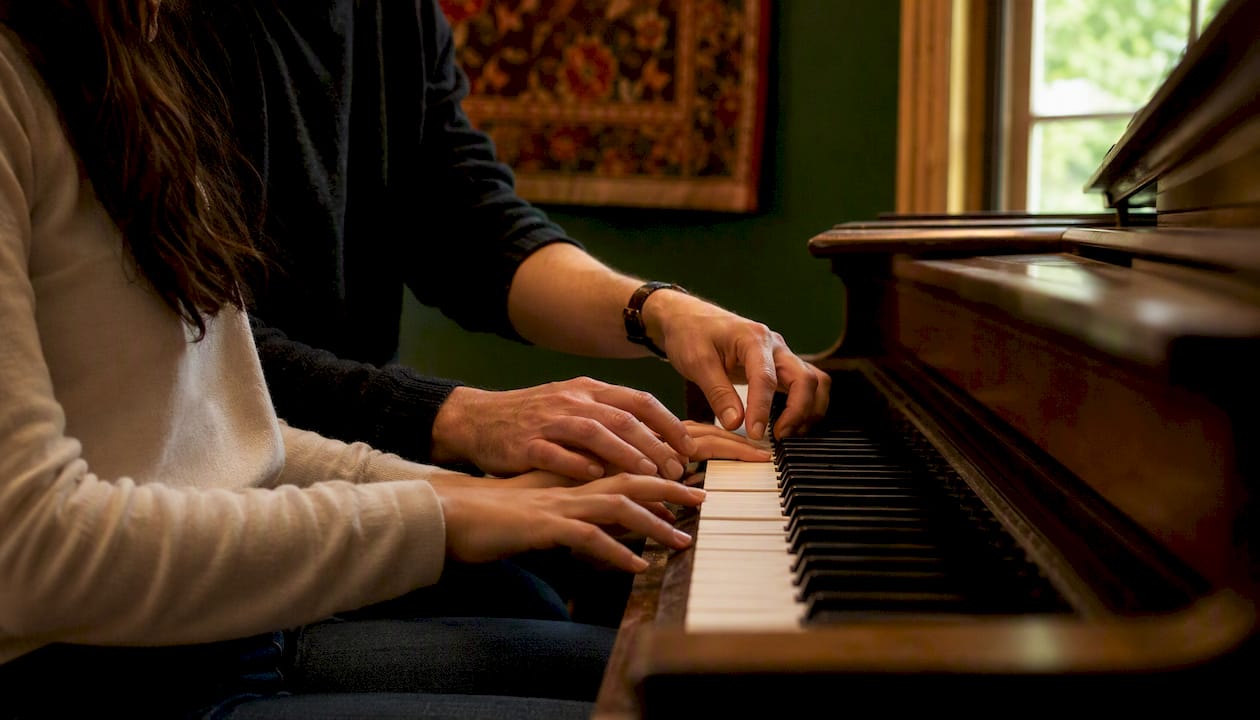
Group lessons are social and cost-efficient. You hear how other beginners approach the same material, which is surprisingly instructive. The trade-off is less individual attention.
Online self-study is flexible and low-cost. Short video lessons focused on one standard at a time, combined with backing tracks, can produce quick wins. Jamzone’s free beginner course is one example of a structured online resource that uses backing tracks and lessons under 15 minutes.
Format | Cost | Feedback speed | Best for |
One-to-one lessons | Higher | Immediate | Absolute beginners wanting fast, accurate progress |
Group lessons | Moderate | Delayed | Beginners who want social learning and lower cost |
Online self-study | Low to free | None or community-based | Flexible learners supplementing other study |
Useful tools for self-study:
iReal Pro: Generates backing tracks for hundreds of jazz standards; invaluable for practising ii–V–I progressions.
Musescore: Free lead-sheet reader and notation tool.
Pro Metronome: Simple, reliable metronome app.
forScore or similar PDF readers: For reading lead sheets on a tablet.
The clearest upgrade path: start with online resources to build basic familiarity, then book one-to-one lessons once you have a specific question a video cannot answer. That moment usually arrives around week three or four.
How Dan at Danpianostudio typically teaches absolute beginners
Most beginners arrive thinking jazz is about theory. It is not, at least not at the start. The first lesson almost never begins with scales or chord charts. It begins with a recording.
The approach at Danpianostudio follows a song-first method: you choose a tune you genuinely like, listen to it until you can sing it, then transfer it to the piano piece by piece. Left hand comes in only once the melody is secure in the right. Voicings are kept simple — two-note guide tones rather than full chords — so the ear can hear the harmony clearly without the fingers getting in the way.
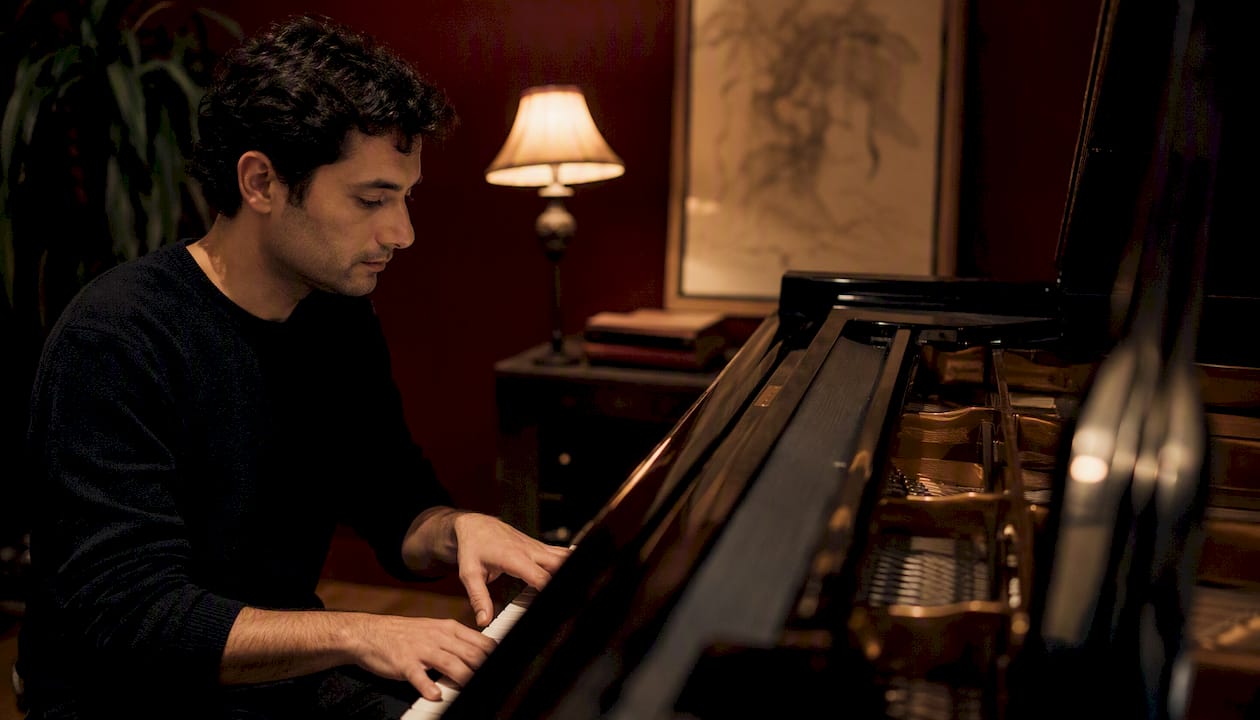
Homework is small and repeatable: listen to the tune once a day, sing the melody, play it through twice. That is it for week one. The point is to build a habit, not to overwhelm.
This teaching philosophy aligns with what practitioners describe as the aural tradition in jazz: learning by listening and singing first, then transferring to the instrument. It is the opposite of reading-first classical training, and for jazz, it works faster.
Danpianostudio: lessons in London and online for beginners
If you are ready to move from self-study to guided lessons, Danpianostudio offers one-to-one jazz piano tuition in Central London (Camden and King’s Cross) and online for students across England.
Lessons are tailored to your pace from the first session. For absolute beginners, a typical starting point is a weekly 45-minute or 60-minute lesson, with short, focused homework between sessions. You can book individual lessons or a starter pack, with no long-term commitment required. Online lessons follow the same structured approach as in-person sessions, with screen sharing for lead sheets and real-time feedback on your playing.
Home piano lessons are available for students in London who prefer tuition at their own instrument. For those outside London or with flexible schedules, online piano lessons offer the same quality of instruction without the commute. Contact Danpianostudio to ask about availability and to book a first session.
Sources
A short list of vetted resources to support your continued learning:
Prioritise ear training and song-based study above dense theory at this stage. The theory will make sense once your ear already knows what it is describing.
Recommended


Comments