


How to Start Piano Lessons and Progress Well

You do not need to wait until you own a grand piano, can read music fluently, or feel naturally “musical” before you begin. If you are wondering how to start piano lessons, the best place to begin is much simpler: choose a clear starting point, get the right guidance, and build a routine you can actually keep.
That matters because most people do not stop piano for lack of interest. They stop because the process feels vague. They are unsure what to practise, whether they are improving, or what kind of lessons they need. A good start removes that uncertainty and replaces it with structure, encouragement, and visible progress.
How to start piano lessons with the right expectations
Piano lessons work best when expectations are realistic from the outset. In the first few weeks, progress is usually less about playing advanced pieces and more about building reliable habits. You are learning how to sit well, move efficiently, listen carefully, count steadily, and understand what your hands are doing.
For children, this often means short, focused activities and a balance between fun and discipline. For teenagers, it may involve a clearer sense of goals, whether that is learning favourite pieces, improving technique, or preparing for graded exams. For adults, the starting point is often confidence. Many adults worry they are too late, too busy, or not quick enough to learn. In practice, adults often do very well because they bring patience, self-awareness, and commitment.
The key is not to measure yourself against someone else’s timeline. A beginner needs lessons that match their age, experience, and goals. What works for a seven-year-old taking first steps in music will not be the same as what suits an adult returning to the piano after twenty years.
Choose the kind of piano lessons that fit your goals
Before booking anything, decide what you want your lessons to lead to. That does not mean mapping out the next ten years. It simply means knowing what matters most right now.
Some students want a strong classical foundation, with attention to reading, technique, phrasing, and repertoire. Others are drawn to jazz, where rhythm, harmony, chord knowledge, and improvisation play a larger role. Many students benefit from a mixture. A structured teacher can help you develop core musicianship while still allowing space for the style of music you enjoy.
This is also where exams may come into the picture. If you are interested in ABRSM or TRINITY, say so early. Exam preparation can be highly motivating when it is handled well. It gives shape to your learning and creates clear milestones. At the same time, exams are not the only valid route. Some students thrive with formal progression, while others prefer to focus on repertoire, creativity, or personal enjoyment first.
A strong teacher will not push every student into the same path. They will help you choose one that makes sense for your stage and your aims.
Finding a teacher who gives you structure
The teacher you choose matters more than the method book you start with. A good piano teacher does more than correct wrong notes. They notice how you learn, explain concepts clearly, and organise lessons so that each week builds on the last.
When considering a teacher, look for a balance of warmth and clarity. You want someone approachable, but you also want someone who can hear detail, spot unhelpful habits early, and guide you properly through technique, reading, rhythm, and musical understanding. If you are interested in both practical playing and theory, that should be part of the lesson approach rather than an afterthought.
For many families and adult learners, one-to-one teaching makes the biggest difference. Personalised lessons allow the pace, repertoire, and feedback to match the student exactly. That becomes especially important if you are preparing for exams, learning remotely, or moving between styles such as classical and jazz.
Virtual lessons can work extremely well when they are taught deliberately rather than treated as a compromise. With the right setup, online tuition offers flexibility, continuity, and individual attention from home. For busy households and working adults, that convenience often makes regular study far easier to sustain.
What instrument do you need before you begin?
One of the biggest questions around how to start piano lessons is whether you need an acoustic piano straight away. In most cases, no. A good-quality digital piano with full-sized weighted keys is a practical and sensible starting point.
What matters is that the keyboard allows proper technique. Very small or unweighted keyboards can create limitations because they do not respond like a real piano. That does not mean you need the most expensive instrument available, but it does mean you should avoid equipment that makes touch, control, and dynamics difficult to develop.
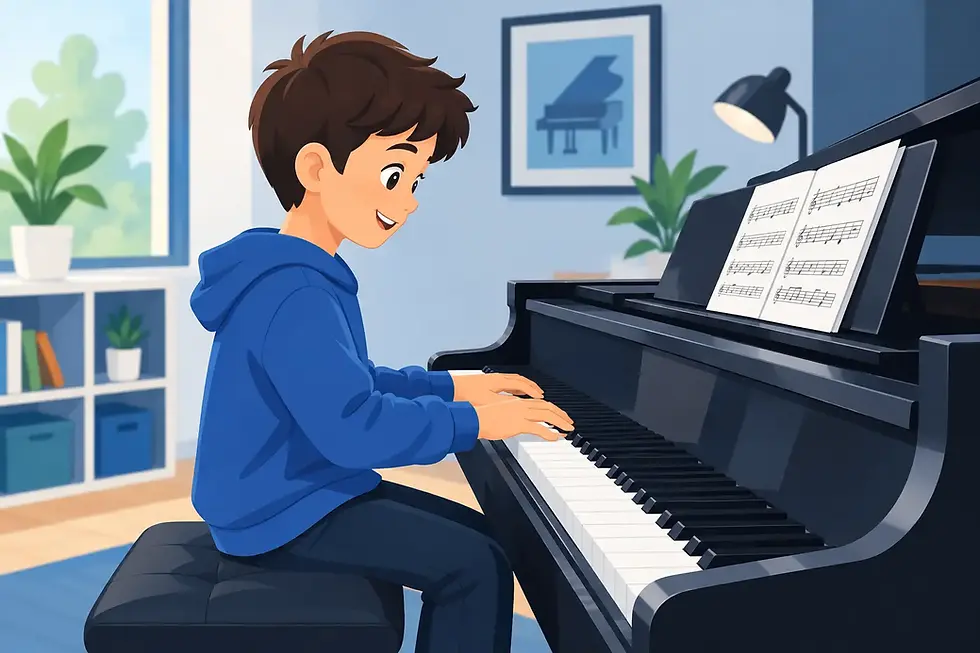
You will also need a stable stand or cabinet, a suitable bench or stool at the right height, and a quiet space where you can concentrate. For online lessons, a reliable internet connection and a camera angle that shows the keyboard clearly will help your teacher give accurate feedback.
If you are unsure what to buy, ask before purchasing. It is much easier to choose well at the start than to replace unsuitable equipment a few weeks later.
Your first month of piano lessons
The first month should feel structured, not overwhelming. A thoughtful teacher will usually introduce a small set of essentials and revisit them often. That might include note reading, basic rhythm, hand position, simple coordination, listening skills, and the beginnings of musical expression.
Do not worry if everything feels slow at first. Piano asks your brain, ears, eyes, and hands to work together in ways that are new. Reading one line of music with one hand is one task. Reading two staves while coordinating both hands and counting accurately is another. Good teaching breaks this down into manageable steps.
You should come away from early lessons knowing exactly what to practise and why. That includes which short sections to repeat, what sound you are aiming for, and what to notice as you play. “Practise more” is not useful advice. Specific instruction is.
Building a practice routine that lasts
The best practice routine is not the longest one. It is the one you can keep. For beginners, regular short sessions are usually better than one long session at the weekend. Ten to twenty focused minutes several times a week can produce excellent results, especially for children and busy adults.
Consistency matters because piano is physical as well as mental. You are training memory, coordination, and listening over time. If practice happens only occasionally, each session starts to feel like starting again.
It also helps to keep expectations realistic. Some weeks are fuller than others. School, work, travel, and family life all affect how much time is available. Rather than aiming for perfection, aim for continuity. Even a shorter practice week is valuable if it keeps the habit alive.
Parents can support younger children by helping to establish a regular time, keeping practice calm, and showing interest without hovering over every note. Adult learners often benefit from treating practice like any other important appointment and giving it a fixed place in the week.
How to know you are making progress
Progress at the piano is not always dramatic. Often, it appears in quieter ways. You may hold a steady pulse more reliably, read with less hesitation, shape a phrase more musically, or recover more calmly from mistakes. These are real signs of development.
A structured lesson plan helps because progress becomes visible. Instead of guessing whether you are “getting better”, you can see that you are moving through repertoire, improving technique, understanding more theory, or preparing confidently for a performance or exam.
This is where personalised teaching makes such a difference. The right teacher can point out improvement you might miss yourself and adjust the next step so that challenge stays productive rather than discouraging.
At Dan Piano Studio, that balance of encouragement and clear direction is central to how students build confidence over time.
Common mistakes when starting piano lessons
A hesitant start is normal, but a few mistakes can slow things down unnecessarily. One is choosing lessons with no clear progression, where each week feels disconnected from the last. Another is buying a keyboard that does not support proper playing. A third is expecting fast results without regular practice.
There is also the mistake of treating theory and practical playing as separate worlds. In reality, they support each other. Understanding rhythm, notation, keys, and harmony makes playing more secure and musical. Whether you are learning classical repertoire, jazz chords, or exam pieces, theory should help you play better, not feel like extra homework.
Finally, do not wait until everything is perfect before you begin. Many people postpone lessons because they think they need more time, more confidence, or better equipment first. Usually, what they really need is a first lesson with someone who can guide the process properly.
Starting piano is not about proving talent. It is about beginning with the right support, in the right format, and with goals that genuinely suit you. Once that foundation is in place, progress becomes much less mysterious and much more rewarding. The first step does not need to be impressive. It only needs to be well chosen.


Comments