


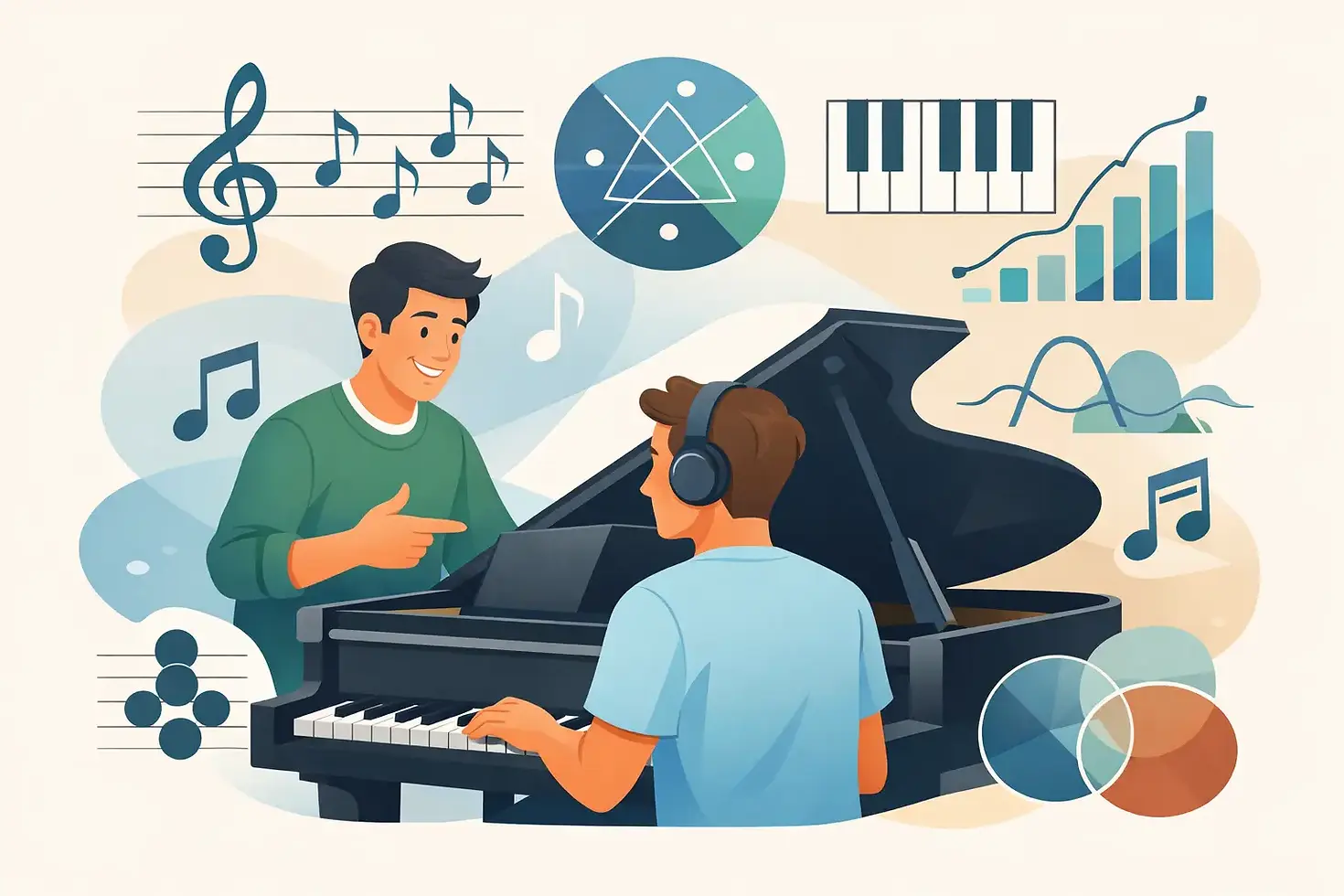
Music Theory for Pianists That Really Helps

You can usually spot the moment a piano student stops guessing and starts understanding. The notes on the page look less random, hands settle more quickly on the keys, and practice becomes far less frustrating. That is where music theory for pianists earns its place - not as an extra subject, but as part of learning to play with confidence.
For many students, theory sounds dry until it solves a real problem. It helps a beginner recognise patterns instead of memorising every note one by one. It helps an intermediate player read more fluently, shape phrases more musically, and remember pieces more securely. For jazz students, it gives harmony a clear logic. For classical students, it brings structure and style into focus. In both cases, theory is most useful when it sits at the piano rather than in a workbook alone.
Why music theory for pianists matters more than people think
The piano is one of the clearest instruments on which to learn theory because everything is laid out in front of you. You can see intervals, build chords physically, and hear harmonic movement immediately. That makes theory especially practical for pianists.
If you understand key signatures, scales, intervals and chord patterns, you do not need to start from zero every time you open a new piece. You begin to recognise familiar shapes. A passage in A minor feels related to another one you have already played. A broken chord pattern becomes easier because you know what harmony sits underneath it. Even sight-reading improves, because your brain starts predicting likely note patterns instead of decoding each symbol in isolation.
This is also why theory often helps students who feel stuck. Sometimes the issue is not effort. It is that too much of the music still feels unexplained. Once the structure becomes clearer, progress tends to speed up.
The theory pianists should learn first
Not every part of music theory needs equal attention at every stage. A beginner does not need an essay on advanced chromatic harmony. A more useful starting point is the material that directly supports reading, listening and hand coordination.
Notes, rhythm and pulse
Reading on the grand stave is the first hurdle for many pianists. Theory helps connect what the eye sees to what the hands do. Knowing how note values work, how bars are grouped, and how beats are counted makes rhythm far more reliable. Students who struggle with timing are often not lacking musicality - they simply need clearer rhythmic understanding.
At the piano, pulse matters as much as pitch. A piece with correct notes but uncertain rhythm never feels settled. Counting aloud, clapping rhythms, and identifying recurring patterns can make a bigger difference than another run-through with crossed fingers.
Scales and key signatures
Scales are sometimes treated as a separate technical task, but they are really a map of the music. Once a student understands how major and minor keys are built, key signatures start to make sense instead of feeling arbitrary.
For pianists, this matters in several ways. Fingering becomes more logical. Reading improves because the hand expects certain notes within a key. Memorisation becomes easier because passages are understood as scale-based patterns rather than isolated events. Exam preparation also becomes less stressful when scales are connected to real musical understanding rather than drilled mechanically.
Intervals and chords
Intervals teach the distance between notes, and chords show how those notes work together. This is central to both classical and jazz playing.
A classical student who recognises tonic and dominant harmony will hear phrasing more clearly and often memorise with greater security. A jazz student needs that same foundation to understand lead sheets, voicings and progressions. In both styles, triads and seventh chords are not abstract labels. They are the building blocks of accompaniment, repertoire and musical awareness.
How theory improves actual playing
A common worry is that theory will make music feel overly intellectual. Good teaching does the opposite. It gives shape to what the ear and hands are already trying to do.
When you know that a phrase is moving towards a cadence, you naturally hear where it is going. When you recognise an arpeggiated chord, your hand can organise itself more efficiently. When you understand syncopation, rhythm stops feeling awkward and starts feeling intentional.
This is especially helpful in practice. Students often repeat difficult bars without identifying why they are difficult. Theory helps diagnose the issue. Is the rhythm unfamiliar? Is the hand position built from an inversion you do not yet recognise? Is the modulation creating accidentals that need to be understood, not merely remembered? Once the reason is clear, practice becomes more focused.
Music theory for pianists in classical and jazz study
The same theoretical foundations support both classical and jazz training, but the application is slightly different.
In classical piano, theory supports reading, phrasing, interpretation and exam work. You may analyse form, identify cadences, understand modulation, and recognise how harmonic tension shapes expression. This does not mean every student must become an analyst, but some level of structural awareness leads to more convincing playing.
In jazz piano, theory becomes even more directly tied to decision-making at the keyboard. Chord symbols, extensions, progressions, modes and voice leading all shape how you comp, improvise and arrange. Still, the basics remain the basics. A student who is shaky on intervals and triads will usually find jazz harmony confusing quite quickly.
That is why a balanced approach works best. Build secure fundamentals first, then apply them to style. One of the strengths of one-to-one teaching at Dan Piano Studio is that theory can be taught in the musical context each student actually cares about, whether that is ABRSM preparation, Trinity work, Chopin, blues, or first attempts at improvisation.
What exam students need to know
For graded exams, theory often feels like a separate obligation. In reality, it supports nearly every part of the assessment. Aural tests rely on recognising rhythm, pitch and harmony. Sight-reading depends on pattern awareness. Scales and arpeggios become easier when students understand their construction. Even performance improves when the music is not just memorised physically but understood musically.
The exact balance depends on the board and grade. Early grades focus on notation, rhythm, key signatures and simple terms. Later stages ask for more harmonic understanding, analysis and stylistic awareness. The mistake many students make is waiting until theory becomes urgent. It is much easier to build it steadily alongside repertoire.
The best way to learn theory at the piano
Theory sticks best when it is taught through sound, touch and real music. Writing note names on paper has its place, but pianists need to hear and feel what they are learning.
A practical lesson might connect a scale to a current piece, then show how its chords appear in the left hand, then ask the student to improvise a short phrase using the same notes. That kind of learning is memorable because each idea has an immediate musical result.
It also keeps theory approachable for children and busy adults alike. Some students enjoy written exercises. Others learn faster by singing intervals, building chords by ear, or spotting harmonic patterns in pieces they already know. It depends on the student, which is why a personalised approach matters so much.
There is also a balance to strike. Too little theory can leave progress vague and unreliable. Too much explanation at the wrong moment can interrupt momentum. A good teacher adjusts the amount and timing so that understanding supports playing rather than slowing it down.
Common myths that hold students back
One myth is that theory is only for advanced musicians. In fact, beginners benefit enormously from simple theoretical clarity. Another is that theory kills creativity. Usually the opposite happens. Improvisation, composing and expressive playing become easier when you know what materials you are working with.
There is also the belief that some people are simply not "theory people". Most of the time, the real issue is how it has been taught. If theory is presented as detached vocabulary with no musical purpose, many students switch off. If it is connected to pieces, patterns and sound, it becomes much more intuitive.
Learning piano should not feel like choosing between enjoyment and understanding. The strongest progress comes when those two work together.
If music theory has ever felt intimidating, start smaller and closer to the keys. Learn the pattern in the piece you are playing this week. Notice the chord under your left hand. Count the rhythm properly. Name the scale. Bit by bit, the fog lifts, and the piano starts to make more sense beneath your fingers.


Comments