


How Adult Learner Progress Grows at the Piano

A busy week can make a piano stool feel like the last place you should be. Work, family, travel and household jobs all compete for attention. Yet adult learner progress rarely depends on finding large blocks of free time. It comes from having a clear musical direction, a sensible routine and guidance that helps each practice session count.
Adults often arrive at lessons with a particular hope: to play a favourite piece properly, return to an instrument they learned years ago, understand jazz chords, or finally work towards a recognised qualification. These are worthwhile goals. The key is turning that initial enthusiasm into a plan that feels enjoyable enough to sustain and structured enough to produce real results.
Adult Learner Progress Starts With a Personal Goal
There is no single definition of success at the piano. One student may want to play Bach with a secure sense of style and rhythm. Another may want to accompany songs, improvise over a jazz standard or prepare for an ABRSM or TRINITY grade. A good learning plan begins with that destination rather than applying the same repertoire and pace to everyone.
This matters because adults are usually more aware of what they want, but also more likely to judge themselves harshly. A student who expected to play a demanding piece in three months may feel disappointed by the early work on hand position, scales and reading. In reality, those foundations are what make expressive playing possible later.
At the first stage, it helps to identify one longer-term aim and one shorter-term target. Your long-term aim might be to play confidently for friends and family. Your short-term target could be to learn eight bars of a piece with accurate notes, pulse and fingering. Small targets give practice a purpose and make improvement visible.
Build a Practice Routine That Fits Real Life
Regular practice is more useful than heroic practice. An hour once at the weekend can be enjoyable, but it is often less effective than four focused sessions of 15 to 20 minutes across the week. Frequent contact with the keyboard strengthens coordination, reading and recall without making piano study feel like another demanding appointment.
A short practice session needs a simple shape. Begin by settling at the instrument and checking posture. Spend a few minutes on technical work, such as scales, broken chords or a carefully chosen exercise. Then focus on the most difficult passage in your current piece before playing something more familiar for enjoyment.
The balance changes according to your goal. A student preparing for an exam will need consistent time for scales, sight-reading, aural work and repertoire. A jazz learner may devote more attention to chord voicings, rhythmic patterns and improvisation. Both still benefit from slow, accurate work. Speed added too soon can hide uneven rhythm and unreliable fingering.
It also helps to be realistic about difficult weeks. If work deadlines or family commitments reduce your available time, do not abandon practice altogether. Five careful minutes spent revising a phrase, naming chords or listening actively to a recording can maintain your connection with the music. Progress is not ruined by a busy fortnight. It is more often delayed by the belief that a shortened session is not worth doing.
Practise Problems, Not Just Pieces
Many adults play from the beginning to the end of a piece each time they sit down. It feels musical, and it has a place. But it can also mean that the easy sections improve while the awkward bar remains awkward for weeks.
A more effective approach is to isolate the problem. Work on two or four bars only. Play each hand separately if necessary, check the fingering, and make sure the rhythm is secure before putting the hands together. Slow practice is not a sign that you are behind. It is the method professionals use to build control.
After that focused work, return to a larger section so the detail makes musical sense. This combination of close work and complete playing develops both confidence and continuity.
Measure Progress Beyond the Number of Pieces
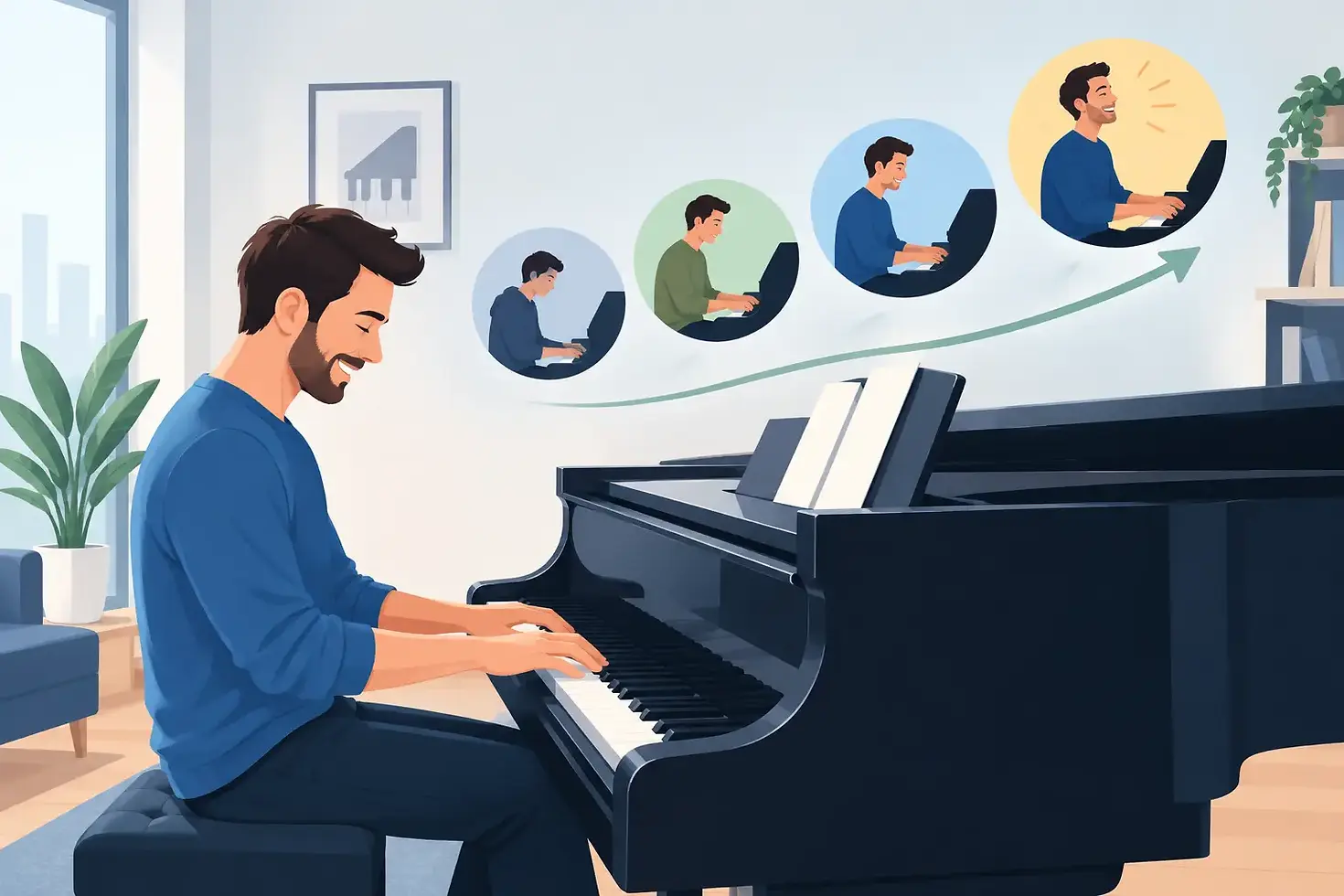
A growing repertoire is satisfying, but it is not the only sign of development. Adult learner progress can be heard in a steadier pulse, cleaner changes between chords, more secure reading, a broader dynamic range or the ability to recover calmly after a mistake.
These changes can be subtle from one week to the next. Looking back over a month or a term gives a fairer picture. Record a piece occasionally, even if it is only on your phone. Listening back may feel uncomfortable at first, but it gives you useful evidence. You might notice that the notes are more reliable than before, while the melody needs more shape. That is a clear direction for the next stage of work.
A teacher can provide the outside perspective that is difficult to create alone. It is easy to overlook improvements because you are close to the daily effort. Equally, it is easy to repeat an inefficient movement or misunderstanding without noticing it. Individual lessons offer feedback on technique, musical detail and practice habits before small issues become fixed.
Why Theory Supports Confident Playing
Music theory is sometimes treated as separate from playing, particularly by adults who want to get straight to their favourite songs. In practice, a working knowledge of theory makes pieces easier to learn and remember.
When you recognise a scale, cadence, interval or chord pattern, the page begins to look less like a collection of unrelated notes. Classical repertoire becomes clearer because you can hear how phrases and harmonies lead forward. In jazz, understanding chord symbols and common progressions gives you the freedom to comp, improvise and adapt a lead sheet.
Theory should serve the music rather than interrupt it. You do not need to memorise every rule before playing with feeling. But learning the relevant ideas alongside your pieces creates a stronger and more independent musician. For students considering ABRSM or TRINITY exams, it also makes the supporting requirements feel connected rather than intimidating.
Choose Repertoire That Challenges and Rewards You
The right repertoire sits just beyond what feels completely comfortable. If every piece is too easy, reading and technique may stop developing. If every piece is too difficult, practice becomes slow and discouraging. A thoughtful selection includes music that builds a specific skill alongside music you genuinely want to play.
For example, a developing classical pianist might study a short piece that improves balance between melody and accompaniment, while keeping a familiar favourite in the week for pleasure. A jazz student may practise a standard with simple shell voicings before attempting richer harmonies and more ambitious improvisation.
There is value in stretching towards difficult music, but timing matters. Simplifying an arrangement can be a useful stepping stone, not a compromise in standards. The aim is to keep musical enjoyment alive while building the skills needed for the fuller version.
Exams Are Useful When They Match Your Motivation
Graded exams can provide an excellent framework. They offer clear repertoire, technical milestones and a date to work towards. For many adults, this structure makes regular practice easier and gives a genuine sense of achievement.
They are not essential for every pianist, however. Some students progress best through a personalised programme centred on performance, accompaniment, songwriting or jazz skills. The most suitable route depends on whether formal assessment will motivate you or make the piano feel unnecessarily pressured.
At Dan Piano Studio, lessons can combine classical or jazz study, practical theory and exam preparation where it supports your goals. The focus remains on making you a more capable, expressive player, not simply getting through a syllabus.
Give Yourself Permission to Learn as an Adult
Adult beginners sometimes assume children learn faster and therefore have an advantage. Children may have more available time and fewer inhibitions, but adults bring concentration, listening experience and a clear reason for learning. They can ask thoughtful questions, make connections between ideas and choose music with personal meaning.
The trade-off is that adults often expect instant competence. Piano playing asks the hands, ears and eyes to coordinate in unfamiliar ways, so early progress can feel uneven. One week a passage suddenly works; the next week it may feel less secure. This is normal. Skill develops through repetition, rest and patient adjustment.
Try to replace the question, “Why can’t I play this yet?” with, “What is this passage asking me to learn?” The answer may be rhythm, fingering, hand independence, harmony or simply more time. That change in perspective makes challenges practical rather than personal.
Set aside a small, protected time for the piano this week, choose one detail to improve, and listen for the change. A few attentive minutes can be the start of music that stays with you for years.


Comments