


8 Best Piano Exercises for Beginners

Sitting at the piano and not knowing what to practise is one of the fastest ways to lose confidence. The best piano exercises beginners use are not the flashiest ones. They are the simple, repeatable patterns that build control, rhythm, reading, and a reliable sense of the keyboard.
That matters whether you are learning for pleasure, preparing for graded exams, or helping a child get started properly. Good exercises give shape to practice. Instead of playing pieces from the beginning every day and hoping for improvement, you train the small skills that make pieces feel easier week by week.
What makes the best piano exercises for beginners?
For a beginner, an exercise should do one job clearly. It might help with finger independence, hand position, note reading, or steady pulse. If one exercise tries to do everything at once, it often becomes frustrating rather than helpful.
The other key point is that exercises must still feel musical. Technical work should not become stiff or mechanical. Even five-finger patterns can be played with a singing tone, a steady beat, and careful listening. That habit matters in both classical and jazz playing, because technique is not separate from musicianship.
A final point is that the right exercise depends on the player. A young child may need short patterns with lots of repetition. An adult beginner may progress well with a little more theory built in. Someone preparing for ABRSM or TRINITY will need strong foundations in reading and rhythm early on, while a hobby player may be more motivated by exercises that quickly connect to familiar tunes.
Start with five-finger patterns
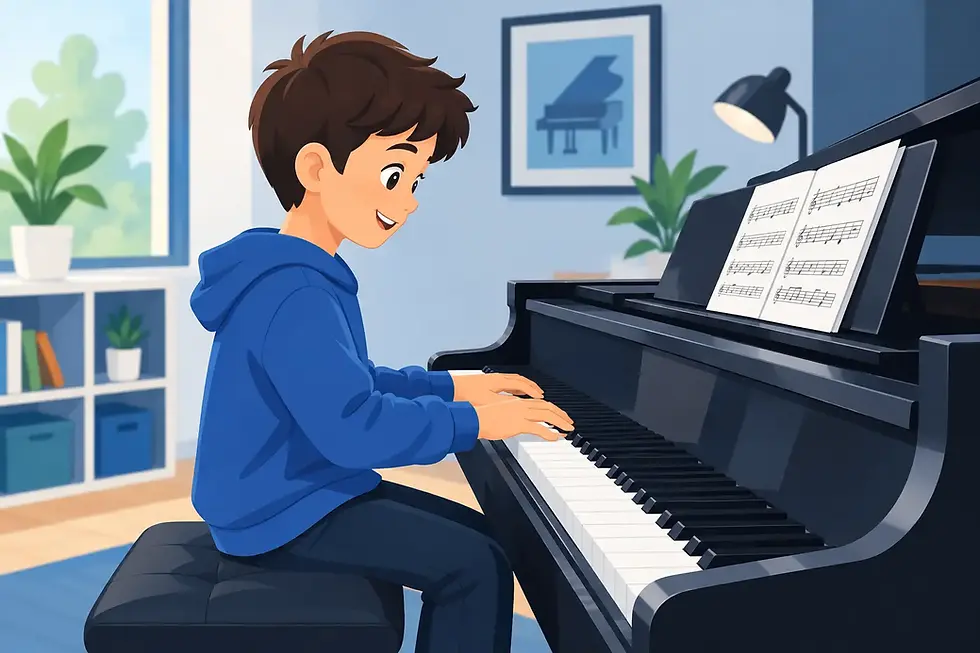
If I had to choose one place for most beginners to start, it would be five-finger patterns. Place the right hand on C-D-E-F-G, with one finger on each note, and play up and down slowly. Then do the same with the left hand.
This looks basic, and that is exactly why it works. It teaches curved fingers, a balanced hand shape, and a calm wrist. It also helps beginners understand that each finger has a home on the keyboard.
Once that feels comfortable, vary the rhythm. Play four equal notes, then try long-short patterns, or groups of three. You are no longer just moving fingers. You are learning control. In early lessons, this is often where real progress begins, because the student starts to feel stable at the keyboard.
Practise simple finger lifts and finger taps
Many beginners struggle because weaker fingers collapse or move with their neighbours. A short finger lift exercise can help. Rest the hand in a natural five-finger position, then gently lift and play one finger at a time while the others stay relaxed on the keys.
This is useful, but there is a trade-off. If done too forcefully, it creates tension. The goal is not to hammer the keys or lift the fingers high. The goal is to notice which fingers feel less obedient and train them with ease rather than strain.
For children, I often keep this playful and brief. For adults, it helps to think of economy of movement. Small, controlled actions usually produce a better tone than exaggerated ones.
Use scales, but keep them beginner-sized
Scales are essential, but beginners do not need to race through every major and minor key immediately. Start with one-octave scales in easy keys such as C major, G major, and F major. Focus on smooth thumb movement, consistent fingering, and an even tone.
In classical training, scales support technique and exam preparation. In jazz, they also help you understand key centres and prepare for improvisation. The same exercise serves different musical goals, which is one reason it remains so valuable.
The mistake many beginners make is treating scales as a speed challenge. At this stage, a slow and even scale is far more useful than a quick uneven one. If the thumb tucks awkwardly or the pulse wobbles, slow down and rebuild it carefully.
Try broken chords early
The next step after five-finger patterns and scales is often broken chords. Instead of playing all the notes of a chord together, play them one at a time. A simple C major broken chord, for example, gives beginners a first feel for harmony under the hand.
This is especially helpful because so much piano music, from beginner classical pieces to pop accompaniments and jazz voicings, is built from chord patterns. Broken chords train the hand to move with purpose rather than guesswork.
They also connect technique to theory. A student starts to see that C-E-G is not just three separate notes. It is a chord with a shape and function. That understanding makes later reading and memorising much easier.
Rhythm exercises are just as important as finger work
A beginner with active fingers but poor rhythm will still feel stuck. That is why clapping rhythms, counting aloud, and tapping one hand while playing with the other are among the best piano exercises beginners can use.
Start simply with crotchets, minims, and quavers. Count steadily and do not rush over rests. Many students find rests harder than notes, because silence requires control too.
If rhythm feels weak, remove pitch for a moment. Clap the pattern first, count it, then return to the keyboard. This is often far more effective than repeating the same bar incorrectly ten times. In lessons, a lot of frustration disappears when rhythm is separated from note-reading and taught as its own skill.
Hands-separately practice is not a shortcut
Beginners sometimes worry that practising each hand alone is a sign they are behind. It is not. It is one of the smartest exercises available.
The right hand may be learning a melody while the left hand is learning position, accompaniment, or bass notes. Putting both together too early often creates confusion. Separate practice lets each hand learn its task properly before coordination becomes the main challenge.
This matters even more in the first year of study, when reading itself still requires effort. A short passage played accurately with one hand is more valuable than a messy attempt with two. Once both hands are secure on their own, bringing them together becomes much more manageable.
Simple sight-reading drills build confidence quickly
Sight-reading should begin earlier than many people think. Not with difficult pieces, but with very short note patterns and rhythms that can be read at sight without pressure.
This is one of the best piano exercises for beginners because it reduces fear of the page. Instead of memorising everything and feeling lost with new music, the student learns to scan, recognise, and respond.
Keep it brief. Four bars is enough. Look for note direction, repeated notes, and stepwise movement. For exam students, this habit is particularly useful, but even casual learners benefit because it makes them more independent. They stop relying on guesswork and start trusting what they see.
Do a little ear training at the keyboard
Not every exercise has to start with notation. Beginners improve faster when they also learn to listen. Play two nearby notes and ask whether the second is higher or lower. Play a simple three-note pattern and copy it back. Find the first note of a familiar tune by ear.
This kind of work is often overlooked, yet it supports everything else. Reading becomes more logical because the ear starts predicting musical direction. Memory improves because the music means something, rather than being just a sequence of finger movements.
For jazz beginners, ear work is particularly valuable. For classical beginners, it strengthens phrasing and tonal awareness. Either way, it helps students become musicians rather than just note-followers.
How long should beginners spend on exercises?
Not long, if they are focused. For many beginners, ten to fifteen minutes of technical work in a practice session is enough. Quality matters more than quantity.
A child may do five minutes of finger patterns and rhythm before moving to a piece. An adult with a longer attention span might spend twenty minutes rotating through scales, chords, and reading drills. It depends on age, goals, and how much total practice time is available.
The more useful question is whether the exercise is carrying over into repertoire. If finger work never improves the pieces, something is off. Either the exercise is too advanced, too mechanical, or simply not the right one for that student.
A simple beginner routine that works
A balanced routine might begin with five-finger patterns, then move to one scale or broken chord, followed by a short rhythm or sight-reading drill. After that, the student can apply the same ideas to a piece.
This structure keeps practice purposeful without making it heavy. It also gives reassurance. When a student knows how to begin each session, they are much more likely to sit down and practise consistently.
That is one reason one-to-one teaching makes such a difference. At Dan Piano Studio, the most effective exercises are chosen around the individual student, not pulled from a generic list. A good exercise at the right moment can save weeks of uncertainty.
The best piano progress rarely comes from practising more and more. It usually comes from practising the right small things, with care, until the keyboard starts to feel familiar under the hands.


Comments