


Hear Tritone Substitution on Piano in Minutes With Three Dan Drills


Tritone substitution replaces a dominant seventh chord with another dominant seventh chord a tritone away, so V7 becomes ♭II7 (G7 becomes D♭7). Both chords share the same tritone between their 3rd and 7th, which is why the swap keeps the same pull towards the tonic while giving you smoother, chromatic bass movement and a darker, more modern set of tensions. Try it first on the V chord of a ii–V–I. It is the fastest way to hear what tritone substitution actually does to your ear.
TL;DR:
Tritone substitution replaces a dominant seventh chord with one a tritone away, sharing the same tension notes and creating a chromatic bass movement from root to tonic.
The substitution is based on the equal split of an octave by a tritone, with the shared notes flipping positions to maintain the same resolution target.
Voice-leading remains unchanged because the shared tritone resolves the same way, resulting in a darker, modern sound without disrupting the original melodic movement.
It is most effective in jazz progressions like ii–V–I and blues, especially on the V chord, where replacing G7 with D♭7 creates smoother bass lines and richer harmonic color.
Practical use involves voicings with guide tones and consistent practice drills, including identification, comping, and improvisation exercises.
Table of Contents
What is a tritone substitution: the interval and root relation
A tritone is the interval that splits an octave exactly in half, six semitones, such as the distance between B and F. Every dominant seventh chord contains one, hidden inside its 3rd and 7th. In a G7 chord, those two notes are B and F. Move the root a tritone away, from G down to D♭, and you land on a new dominant chord, D♭7, whose own 3rd and 7th are F and B, the same two notes flipped around. That shared tritone is the whole trick behind tritone substitution: swap the root, keep the tension.
Here is the relationship laid out plainly:
Original dominant: G7 (built on G, the V of C major)
Substitute dominant: D♭7 (built on D♭, a tritone from G)
Shared notes: B and F appear in both chords, just relabelled as 3rd/7th and 7th/3rd
Result: the bass now moves D♭ to C, a half-step, instead of G to C, a fourth
A quick reference for this kind of chord relationship sits in classical theory too. The University of Puget Sound’s overview of augmented sixth chords describes a functionally similar device from a much older tradition, worth a look if you already read notation from a classical background.
Why tritone substitution works: voice-leading and shared tones
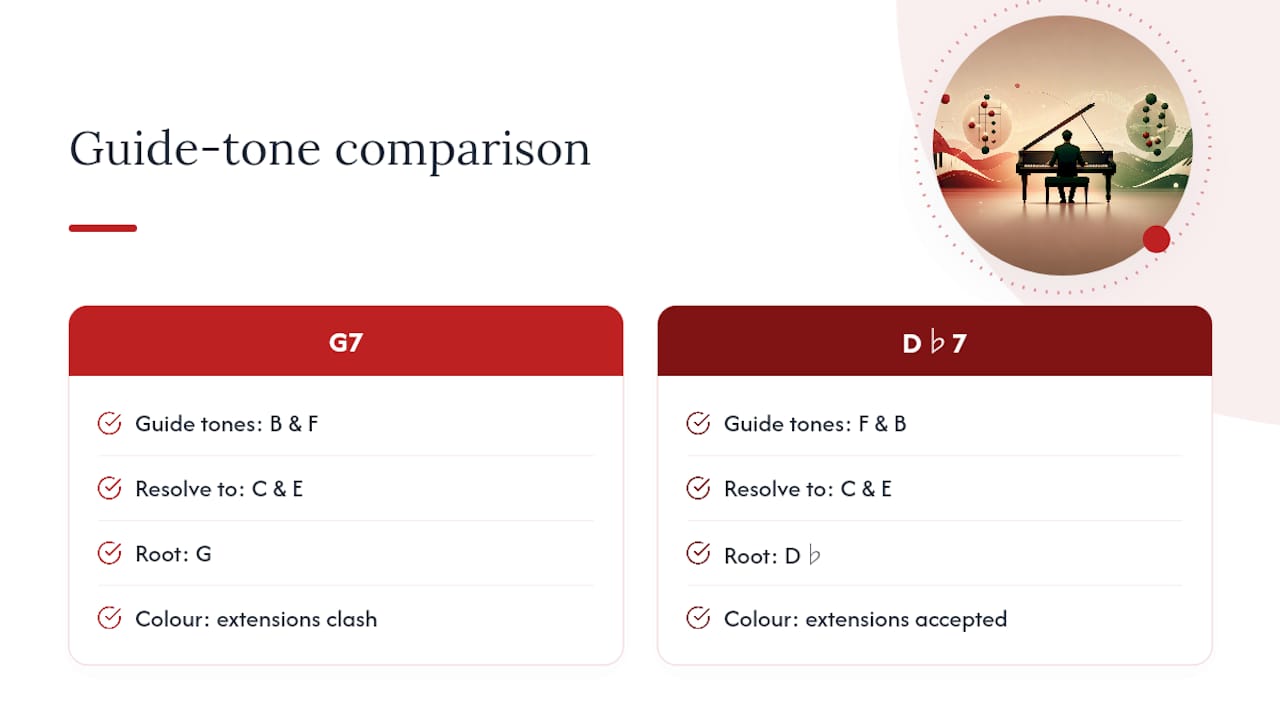
The tritone inside a dominant chord wants to resolve inward by a half-step. In G7, the 3rd (B) climbs to C, and the 7th (F) falls to E, both landing on notes of the C major triad. Play D♭7 instead and the same two pitches, now spelled F and B, resolve the same way, into the same C major target. The ear is following two magnetic notes that never move, only their name and the bass note underneath them change.
That is the real mechanism, and it is worth sitting with because most explanations skip it: tritone substitution is not a clever trick layered on top of the ii–V–I, it is a reharmonisation that leaves the resolving voices completely untouched. The jazz piano tutorial approach that many teachers use is exactly this: keep your right hand playing the guide tones of G7, then simply change the bass note underneath to D♭.
The tritone shared between a dominant chord and its substitute is the anchor. Change the root, change the colour, but leave that tritone’s resolution alone and the progression still lands exactly where the listener expects.
What actually changes is the flavour of tension above those guide tones. Voicing D♭7 with its own 9th, 11th, or 13th introduces notes that would sound like wrong-key accidents over G7, but read as rich, expected colour over D♭7. That is where the “modern jazz” character comes from, not from the resolution itself, which barely moves.
Applying the substitution in a ii–V–I and common jazz contexts
The classic testing ground is a ii–V–I in C major. Play through both versions back to back and the effect becomes obvious immediately.
Standard progression: Dm7 to G7 to Cmaj7. The bass moves by a fourth from G to C, a strong, expected cadence.
Substituted progression: Dm7 to D♭7 to Cmaj7. The bass now creeps down by a half-step from D♭ to C, which sounds more chromatic and, to most ears, more sophisticated.
Turnaround use: in a I–vi–ii–V turnaround, sub the final V for its tritone equivalent on the last two beats only, so the progression becomes Cmaj7, Am7, Dm7, D♭7, resolving back to C. This is a common passing use rather than a full rewrite.
Blues application: in a jazz blues, the V7 chord in bar 9 or 10 is a favourite spot for the substitution, since blues already tolerates heavy chromaticism.
Chained substitutions: more adventurous players sub the ii chord as well, turning Dm7–G7 into A♭7’D♭7, a device sometimes called a “tritone sub of the tritone sub.” Save this for later; it is easy to lose the thread of the original key.
Start with option two on a slow tune you already know. Hearing it inside a progression you have played a hundred times teaches your ear faster than any isolated exercise.
Scales and melodic choices over the substituted chord
Once the ♭II7 chord is under your fingers, the next question is what to play over it. A handful of scale choices cover most situations.
Altered scale (super-Locrian): built from the 7th degree of the melodic minor a half-step above the root, this gives you every altered tension the chord invites, and it is the standard first choice for a jazz-flavoured altered dominant sound.
Diminished (half-whole) scale: works well when you want a more symmetrical, slightly brighter tension than the altered scale offers.
Lydian dominant: the fourth mode of melodic minor, useful when the chord functions less like a hard-altered dominant and more like a colourful passing chord.
Guide-tone targeting matters more than scale choice here. Land on the 3rd or 7th of the substitute chord on strong beats, then let the scale fill in around those anchors rather than running the scale for its own sake. Research into jazz reharmonisation consistently lists tritone substitution among the standard tools of the trade, alongside devices like backdoor progressions, precisely because it slots into so many existing tunes without a rewrite.
Pro Tip: Practise a two-note lick using only the guide tones first, no scale at all. Once that resolution feels automatic in your fingers, add the altered scale around it.
Piano voicings and left-hand options for the substituted chord
The substitute dominant needs voicings that sound settled, not like a mistake, and rootless or drop-2 voicings do that job well on piano.
Rootless voicing: play 3rd, 5th, 7th, 9th (or an altered 9th/13th) in the right hand while the left hand or bass implies the root, a standard approach for dominant chords generally, and one that adapts cleanly to ♭II7 substitutions.
Drop-2 voicing: take a close-position four-note chord and drop the second-highest note down an octave, spreading the sound across both hands for a fuller texture in comping.
Closed-stack voicing: useful for slower ballads where you want the tension notes stacked tightly for a darker, more compressed colour.
Left-hand bass approach: walk chromatically from the ♭II7 root down into the tonic, or hold a simple root and fifth pedal if the tune calls for something plainer underneath busier right-hand voicings.
Whichever voicing you choose, keep the two guide tones from the original V7 somewhere in the chord. That is what stops the substitution from clashing with a melody line that was written expecting G7 rather than D♭7. If the tune’s melody note is a note that only makes sense against the original chord, hold that note and adjust the voicing underneath it rather than forcing a scale run that fights the tune.
Once these shapes feel automatic, they connect directly to broader jazz piano voicing practice, since the same rootless and drop-2 principles apply across most dominant chords you will meet.
Practice exercises to internalise the substituted sound
Three drills, worked in order, build the sound into your hands faster than reading about it ever will.
Identification drill: in every key, find the V7 chord, locate its tritone (3rd and 7th), then play the ♭II7 chord built a tritone below the root. Do this ascending chromatically through all twelve keys as a five-minute warm-up.
Comping drill: play a ii–V–I with the left hand comping a simple rhythm, swap the V for its substitute on the second half of the bar only, then resolve to I. Repeat in several keys until the hand movement feels automatic rather than calculated.
Improvisation drill: over a two-bar ii–(V→♭II7)–I loop, improvise short phrases that deliberately land on the guide tones of the substitute chord on beat one of the second bar. Keep the phrases short, two or three notes, before worrying about longer lines.
Loop each drill slowly with a metronome before pushing the tempo. The identification drill in particular exposes any key you are shakier in, usually the ones with more sharps or flats, faster than almost any other exercise. Once the identification drill feels instant, folding it into broader improvisation practice keeps the sound musical rather than mechanical.
Common mistakes and when to leave the substitution alone
The substitution fails most often when it fights the melody rather than supporting it.
Don’t force ♭II7 under a melody note that only makes harmonic sense against the original V7, the clash will be obvious even to untrained ears.
Recognise that some styles, particularly straight-ahead swing standards played in a traditional setting, tolerate less chromatic reharmonisation than modern or post-bop material.
Play both versions back to back before committing. If the substitute version creates a genuine clash rather than colour, use it sparingly, perhaps only on the final beat of the bar, until your ear trusts it fully.
How Dan teaches tritone substitution in lessons
Lessons at Danpianostudio work through this in three passes: hearing the tritone inside V7 by ear first, then applying it inside a ii–V–I the student already plays, then improvising over it. It follows naturally from jazz chord foundations and broader harmony study, so the substitution lands as an extension of what a student already knows, not an isolated trick.
— Dan
Book a lesson and get this sounding right, faster
Reading about tritone substitution gets you halfway. Hearing exactly where your voicing clashes with a melody, in real time, from someone watching your hands, gets you the rest of the way in a fraction of the time. Danpianostudio builds jazz harmony and improvisation lessons around what a student is actually working on, whether that is a specific standard, an ABRSM jazz piece, or a comping habit that needs sharpening, so the feedback is tailored rather than generic.
You can start with a trial lesson at the Camden studio or online for £55 per hour, or a home lesson in London for £65 per hour if you would rather learn on your own piano. For the full picture of how Dan structures jazz piano and improvisation lessons, the lesson page covers what is included beyond the trial. Either way, book a slot and bring a tune you already play, that is the fastest way to hear the substitution working in context rather than in isolation.
Sources
For the underlying interval theory and history, Wikipedia’s entry on tritone substitution is a solid starting point. Readers with a classical background will find the University of Puget Sound’s guide to augmented sixth chords useful for connecting the jazz device to older harmonic theory. For hands-on notation examples and a teacher’s framing of the same idea, the Jazz Piano Blog’s piece on tritones and chord substitutions is worth a read alongside your own practice.
FAQ
What is an example of a tritone substitution?
The clearest example is swapping G7 for D♭7 in a C major ii–V–I: Dm7, D♭7, Cmaj7 instead of Dm7, G7, Cmaj7, since G and D♭ sit a tritone apart and share the same 3rd and 7th.
What is the forbidden chord on piano?
There is no single chord that carries that name in mainstream theory; the phrase sometimes circulates online attached to the tritone interval itself, historically nicknamed diabolus in musica, because of its unstable, unresolved sound in early Western music.
Can you give me a list of tritones?
Every note has exactly one tritone partner six semitones away: C and F♯, D♭ and G, D and A♭, E♭ and A, E and B♭, F and B, and their reverse pairings, since the interval works symmetrically in both directions.
Why do tritone substitutions work?
They work because both the original dominant chord and its substitute share the same tritone between their 3rd and 7th, so the same half-step resolutions into the tonic still apply, only the bass note and the surrounding tensions change.
Can Danpianostudio help me learn tritone substitution on piano?
Yes, Danpianostudio’s jazz piano and improvisation lessons work through tritone substitution as part of ii–V–I study and comping practice, tailored to the tunes a student is already learning.
Recommended



Comments