


How Trinity piano exams are marked: the full criteria explained

Trinity graded piano exams are scored out of 100, with marks drawn from your repertoire pieces, technical work and supporting tests. That total then places you into one of four attainment bands: Distinction, Merit, Pass or Below Pass. Every component has its own maximum and its own descriptors, and understanding where the marks actually sit is the fastest way to shift your result up a band.
TL;DR:
Most candidates should focus their preparation on repertoire pieces, as they account for two-thirds of the total mark, to maximize score potential.
Communication and interpretation are weighted heavily in each piece, so expressive phrasing can significantly impact overall performance ratings.
Technical work is scored out of 14 marks, with near-perfect scores typically corresponding to Distinction, making accuracy essential at higher levels.
Supporting tests, which vary by grade and pathway, contribute up to 20 marks, emphasizing the importance of quick, confident execution under exam conditions.
Final scores are based on the total out of 100, with thresholds of 87+ for Distinction and 45–59 for Below Pass, allowing weak sections to be offset by stronger ones.
Table of Contents
Trinity piano marking criteria: the 100-mark breakdown
Candidates on the standard, technical-work pathway sit three pieces, a technical work section and a set of supporting tests. Trinity’s own piano syllabus mark scheme sets the weighting like this:
Three repertoire pieces: 22 marks each, 66 marks total
Technical work (scales, arpeggios, exercises): 14 marks
Supporting tests (sight reading, aural, improvisation or musical knowledge, depending on grade): 20 marks
Add those together and you get the full 100. It’s a heavily piece-weighted system: two thirds of your mark comes from repertoire alone, which is why most preparation time should go there rather than being split evenly across every element.
Candidates on the digital or repertoire-only pathway see this structure change. Per-piece maxima are adjusted, and supporting tests are replaced by an overall performance assessment that judges the whole submission rather than isolated exercises.
One practical detail worth knowing: on the face-to-face technical-work pathway, you can perform your scales, arpeggios and exercises in any order relative to your pieces, before, between or after them, provided the technical work itself is played as a single continuous unit rather than broken up. That flexibility matters when you’re building a programme that flows well and keeps nerves under control.
How is each piece marked?
Every repertoire piece in the technical-work pathway carries a maximum of 22 marks, split across three components, according to Trinity’s guidance on how pieces are marked:
Notational accuracy & fluency: 7 marks
Technical facility: 7 marks
Communication & interpretation: 8 marks
Notice that communication carries the highest single weighting of the three. Examiners aren’t just checking whether you played the right notes in the right order; they’re listening for whether the performance said something.
For top marks in accuracy and fluency, examiners want a secure, unwavering pulse and minimal hesitation, the kind of playing that sounds rehearsed rather than reconstructed in real time. Technical facility rewards consistent tone control, evenness across registers and clean articulation, particularly in passages that expose weak fingers or awkward hand shifts. Communication and interpretation is the most subjective but also the most generous: examiners are listening for phrasing that shapes a musical line, dynamic contrast that isn’t just loud and quiet but expressive, and a stylistic understanding appropriate to the piece, whether that’s Baroque ornamentation or blues inflection in a jazz piece.
Piece-level totals convert directly to a band for that piece:
Marks out of 22 | Band |
High scores | Distinction |
Moderately high scores | Merit |
Mid-range scores | Pass |
Lower scores | Below Pass |
A student who nails accuracy but plays with a flat, uncommunicative sound will typically cap out around Pass or low Merit, even with technically clean fingerwork. The eight marks for communication are often where the real ceiling sits.
How are technical work and supporting tests scored?
Technical work has its own 14-mark maximum, judged on accuracy, evenness and fluency across the required scales, arpeggios and exercises for the grade. A typical band threshold sees 13–14 marks awarded for Distinction-level playing: fully even tempo, no audible stumbles, correct articulation throughout.
Supporting tests add up to 20 marks and vary by grade and pathway, covering sight reading, aural awareness, improvisation or musical knowledge depending on what’s specified. These marks accumulate toward your final 100 alongside pieces and technical work.
Practical notes that make a real difference:
Decide your performing order in advance and rehearse the transitions, not just the individual sections.
Time management in the exam room matters: rushing technical work to “get it over with” is where accuracy marks quietly disappear.
The most common avoidable loss is restarting a scale or arpeggio after a small slip. A confident continuation, even with a minor error, usually scores higher than a hesitant restart.
What do the final scores mean?
Once every component is totalled, your mark out of 100 lands you in one of four attainment bands:
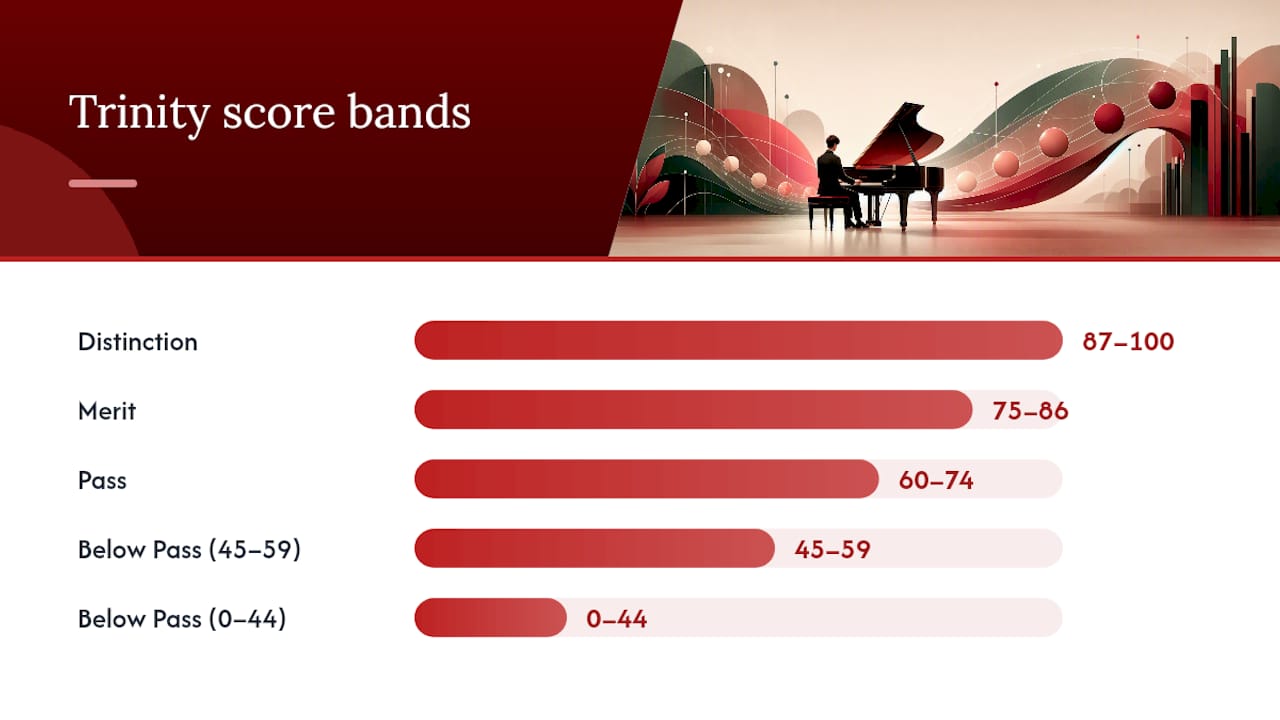
Distinction: 87–100 · Merit: 75–86 · Pass: 60–74 · Below Pass: 45–59 and 0–44.
You do not need to pass every individual section to achieve an overall pass. Strong pieces can offset a weaker supporting test result, since the bands apply to the combined total, not to each component separately. This is one of the most reassuring facts about the system and one candidates rarely hear until after their exam.
Diploma-level assessments (ATCL, LTCL, FTCL) use broadly similar banding principles but weight programme building, viva voce discussion and technical demand differently from graded exams, worth knowing if you’re looking beyond Grade 8. On digital and repertoire-only pathways, the overall performance criteria assess performance delivery, focus and musical awareness across the whole submission rather than through discrete supporting tests, so consistency across pieces matters more than isolated technical drills.
How do you read your Trinity mark form?
Trinity’s mark form is genuinely useful, and most candidates read it once and file it away. That’s a mistake. The scheme is a diagnostic tool by design, meaning examiner comments are written to be acted on, not just filed.
Check the component breakdown first. Look at where marks were lost, piece by piece, and whether it was accuracy, technical facility or communication that dragged the total down.
Read the written comments alongside the numbers. A comment like “phrasing became four square in the second subject” tells you exactly what to fix; the number alone doesn’t.
Compare pieces against each other. If communication scored well in one piece but poorly in another, that’s a specific, fixable pattern, not a general weakness.
Only then consider a results enquiry. If you believe the mark doesn’t reflect the performance, Trinity’s enquiries about results process allows a formal request for review, but it works best once you’ve genuinely absorbed the feedback rather than reacting to the headline number.
Most students who query a result would have got more value from six weeks of targeted practice on the exact component the mark form flagged.
Practitioner tips: targeted practice to win the extra marks
Pro Tip: Record yourself playing each piece straight through, then mark your own performance against the official component descriptors before your teacher does. You’ll usually flag your own weak spots faster than you expect.
The gap between Pass and Merit, or Merit and Distinction, is rarely about learning harder repertoire. It’s about closing small, specific gaps that the mark scheme rewards disproportionately.
Work communication and interpretation directly, not as an afterthought once notes are learned. Try playing a phrase three different ways (louder, more legato, with a rubato lean) and decide which serves the music, rather than defaulting to the first version you learned.
Simulate real exam conditions for technical work and supporting tests. Practise scales cold, without a warm-up run-through, since that’s exactly the pressure you’ll face in the room.
Use a mock mark sheet built from the actual band descriptors and ask your teacher to mark you as an examiner would, comments included. It’s uncomfortable the first time and extremely clarifying.
Drill fluency and tone control in short, focused bursts rather than full run-throughs every time; five minutes on a tricky sixteen-bar passage often fixes more than a fifth full playthrough.
A structured piano exam preparation checklist helps keep these drills consistent across the weeks before an exam rather than left to chance the night before.
What do examiners look for in sight reading and aural tests?
Sight reading is assessed on how accurately and fluently you can realise unfamiliar notation under time pressure, examiners are listening for correct rhythm, appropriate tempo choice and a willingness to keep going rather than stopping to correct every error. A candidate who plays through a wrong note with the pulse intact typically scores higher than one who freezes and restarts.

Aural tests vary by grade but generally assess pitch recognition, rhythmic recall, and the ability to comment meaningfully on a piece of music played by the examiner, things like identifying the metre, spotting a change in dynamics, or recognising a cadence. At higher grades, aural tests lean more toward musical understanding than mechanical recall: can you describe what makes a phrase feel like it’s ending, not just repeat it back correctly.
Both tests reward calm, decisive responses over hesitant, technically perfect ones delivered too slowly. Examiners are trained to assess what you can do fluently under mild pressure, not what you could theoretically achieve given unlimited time. That’s a deliberately different skill from prepared repertoire, which is precisely why so many otherwise strong candidates lose marks here: they’ve drilled their pieces for months but never simulated the specific, quick-fire pressure of sight reading or aural recall until the exam itself.
How does examiner feedback work, and what will it actually say?
Every Trinity exam produces written feedback alongside the numerical mark, and it’s built to be genuinely useful rather than a formality. Examiners work from the same diagnostic mark scheme candidates can access in advance, which means the comments map directly onto the criteria you were assessed against, not vague general impressions.
Typical comments cluster around a handful of recurring themes. On accuracy, you’ll often see notes like “occasional rhythmic uncertainty in bars 12 to 16” rather than a blanket “needs more practice”. On technical facility, expect specifics such as “left hand arpeggios lost evenness at speed” pointing to exactly which passage needs work. On communication, comments tend to be more descriptive: “phrasing felt episodic rather than continuous” or “good use of dynamic contrast in the development section” are the kind of remarks that tell you what worked and what didn’t.
Examiners are trained and moderated externally to keep this feedback consistent across different exam centres and different examiners, so a Distinction comment in Camden should reflect the same standard as one anywhere else in the country. That consistency is what makes the written feedback worth reading closely rather than skimming for the number at the bottom. The comments are the actual curriculum for your next few months of practice, written by someone who just watched you play.
Does performance length or timing affect your mark?
Timing plays a more direct role in marking than many candidates assume. Each piece and technical work section has an expected duration, and examiners factor pacing into both accuracy and communication marks, not as a separate penalty, but because tempo choices are part of musical judgement.
Playing significantly under tempo to guarantee accuracy usually costs marks in communication and interpretation, since an overly cautious tempo often flattens phrasing and undermines the stylistic character the piece needs. Playing too fast, chasing an impressive pace, tends to expose exactly the technical facility weaknesses the syllabus is designed to catch, missed articulation, blurred passagework, an uneven left hand.
There’s also a practical timing element within the exam itself. Supporting tests and technical work are time bound, and candidates who rush to “get through” a scale or sight-reading passage without settling into a pulse first tend to make more audible errors than those who take a breath, establish a tempo mentally, and then commit. A few seconds of preparation before playing rarely costs marks and often prevents the kind of early stumble that colours an examiner’s impression of the whole section.
The overarching principle: examiners are marking musical judgement about pace, not simply rewarding speed or caution for their own sake.
What’s the minimum mark needed for each attainment band?
The thresholds are fixed and published, which makes this one of the more reassuringly concrete parts of the system. Based on the official scoring bands, you need:
87 or above for a Distinction
75 to 86 for a Merit
60 to 74 for a Pass
45 to 59 for a Below Pass (upper band)
0 to 44 for a Below Pass (lower band)
These thresholds apply to your combined total across pieces, technical work and supporting tests, not to each section individually. A candidate scoring strongly across two pieces and technical work can absorb a shakier third piece or a modest supporting test result and still land comfortably in Merit or Distinction territory.
Where this matters practically: don’t panic-abandon a weak area in the final week before your exam on the assumption that it will sink your whole result. It’s genuinely more efficient to shore up your strongest components further, since marks near the top of the scale are often easier to gain in a component you’re already good at than to claw back in one you’re struggling with. Knowing the exact numeric gap between Pass and Merit, generally around 15 marks across the whole exam, helps you and your teacher decide where to spend the final weeks of preparation with more precision than “practise everything a bit more”.
How should you prepare for each part of the marking criteria?
Preparation works best when it’s mapped directly onto the components you’ll actually be marked on, rather than treated as one undifferentiated block of “practice”.
For notational accuracy and fluency, slow, deliberate practice with a metronome catches wrong notes and rhythmic slips long before they become habits. Practising hands separately at performance tempo, then combining, tends to expose weaknesses that full-speed run-throughs disguise.
For technical facility, isolate the specific technical demands of your grade, scale patterns, arpeggio shapes, particular finger crossings, and drill them outside the context of full pieces so they become automatic rather than effortful.
For communication and interpretation, the most effective preparation is often the least technical: listen to professional recordings of your pieces, decide what you’d do differently, and practise articulating your interpretive choices out loud before you play them.
For supporting tests, regular short sessions of unseen sight reading and aural drills, even five minutes a day, build the fluency that a single long weekly session rarely achieves.
Structured, one-to-one coaching that tracks progress against each of these components individually tends to produce faster, more measurable improvement than generic practice, because it treats the mark scheme as a genuine roadmap rather than a mystery to be solved on exam day.
How Danpianostudio builds lessons around the marking criteria
Every lesson plan Danpianostudio builds for exam candidates in England starts with the component breakdown, not the repertoire list. If a student’s mock assessment shows strong accuracy but flat communication, that becomes the week’s focus, not another run-through of notes they already know.
The most common milestone we see is a student moving from Pass to Merit once phrasing and dynamic shaping become instinctive rather than instructed, usually within a term of focused work. Distinction candidates typically arrive already fluent and need targeted refinement on stylistic detail instead.
If you’d like guided preparation mapped to these exact criteria, Danpianostudio’s home piano lessons in Central London, Camden and King’s Cross, or online piano lessons for candidates further afield, are built around this exact structure.
— Dan
Sources
Recommended


Comments