


Skip sight reading with Trinity piano grades in England

Trinity piano grades run from Initial through to Grade 8, assessing performance and musicianship rather than pure technical drilling. Candidates choose between two exam formats: face-to-face practical exams marked by an examiner in the room, or digital exams submitted as a recording, with the digital route splitting further into a technical-work pathway and a repertoire-only pathway. Every route produces a result out of 100 marks, banded into pass, merit and distinction.
TL;DR:
The digital repertoire-only pathway simplifies preparation by removing technical exercises and support tests, making it ideal for performance-focused or nervous exam-takers.
Grade boundaries are strict, with 87 to 100 marks needed for a distinction, and the marking system treats all pathways equally across different exam formats.
Trinity’s syllabus now offers broader repertoire choices, including own compositions and one-hand pieces, to accommodate various learning needs and preferences.
Candidates typically progress from foundational grades with focus on confidence and sight-reading to advanced repertoire and performance polish at higher levels.
Personalized, focused coaching—whether in person or online—significantly improves chances of achieving higher grades, especially when tailored to individual strengths and exam formats.
Table of Contents
What are Trinity piano grades and how has the syllabus changed?
Trinity College London’s piano grades stretch from Initial (a pre-Grade 1 introduction) to Grade 8, after which candidates can progress to diploma-level qualifications such as ATCL and LTCL. Unlike some exam boards, Trinity builds its entire system around musical performance first, treating scales and technical exercises as support for that performance rather than the main event.
The 2023 syllabus update widened repertoire choice considerably. Candidates now pick from standard and extended editions, with some grades offering a wide selection of pieces to choose from across both books. That breadth matters in practice: a student who dislikes Baroque counterpoint can lean towards Romantic or contemporary options without being boxed into a narrow list.
Trinity’s flexibility extends further than piece selection. Its own graded exam philosophy allows:
Own compositions to be submitted as one of the exam pieces at several grades
Duet performances, useful for younger or less confident players
One-hand repertoire options built into later syllabus editions, widening access for candidates with physical limitations
This candidate-centred design is why so many teachers in England describe Trinity as the more forgiving of the two major UK boards, particularly for students who thrive on stage but find rigid technical checklists demoralising.
What do you actually have to prepare, and how is it marked?
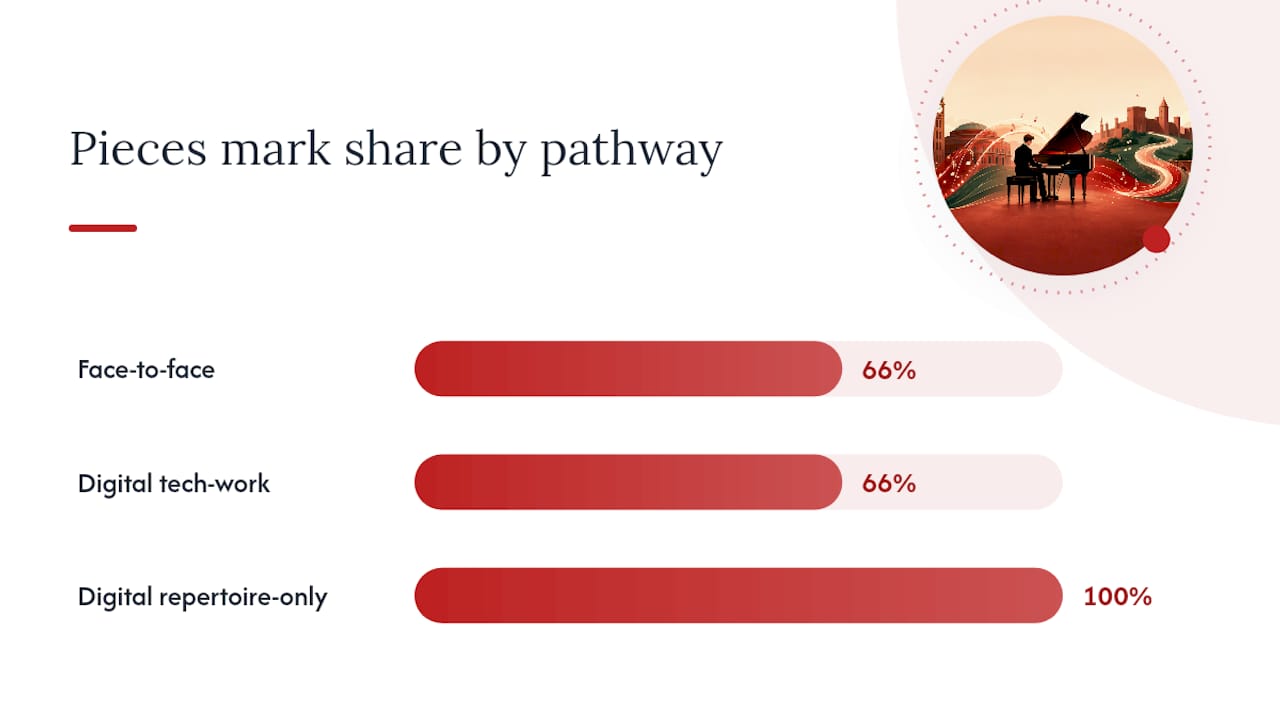
The components differ depending on which exam format you sit, and the mark allocation shifts with them. A face-to-face practical exam is built from three pieces worth 66 marks, technical work (scales, arpeggios and exercises) worth 14 marks, and two supporting tests, usually sight-reading and aural or improvisation, worth 20 marks between them.

The digital technical-work pathway mirrors that structure closely: three recorded pieces plus technical work, with supporting tests assessed within the performance context rather than as a separate live task. The newer digital repertoire-only pathway strips things back further, with four pieces carrying the full 100 marks and no separate technical work or supporting tests at all, according to Trinity’s own marking documentation.
Pro Tip: If sight-reading nerves are what put you off exams, the repertoire-only digital pathway removes that pressure entirely, since it’s assessed purely on performed pieces.
Whichever pathway you choose, the mark boundaries stay consistent:
Distinction: 87 to 100 marks
Merit: 75 to 86 marks
Pass: 60 to 74 marks
Below Pass: under 60 marks
For technical work on the digital pathway, exercises are recorded as one continuous unit, and Trinity’s rules forbid metronome assistance during that recording. If those numbers feel abstract, a plain-English breakdown of grade boundaries can help parents unfamiliar with UK marking conventions make sense of where a result actually sits.
Face-to-face or digital: which exam format suits you?
The choice comes down to temperament and logistics as much as musical ability. Some candidates play better in front of a live examiner; others produce their best work with the safety net of multiple recording attempts.
Choose face-to-face if you want examiner interaction, a fixed exam date, and don’t mind performing without a second take.
Choose the digital technical-work pathway if you want the flexibility of recording from home while still demonstrating scales and technical exercises alongside your pieces.
Choose the digital repertoire-only pathway if you’re a performance-focused player, someone who struggles with sight-reading under pressure, or a candidate without easy access to an exam centre. Trinity itself positions this pathway as an option for those who prefer recording in a familiar, low-pressure environment.
Own compositions and duets remain available on both face-to-face and technical-work digital exams at eligible grades, though repertoire-only candidates should check the current syllabus PDF, since options can vary slightly between pathways.
Trinity versus ABRSM: what’s actually different?
Trinity and ABRSM are the two exam boards most English piano students encounter, and the differences run deeper than branding. Trinity builds its grades around flexible, performance-led assessment with wide repertoire choice and no compulsory theory prerequisite. ABRSM, by contrast, runs two separate tracks: traditional Practical Grades (scales, sight-reading and aural tests alongside pieces) and standalone Performance Grades, which involve four recorded pieces, three chosen from set lists plus one of the candidate’s own choosing.
The practical differences that matter to families:
Trinity doesn’t require a Grade 5 theory pass before progressing to higher practical grades, though parallel theory study still helps musical understanding.
ABRSM’s Practical Grades historically carry slightly more weight in some conservatoire and UCAS contexts, though this gap has narrowed as digital and performance-based routes gain recognition.
Both boards now offer one-hand repertoire options in current syllabus editions, a genuinely useful development for candidates with hand injuries or physical differences.
For equivalence to broader academic qualifications, Gov is the clearest official reference. Higher grades (typically Grade 6 upward) are generally recognised as comparable to Level 2 and Level 3 qualifications, useful context if a student is weighing music grades against GCSEs or A Levels for progression planning. For a fuller side-by-side, our ABRSM vs Trinity comparison goes into more depth on which system suits which kind of learner.
How should you actually prepare, grade by grade?
Preparation timelines shift as grades climb, and treating every grade the same way is a common mistake among self-taught or newly-arrived students.
Initial to Grade 3: focus on steady weekly progress, short practice goals and building confidence with sight-reading basics rather than rushing repertoire.
Grades 4 and 5: consolidate technique, introduce regular mock exams, and start balancing programme choices across contrasting styles.
Grades 6 to 8: shift towards advanced repertoire, performance polish and, where relevant, conversations about UCAS points and continuation into diploma study.
At the higher grades, Trinity expects programmes to draw from both technique-focused and expressive repertoire lists, so a good teacher will steer you away from picking four similar-sounding pieces. Lesson time should cover:
A technical warm-up integrated with (not separate from) repertoire practice
Regular sight-reading and aural drills, even on the repertoire-only pathway, since musicianship still underpins performance quality
Mock recordings or mock performances in the weeks before the real exam
Trinity provides free demo tracks, performance notes and full repertoire lists on its website, and working through a structured exam preparation checklist in the final month tends to catch the small gaps, missed articulation marks, inconsistent dynamics, that examiners notice first.
Preparing Trinity candidates in London: what actually moves the needle
Working with students across grades, the pattern is consistent: musical personality often plays a greater role than technical competence in distinguishing merits from distinctions. Lessons that work best pair a genuine technique warm-up with focused repertoire work, then close with sight-reading, aural practice and a full mock performance under exam conditions.
Readiness shows up in small ways: playing through a piece without stopping to fix mistakes, and describing musical intention rather than just fingering. Parents can watch for that shift.
— Dan
Get tailored Trinity exam preparation in London or online
Reading about grade boundaries and repertoire lists only gets you so far. What actually moves a student from “hopeful” to “distinction” is focused, personalised teaching that adapts to how they play, not a generic syllabus checklist. Danpianostudio builds exam preparation around the individual, whether that means drilling technical work for a face-to-face Grade 5 or coaching performance nuance for a digital repertoire-only submission.
For families in Central London, Camden or King’s Cross, home piano lessons bring exam-focused teaching straight to your living room, ideal if practising on your own instrument matters for exam-day comfort. Students preparing for a digital pathway, or based outside London, can work just as effectively through online piano lessons, which suit mock-recording practice particularly well since you’re already working in the format the exam itself will use. A good teacher match makes the difference between vague progress and a clear route to your next grade. Book a trial lesson through Danpianostudio to map out a preparation plan built around your grade, your timeline and your preferred exam format.
Sources
Recommended


Comments