


Small hands piano: techniques and repertoire that work
- Dan Piano Studio
- 4 hours ago
- 7 min read


Small hands are not a barrier to playing the piano well. What holds small handed pianists back is usually the wrong fingering, not the wrong hands. The single fastest thing to try today: sit at the keyboard, find your comfortable stretch from thumb to little finger, and rework one chord in your current piece so it fits that span rather than fighting it.
Your first move should be a short assessment, not months of stretching drills. Once you know your actual comfortable reach, most of the “impossible” passages in your repertoire turn out to have simple workarounds.
Technique: forearm rotation and grouping instead of forced stretching
Repertoire: choose or edit pieces written without demanding octave spans
Instrument: consider a narrower keyboard if reach is a genuine barrier
Teaching: a teacher who understands small hands piano technique can shortcut months of trial and error
Key Takeaways
Small hands limit specific chord voicings, not your ability to become a skilled pianist, provided you adapt fingering, technique and repertoire deliberately.
Point | Details |
Measure your span first | Find your comfortable thumb to little finger reach before choosing fingering or repertoire. |
Adapt before you buy | Redistribution, re-fingering and pedal use solve most reach problems without a new instrument. |
Watch for pain signals | Sharp pain, numbness or lost control mean stop and reassess technique immediately. |
Choose suited repertoire | Bartók’s For Children and Hartmann’s Big Pieces for Small Hands avoid demanding octave spans. |
Get tailored guidance | Danpianostudio builds lesson plans around your measured span, both in London and online. |
Table of Contents
Are your hands too small for the piano?
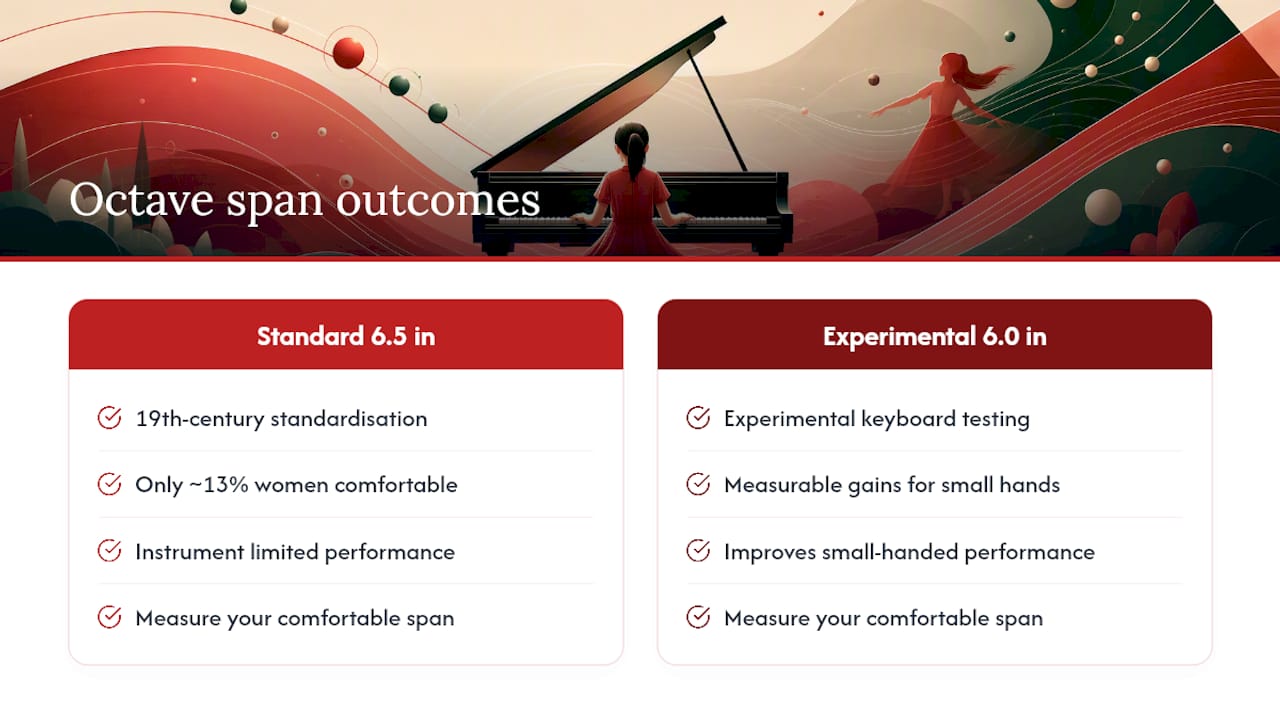
Almost certainly not, in the sense that matters. The standard keyboard was standardised with a 6.5 inch octave, a width settled on in the 19th century when instrument makers were building for average adult male hands, not for the full range of hands that actually play piano today.
That history has consequences. A Stanford Human Performance Alliance study found that only around 13% of women can comfortably span an octave on a standard keyboard, and testing on an experimental 6.0 inch octave keyboard showed measurable performance gains for smaller handed pianists. The instrument, not the player, was the limiting factor.
Pro Tip: Measure your comfortable span by placing your thumb on middle C and stretching your little finger as far as it goes without lifting your palm or straining. If you land short of a full octave, you’re working with a ninth or less. That’s not a deficiency. It just means your fingering choices need to reflect it, the same way a shorter person adjusts their stride rather than pretending they’re six feet tall.
What adaptations actually work on the keyboard?
Teachers who specialise in this area rarely tell students to “just stretch more.” The MTNA symposium guide on Taubman Technique and Music Teacher magazine’s guidance both point toward editing the passage, not the hand. Here’s what that looks like in practice.
Redistribution: move a note or line from one hand to the other. If the left hand has room during a sustained chord, hand it the tenor note and free the right hand’s stretch.
Re-fingering: swap the printed fingering for one that uses a smaller working span, often by shifting the thumb earlier or later in a passage.
Arpeggiation and breaking: roll a wide chord slightly rather than forcing a simultaneous strike. Done musically, most listeners never notice.
Omission: drop a doubled note inside a thick chord, keeping the root, third, and any note that carries the melodic colour.
Pedal and early release: let the sustain pedal hold a bass note while your hand releases early to prepare the next shape.
Lateral arm movement: shift the whole arm sideways to reach a wide interval instead of stretching fingers apart from a fixed hand position.
Interlude’s writing on small handed pianists makes a point worth repeating: many celebrated concert pianists have had small hands, and revoicing or arpeggiating a chord for musical effect is standard professional practice, not a compromise reserved for beginners.
Pro Tip: When deciding what to cut from a thick chord, keep the root, the third, and whatever note carries the melody or a striking harmonic colour. Doubled octaves and filler inner voices are almost always the first thing to go.
How should you practise if you have small hands?
Comfort and control build faster than most people expect, provided the practice is structured rather than just “playing through” the piece repeatedly.
Week 1: isolate the stretch. Ten minutes a day on slow, five-finger patterns that extend gradually toward your comfortable maximum, always releasing tension immediately after the stretch rather than holding it.
Week 2: add lateral arm drills. Practise reaching wide intervals by moving your whole forearm, not just spreading fingers from a static wrist.
Weeks 3 to 4: apply redistribution to your actual repertoire. Take one difficult bar, rewrite the fingering or hand allocation, and drill it slowly until it’s automatic.
Weeks 5 to 6: reassess. Test your span again and see whether passages that felt impossible now feel merely awkward.
Useful daily exercises include finger isolation drills, controlled octave preparation (practising the shape of an octave without striking it, to build the reflex), and quick release drills where you land on an interval and relax the hand within a second.
Expect noticeable ease within two to three weeks of focused practice
Expect genuine comfort with previously awkward passages by week six
If nothing has changed by six weeks, the fingering choice, not your hand, is probably the problem
When does hand stretching become a safety issue?
Pianists who force a stretch beyond their comfortable range, repeatedly and under tension, risk real and lasting damage to tendons and small hand muscles. The safer route is an immediate relaxation reflex after landing on a wide interval, using the Taubman Technique’s principle of releasing tension rather than holding a stretch.
Watch for these warning signs and stop immediately if you notice them:
Sharp or stabbing pain during or after playing
Numbness or tingling in the fingers or forearm
Persistent aching that doesn’t resolve with rest
A sudden loss of speed, control, or evenness in passages you previously played comfortably
Pro Tip: Check your bench height so your forearms sit level with the keys, not angled up or down, and keep your fingertip-to-elbow line roughly straight. That single postural fix, drawn from Taubman principles, prevents a surprising amount of unnecessary strain. Our guide to piano posture for beginners covers the full setup in more depth.
Should you switch to a narrower keyboard?
Changing the instrument is a legitimate option, not a last resort, though it’s worth weighing against simply adjusting technique first.
Adapt technique: free, works with any instrument, takes weeks to feel natural, preserves full standard repertoire without alteration.
Change instrument: immediate physical relief, but costs money and narrower keyboards remain a niche UK market with limited stock.
In the UK, narrower keyboard availability is still patchy. Reduced key width digital pianos and adapted acoustic keyboards exist, but you’ll typically need to contact a specialist piano technician or a university music department for a fitting or trial rather than walking into a general music shop.
Pro Tip: Before buying anything, ask your teacher or a local conservatoire whether they have a narrower keyboard you can trial for a lesson or two. A 30 minute test tells you more than any spec sheet.
Which repertoire and editions suit small hands?
Some music was written with narrower hands in mind, and some publishers have deliberately filled that gap.
Béla Hartmann’s Big Pieces for Small Hands gives intermediate to advanced players virtuosic textures without excessive stretches, and it’s available to UK buyers directly from the publisher.
Barbara Arens’ Small Hand Piano arrangements rework popular repertoire for limited spans.
Bartók’s For Children collection offers short, teachable pieces that avoid octaves entirely.
Baroque and Classical repertoire, particularly Bach, Scarlatti, and early Haydn, tends to be more accessible since it predates the Romantic era’s demand for wide-spanning chords. Check your local library catalogue or a UK sheet music retailer before buying full price.
What does the research say about reach and keyboard design?
The strongest evidence here comes from actual measurement, not assumption. The Stanford narrow-keyboard study tested a 6.0 inch octave against the standard 6.5 inch and found measurable performance improvements for pianists with limited span, confirming that the benefit scales with how constrained a player’s reach actually is.
A minority of women can comfortably span a standard octave
A narrower keyboard produced measurable gains specifically for smaller handed players
Taubman-based pedagogical work independently reaches the same conclusion: technique adaptation reduces strain without needing an instrument change
A teacher’s note for students in England
Every student’s span is different, so lesson plans should be too. I’ve found that measuring a student’s reach early and building repertoire choices around it, rather than around a grade syllabus alone, saves months of frustration.
Get hands-on help adapting your technique
Reading about redistribution and re-fingering only gets you so far. What actually moves the needle is having someone watch your hands and tell you, in real time, which fingering choice fits your span. Danpianostudio offers exactly that, whether you’re in Camden, King’s Cross, central London, or joining remotely.
A first lesson focused on small hands piano technique typically starts with a proper span assessment, moves into a short-term plan built around your current repertoire, and includes a follow-up to check progress. Here’s what booking looks like in practice:
Initial assessment of your comfortable reach and current technique
A tailored four-week plan targeting your specific repertoire challenges
Follow-up lesson to reassess span comfort and adjust fingering choices
Ongoing repertoire selection that favours pieces suited to your hands, not against them
If central London suits you better in person, home piano lessons bring the assessment to your own instrument. If you’d rather work remotely, online piano lessons offer the same tailored approach over video. Book a first lesson and bring whatever piece is currently giving you trouble.
Sources
Recommended


Comments