


Sight reading piano made simple: a practical routine


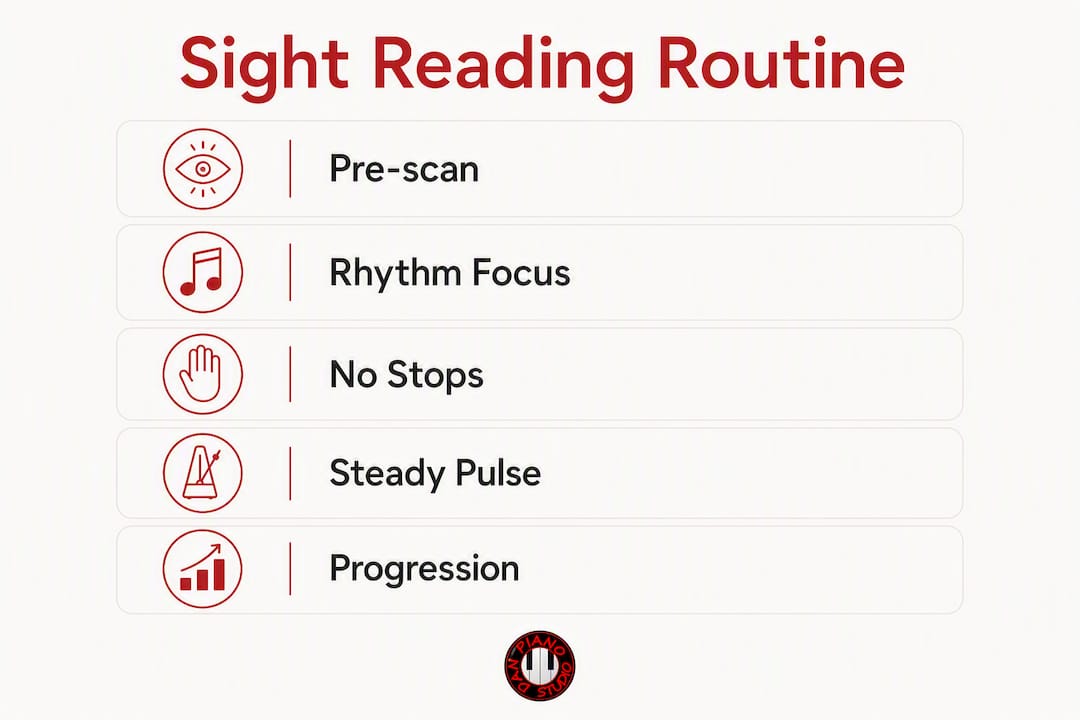
The fastest way to improve your sight reading at the piano is a short daily routine built on three rules: scan the page before you play, prioritise rhythm over pitch, and never stop mid-read. You can start in under ten minutes, and with consistent daily practice you will notice measurable gains within a few weeks.
Here is a single-session checklist to begin right now:
Scan first briefly. Before touching a key, check the key signature, time signature, tempo marking, any repeats, and the trickiest-looking bar.
Clap the rhythm. Away from the piano, tap or clap through the piece once to lock in the pulse.
Play hands separately, briefly. One pass each hand, slowly, to preview the shapes.
Read through without stopping. Keep going even when you make mistakes. Analyse errors only after the run.
Micro-fix one thing. Identify the single trickiest bar and drill it for 60 seconds, then move on to fresh material.
For structured support, the ABRSM Piano Sight-Reading Trainer app provides graded exercises matched to your level, and Danpianostudio offers in-person London and online lessons where a teacher can guide this exact process with you.
Table of Contents
What is sight reading, and how does it differ from learning a piece?
A step-by-step daily sight-reading routine you can use every day
How to structure a weekly practice plan for steady improvement
When does a teacher make a real difference to your sight reading?
Why these practice rules work: the research behind the method
Mental preparation and focus techniques for better sight reading
What is sight reading, and how does it differ from learning a piece?
Sight reading is the skill of performing music from a score on the first attempt, without prior preparation. It is a performance mode: you keep moving forward, maintain the pulse, and make real-time decisions about notes, rhythm, and expression simultaneously.

Learning repertoire is the opposite. When you learn a piece, you stop, repeat, isolate difficult passages, and gradually memorise. Both modes are valuable, but they train different mental habits. Practising repertoire alone will not improve your sight reading, because stopping to fix mistakes is the exact habit sight reading requires you to suppress.
The clearest illustration: a fluent sight reader’s eyes are always one or two bars ahead of their hands. They are reading the next phrase while playing the current one, much like a skilled reader who processes whole words rather than individual letters. That anticipatory scanning is a learnable skill, and it is the core of what the exercises in this article train.
Why better sight reading improves your whole piano playing
The practical benefits extend well beyond the ability to read a new piece at a lesson. Stronger sight reading touches almost every area of your musical development:
Exam readiness — Both ABRSM and Trinity graded exams include a compulsory sight-reading component at every grade. Students who practise it daily consistently outperform those who treat it as an afterthought.
The exam angle is worth emphasising for UK learners. ABRSM sight reading is marked out of 21 at higher grades, and a weak sight-reading performance can cost marks that are genuinely difficult to recover elsewhere in the exam. Treating it as a daily habit rather than an exam-week panic drill is the single most effective change most students can make. For more on preparing the full exam, the ABRSM exam preparation guide on the Danpianostudio blog covers the broader picture.
A step-by-step daily sight-reading routine you can use every day
A reliable daily routine does not need to be long. Research on spacing and consolidation shows that short daily sessions outperform infrequent longer ones because sleep consolidates what you practised. Ten minutes every day beats an hour once a week.
Here is a structured routine for beginners and intermediate players:
Warm up (2 minutes). Play a scale or five-finger pattern in the key of the piece you are about to sight-read. This primes your hand for the key signature and warms up the fingers without burning mental energy.
Pre-scan (10–30 seconds). Paul Harris recommends spending this time identifying the key signature, time signature, tempo, any repeats, and the one or two bars that look most demanding. Do not try to memorise the piece; just flag the hazards.
Clap the rhythm (1–2 minutes). Away from the keys, tap or clap the rhythm of the right-hand part, counting aloud. Prioritising rhythm over pitch reduces breakdowns because a lost pulse is far harder to recover than a wrong note.
Hands-separate preview (1–2 minutes). Play each hand once through, slowly, without stopping. You are not learning the piece; you are previewing the shapes.
Full read-through with metronome (3–4 minutes). Set the metronome to a tempo where you can keep going. Treat this as a performance: do not stop, do not go back, do not slow down for a tricky bar. Keep the pulse.
Micro-fix (1–2 minutes). After the run, identify the single bar that caused the most trouble. Drill it slowly, hands separately if needed, for 60–90 seconds. Then move on. Do not spend the session fixing one piece.
Progression rule: once you can read through a piece with roughly 70–80% note accuracy and a steady pulse, move to slightly harder material. If errors exceed that range, the piece is too difficult for sight-reading practice; drop a grade.
For beginners: aim for 5–8 minutes total, using very short pieces (4–8 bars). For intermediate players: 10–15 minutes, using 16–32 bar pieces at two to three grades below your current repertoire level.
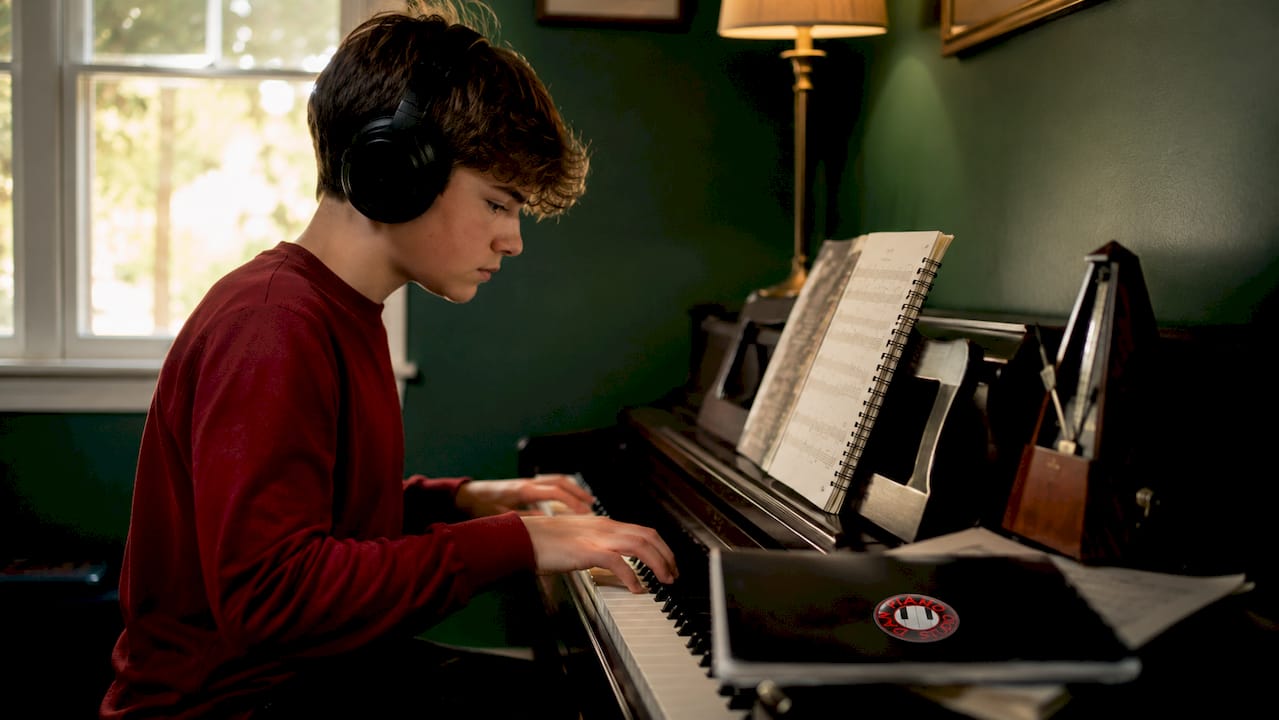
Pro Tip: If you feel the urge to stop mid-read, use a metronome set slightly faster than comfortable. The ticking makes stopping feel more disruptive than pressing on, which trains the “keep going” reflex quickly.
Concrete exercises and drills to build the sub-skills
The full read-through is the main event, but targeted drills build the sub-skills that make it possible. Each of the following can be done in 3–5 minutes as a standalone exercise or slotted into the warm-up phase.
Rhythm drills
Tap a line of music on a single key, ignoring pitch entirely. Count the subdivisions aloud (1-and-2-and for quavers in 4/4). This isolates the rhythmic problem from the pitch problem.
Clap a bar, then immediately play it. The physical memory of the rhythm transfers to the fingers.
Use a metronome at a slow tempo and tap dotted rhythms, syncopations, or triplets until they feel automatic.
Interval and pattern drills
Open any graded piece and identify every third, fifth, and octave on the page before playing a note. Experienced readers perceive music in blocks rather than individual notes; training your eye to see intervals rather than single pitches is what builds that chunking ability.
Play short two-bar phrases and name the interval between the first and last note. Do this across different keys.
Practise recognising common chord shapes (triads, first inversions, dominant sevenths) by sight in both clefs.
Hands-separately and five-note drills
For beginners, the five-finger position exercises are ideal: play a five-note ascending and descending pattern in the right hand while the left holds a single bass note, then swap. This trains independent reading without the coordination overhead.
Step-skip drills: write out (or find) a short melody that alternates steps and skips. Play it hands separately, naming each interval as you go.
Hands-together progression: once both hands are comfortable separately, play the piece at half tempo hands together. Do not aim for perfection; aim for continuity.
Fresh material and technology
Reading many different short pieces builds a larger pattern vocabulary than repeating the same piece. Use graded collections, apps, or printed anthologies to ensure you never sight-read the same piece twice.
The ABRSM Piano Sight-Reading Trainer generates graded exercises and gives immediate feedback, making it practical for daily use without needing to source new sheet music manually.
How to structure a weekly practice plan for steady improvement
A single good session does not build a skill. Consistency and variety across the week do. Here is a sample weekly structure for a beginner or intermediate player with 10–15 minutes per day available for sight reading:
Monday: Warm up in a major key, scan and clap a new piece, full read-through, one micro-fix.
Tuesday: Different piece, different key. Focus the drill on rhythm only: tap the whole piece before playing.
Wednesday: Interval recognition drill (5 minutes), then a short hands-separately read of a new piece.
Thursday: Full routine with a piece one grade harder than usual. Note where it breaks down; that is your next target skill.
Friday: Return to a piece from Monday or Tuesday. Notice what feels easier. This spaced repetition is where consolidation happens.
Saturday: Longer session (15–20 minutes) using a graded collection or app. Try three or four very short pieces rather than one long one.
Sunday: Rest, or a single slow, enjoyable read-through of something easy.
Progress metrics to watch:
Aim for roughly 70–80% note accuracy on first read-through. Below that, the material is too hard; above 90%, it is too easy.
Practise two to three grades below your current repertoire level. If you are working on Grade 4 pieces, sight-read Grade 1–2 material.
Track how often you stop involuntarily. Fewer stops per session is a clearer progress signal than note accuracy alone.
Every four weeks, try a piece one grade higher than your usual sight-reading level. If it feels manageable, you have moved up.
For broader guidance on structuring your whole practice week, the how to practise piano effectively article on the Danpianostudio blog covers session planning in more depth.
What are the best UK resources for sight-reading practice?
The right materials make daily practice sustainable. These are the most useful options available to UK learners:
ABRSM Piano Sight-Reading Trainer (app) — Available on iOS and Android, this app generates graded sight-reading exercises aligned to ABRSM grades. It provides immediate feedback and tracks your progress over time. Connecting a MIDI keyboard gives you real-time note detection, which makes the feedback genuinely useful rather than self-assessed. Available from the ABRSM website.
Pro Tip: Whatever resource you use, the rule is one read only. The moment you play a piece a second time, it is no longer sight reading; it is learning. Keep a log of what you have read so you do not accidentally revisit pieces.
When does a teacher make a real difference to your sight reading?
Self-directed practice takes you a long way, but a teacher accelerates progress in ways that are genuinely difficult to replicate alone. The core reasons:
Exam preparation linkage — For ABRSM and Trinity candidates, a teacher knows exactly what the examiner is listening for and can model the pre-scan and read-through process live.
A typical 15-minute sight-reading segment in a lesson might look like this: the teacher selects a piece two grades below your current level, gives you 20 seconds to scan it, then asks you to play through without stopping while they observe. Afterwards, they identify the two or three specific issues (a rhythmic pattern, a key signature error, a hand-position problem) and give you a targeted drill to take home. That feedback loop is what makes lessons so much more efficient than solo practice.
Danpianostudio offers both in-person lessons in London and online lessons, with sight-reading integrated into lesson plans for beginners through to exam candidates. Whether you are preparing for a grade exam or simply want to read music more fluently, piano lessons for beginners and intermediate players are structured to include this kind of targeted work from the first session.
Common sight-reading mistakes and how to fix them quickly
Most sight-reading problems come down to a handful of recurring habits. Recognising them is the first step to correcting them.
Stopping to fix a wrong note. The fix: set a metronome and commit to keeping up with it. A wrong note costs you nothing; stopping costs you the pulse and your place.
Obsessing over pitch and ignoring rhythm. Clap the rhythm before you play. A rhythmically accurate performance with some wrong notes sounds musical; a rhythmically chaotic one with correct notes does not.
Looking at your hands. Mark the trickiest position shifts during your pre-scan, then trust your hand to find them. Practise scales and arpeggios with eyes closed to build tactile confidence.
Ignoring the key signature. During the pre-scan, write a small pencil mark next to the first bar reminding yourself of the sharps or flats. Check it again before you start.
Losing tempo in difficult bars. The instinct is to slow down for hard passages. Instead, simplify: drop the left hand to a single note, skip an ornament, play the chord as a single note. Keep the pulse at all costs.
No recovery strategy. If you lose your place entirely, jump to the nearest barline and rejoin. In an exam, the examiner expects small errors; they do not expect you to stop and restart. Scan ahead during rests to find your re-entry point.
Why these practice rules work: the research behind the method
The routine in this article is not arbitrary. Each element is grounded in how the brain actually learns and consolidates musical skills.
Spacing and short sessions. Research on spacing and consolidation consistently shows that distributing practice across multiple short sessions produces better long-term retention than massed practice. For sight reading, this means daily 5–10 minute sessions are more effective than a single weekly hour.
Pre-scan timing. Paul Harris’s recommendation of a 10–30 second pre-scan is grounded in the way working memory operates: a brief, structured scan primes the brain for the key features without overloading it with detail.
Rhythm first. Rhythmic problems cause more breakdowns in sight reading than pitch errors. Dr Noa Kageyama of the Bulletproof Musician blog notes that internalising rhythm through tapping or counting aloud before playing is one of the most reliable ways to prevent mid-read collapses.
Pattern recognition and chunking. Music cognition research shows that advanced readers perceive music in intervallic and chordal blocks rather than individual notes. Training interval and chord-shape recognition directly builds this chunking ability, which is why the drills in this article focus on shapes rather than note names.
Varied material over repetition. Reading many different pieces expands the brain’s pattern vocabulary faster than repeating the same piece. This is the cognitive basis for the “one read only” rule.
Difficulty calibration. The 70–80% accuracy target comes from the principle that learning is most efficient at the edge of current ability. Too easy and the brain is not challenged; too hard and it panics and consolidates errors rather than correct patterns.
How to approach different musical styles in sight reading
Different genres present different reading challenges, and rotating through styles is one of the most effective ways to build a broad sight-reading vocabulary.
Classical and Baroque. Expect regular phrase structures, predictable harmonic patterns, and ornaments. During the pre-scan, note any trills or mordents and decide in advance whether to play them or simplify. Baroque counterpoint (two independent voices in one hand) is particularly demanding; practise each voice separately before combining.
Romantic and late Classical. Wider dynamic range, more complex rhythms, and frequent key changes. Scan for accidentals carefully; a sudden modulation mid-phrase is a common trap. Chord voicings tend to be denser, so practise recognising spread chords and arpeggiated figures as shapes.
Jazz and popular styles. Syncopation and swing rhythms require a strong internal pulse. Clap the rhythm with extra attention to off-beats before playing. Lead sheets (melody plus chord symbols) are a different reading skill from fully notated scores; if you encounter them, practise reading chord symbols separately from the melody line.
Contemporary and atonal. No predictable tonal centre means fewer pattern shortcuts. Slow the tempo significantly and focus on interval accuracy rather than harmonic expectation. These pieces are excellent for training pure interval reading.
Rotating through two or three styles each week prevents the brain from over-relying on stylistic shortcuts and builds genuine reading flexibility.
How to track your progress and set measurable milestones
Progress in sight reading is easy to underestimate because it accumulates gradually. A simple tracking system makes the gains visible and keeps motivation steady.
Keep a sight-reading log: a notebook or spreadsheet with the date, the piece or exercise, the grade level, and a brief note on what went well and what broke down. After four weeks, patterns become clear: you will see which rhythmic figures trip you up consistently, which keys cause hesitation, and how your stop count has changed.
Milestones to aim for at four-week intervals:
Week 4: Completing a full read-through without stopping on Grade 1–2 material (for beginners) or two grades below your current level (for intermediate players).
Week 8: Maintaining a steady pulse through the whole piece, even when notes are wrong.
Week 12: Recognising common chord shapes (triads, dominant sevenths) on sight without pausing to decode them.
Week 16: Reading ahead by at least one bar consistently, so the eyes are always ahead of the hands.
Recording yourself (even on a phone) once a week is one of the most honest progress tools available. Listening back reveals pulse inconsistencies and stopping habits that are invisible in the moment of playing.
Mental preparation and focus techniques for better sight reading
The mental side of sight reading is underestimated by most learners. The skill is not purely technical; it is also about managing attention and suppressing the correction impulse under pressure.
Before you play: treat the pre-scan as a focused mental rehearsal, not just a checklist. Hear the opening bars internally before your hands move. This internal audiation primes the motor system and reduces the gap between reading and playing.
During the read-through: narrow your focus to one bar ahead. Trying to process the whole page at once leads to overload; committing to a one-bar lookahead is manageable and trainable. Use rests and held notes as micro-recovery moments to scan further ahead.
Managing anxiety in exams or performances: the most common cause of sight-reading anxiety is the fear of wrong notes. Reframe the goal: the task is to maintain pulse and musical shape, not to play every note correctly. Examiners and listeners respond to rhythmic confidence far more than they notice individual pitch errors.
Concentration drills: practise sight reading in conditions that simulate mild distraction: background noise, a slightly uncomfortable seat, or a time limit. This builds the attentional resilience that exam conditions require. Even two or three minutes of focused reading with a deliberate distraction present will sharpen your concentration over time.
A guide to piano theory basics can also support the mental side of sight reading: the faster you recognise key signatures and chord functions theoretically, the less cognitive load the reading itself carries.
Key takeaways
Consistent daily sight-reading practice using the pre-scan, rhythm-first, and no-stop method produces measurable improvement within four weeks, even at beginner level.
Point | Details |
Daily short sessions | 5–15 minutes every day outperforms longer infrequent practice due to spacing and consolidation. |
Grade selection rule | Practise two to three grades below your current repertoire level to maintain fluency and avoid frequent stops. |
Rhythm before pitch | Clap or tap the rhythm before playing; rhythmic breakdowns are harder to recover than wrong notes. |
Accuracy target | Aim for roughly 70–80% note accuracy on first read-through; below that, the material is too difficult. |
Danpianostudio lessons | In-person London and online lessons with Danpianostudio integrate targeted sight-reading drills and exam preparation from the first session. |
What actually moves the needle in sight reading
The conventional advice is to practise sight reading regularly, and that is correct as far as it goes. What most guides miss is that the quality of the habit matters more than the quantity. A student who spends ten minutes a day reading fresh material at the right difficulty level, never stopping, will outpace a student who spends thirty minutes drilling the same two pieces they already half-know.
The rhythm-first principle is the one change that produces the most immediate results, and it is also the most resisted. Players want to hear the notes; they find clapping a rhythm away from the piano unglamorous. But the evidence is consistent: rhythmic instability is the primary cause of sight-reading breakdowns, and clapping before playing is the fastest way to address it.
The other underestimated factor is difficulty calibration. Practising at the right level feels almost too easy. That slight ease is not a sign that you are wasting time; it is the condition under which the brain consolidates correct patterns rather than rehearsing errors. The two-to-three-grades-below rule feels counterintuitive, but it is the reason students who follow it progress faster than those who push into difficult material too soon.
Finally: a teacher is not a luxury for sight reading. It is the one area of piano playing where self-assessment is most unreliable, because the habits that hold you back (stopping, slowing, looking at your hands) are invisible to you in the moment. A single lesson focused on sight reading will reveal more about your specific weaknesses than months of solo practice.
Piano lessons in London and online with Danpianostudio
Sight reading is one of the skills that responds fastest to targeted teaching, and Danpianostudio builds it into lessons from the very beginning. Whether you are a complete beginner working through Grade 1 material or an intermediate player preparing for a higher ABRSM or Trinity exam, lessons are structured to include a dedicated sight-reading segment alongside technical work and repertoire.
In-person lessons are available in Central London, Camden, and King’s Cross. Online lessons are available worldwide. Both formats include the same approach: graded sight-reading exercises matched to your current level, immediate feedback on rhythm and pulse, and a take-home drill to practise between sessions. Exam candidates receive specific preparation for the sight-reading component, including timed pre-scans and mock read-throughs under exam conditions.
To book a lesson or find out more about lesson packages, visit the home piano lessons page or the online piano lesson page. You can also explore the full range of services at danpianostudio.com.
Further reading and authoritative sources
ABRSM Piano Sight-Reading Trainer — the official ABRSM app for graded sight-reading practice, with exercises aligned to exam grades and MIDI keyboard support.
Teaching the technique of sight reading with Paul Harris | Faber Music — a detailed discussion of pre-scan technique and the pedagogical principles behind structured sight-reading practice.
Mastering the art of sight reading | Pianist Magazine — practical guidance on rhythm-first approaches and the “musical detective” mindset for sight reading.
Research on spacing and consolidation | PMC — the cognitive science behind short daily sessions and the spacing effect; directly relevant to building a daily sight-reading habit.
Music cognition research on pattern recognition | Journal of Research in Music Education — research on how experienced readers perceive intervallic and chordal shapes rather than individual notes; the basis for chunking drills.
How to improve sight reading on piano | AnyScore — practical advice on using varied material to build pattern vocabulary, with guidance on apps and generators for fresh content.
MasterPiano sight-reading platform — an online platform with graded libraries and MIDI tracking; useful for players who want data-driven progress monitoring.
How to improve piano sight reading | SightReader — covers the no-stop policy, difficulty calibration, and the 70–80% accuracy target in detail.
Danpianostudio: how to improve sight reading at the piano — the studio’s own guide to sight-reading methods, drills, and teacher-backed advice for London and online students.
Recommended



Comments