


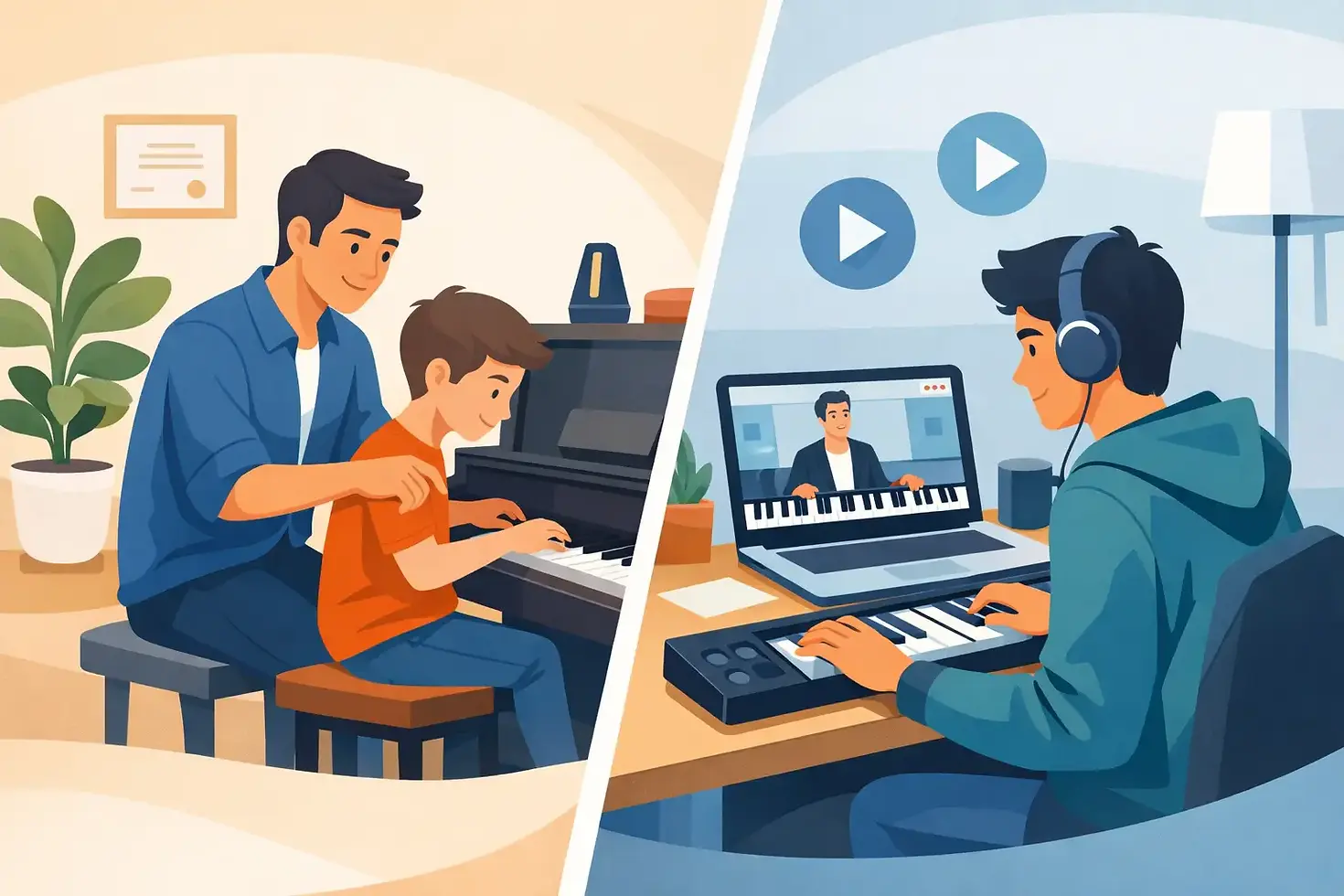
Piano Teacher Versus Video Tutorials Compared

A piano tutorial can make a new piece look wonderfully achievable. The camera is close to the keys, the notes are labelled, and within minutes you may be playing a recognisable melody. Yet the question of piano teacher versus video tutorials becomes more significant when you want to play with confidence, understand what you are doing, and keep progressing beyond the first few pieces.
Video lessons and one-to-one teaching are not enemies. Many successful students use both. The real difference lies in what happens when something feels difficult, sounds uneven, or needs to fit your own goals. Whether you are a complete beginner, returning to the piano as an adult, preparing for an ABRSM or TRINITY exam, or moving from classical repertoire into jazz, the right support can make practice more rewarding.
Piano teacher versus video tutorials: the key difference
A video tutorial gives you information. A piano teacher gives you information, observation and a response tailored to you.
A well-made video can explain where to put your hands, demonstrate a rhythm, or show how a piece should sound. It is available whenever you have a spare half hour, and you can replay a tricky passage as often as needed. For someone curious about the piano or working through a very busy week, that convenience has genuine value.
However, a video cannot notice that your shoulders are rising, your wrists are locked, or your thumb is tucking under too early in a scale. It cannot hear that the left hand is overpowering the melody, even though you are playing all the right notes. It also cannot ask why you want to learn piano and adjust the lesson accordingly.
In a one-to-one lesson, those details are not minor corrections. They are the building blocks of comfortable technique, musical control and lasting enjoyment. A teacher can change the pace, choose a more suitable exercise, demonstrate a different approach, and make sure a problem is understood before it becomes a habit.
Feedback changes how quickly you improve
Most pianists can tell when a piece is not quite right. The harder question is identifying why. Is the rhythm inaccurate? Are the fingers tense? Is the fingering making the passage harder than necessary? Is the pedal blurring the harmony, or is the pulse becoming unsteady at every jump?
Tutorials are usually designed for a general audience, so they offer a single route through a piece. That route may work well for one learner and be frustrating for another. A child with small hands, for example, may need a different solution from an adult beginner. A developing player may be ready to focus on voicing and phrasing rather than simply finding the notes.
Personal feedback shortens the gap between practising and improving. Instead of repeating a passage ten times and hoping it settles, a student can learn a specific strategy: practise hands separately, use a metronome at a slower tempo, group the notes differently, or alter the fingering. Small, clear adjustments often produce the biggest breakthrough.
This matters especially in online piano lessons. Virtual teaching can still provide real-time feedback on posture, sound, rhythm and interpretation, while allowing students to learn from home. With a well-positioned camera and regular guidance, the lesson remains personal rather than passive.
Technique needs more than imitation
Watching a pianist's hands is useful, but technique is not just a visual skill. Two people can appear to make the same movement while one is relaxed and the other is carrying tension through the hand and forearm.
A trained teacher listens as well as watches. They can help you produce a singing tone in a classical melody, shape a crescendo without rushing, or use chord voicings that sound balanced in jazz. These are physical and musical skills that develop over time. They are much easier to establish with guidance than to repair later.
Structure gives practice a purpose
The appeal of tutorials is choice. Search for almost any song, and you will find several versions to try. The drawback is that choice can become a collection of unfinished pieces. You may learn an introduction, move on when the middle becomes difficult, then feel unsure what to practise next.
A teacher creates a route through that uncertainty. Lessons can balance repertoire with scales, sight-reading, aural work, theory and technical development. This does not mean every student follows the same programme. A young beginner may need short musical activities and clear weekly goals, while an adult hobbyist may prefer a favourite film theme alongside practical chord work.
For students taking graded exams, structure is essential. ABRSM and TRINITY assessments involve more than learning pieces. There may be scales and arpeggios, sight-reading, aural tests, supporting exercises and expectations around style. A teacher can select suitable repertoire, build skills in the right order, run mock performances, and help the student arrive prepared rather than overwhelmed.
Even without an exam goal, structured learning brings a sense of direction. You know what you are working towards this month, why a particular exercise matters, and how your current piece connects to the next one.
Motivation is personal
Playing piano at home can be peaceful, but it can also be easy to postpone. A tutorial library will not notice that you have avoided practice for two weeks because a passage felt discouraging. Nor will it celebrate when you finally play a difficult section smoothly.
A regular lesson creates gentle accountability. More importantly, it gives students a place to talk honestly about what is going well and what is not. Progress is rarely a straight line. There are weeks when work, school or family life leaves little time for the piano. There are pieces that take longer than expected. A supportive teacher helps you adjust the plan without losing sight of the larger goal.
For children and teenagers, encouragement needs to sit alongside clear expectations. They benefit from achievable targets, engaging music and recognition of effort. Adults often need permission to be beginners again, as well as practical ways to fit practice around a full timetable. Individual teaching can meet both needs without lowering musical standards.
Where video tutorials work well
Video tutorials are not a poor choice by default. They can be an excellent extra resource for students who already have a sound foundation. A demonstration may help you hear the character of a new piece, revise a rhythm between lessons, or explore a style that interests you.
They are also useful for discovering music. If you are wondering whether jazz piano appeals to you, watching performances and simple tutorials can be a motivating first step. The same is true for classical repertoire: hearing several interpretations can encourage curiosity about phrasing, tempo and sound.
The limitation is relying on videos as your entire musical education. A tutorial can show you a version of a song, but it may not teach you how to read independently, accompany a singer, improvise over a chord sequence, or solve the next unfamiliar piece on your own. Those broader skills are what turn piano playing into a lasting ability.
A sensible approach is to use videos as a supplement. Bring a tutorial-inspired piece to a lesson, ask about the technique involved, and learn how to make it your own. The video supplies inspiration; the teacher provides the context and progression.
Cost, flexibility and what you are really investing in
Video tutorials are usually free or low-cost, which makes them attractive at the beginning. They are flexible too: no appointment, no travel and no pressure to play for someone else. For a casual learner with a narrow goal, this may be enough.
One-to-one tuition costs more because it is a professional service shaped around the student. You are paying not only for time at the piano, but for lesson planning, musical expertise, diagnosis, encouragement and a programme that develops as you do. The value becomes clearer when it saves months of unfocused practice or helps you avoid technical habits that limit your playing.
The best choice depends on your aim. If you simply want to pick out one tune for fun, videos may suit you well. If you want dependable foundations, expressive playing, exam preparation, classical or jazz development, or the confidence to tackle music independently, a teacher is likely to offer more lasting value.
At Dan Piano Studio, lessons are shaped around each student's starting point and ambitions, whether that means first notes at the keyboard, a return to favourite repertoire, jazz harmony, or a recognised exam pathway.
The most useful first step is to be honest about the musician you want to become. Choose the support that will help you enjoy playing this week, while still giving you the skills to sit at the piano with a new piece in front of you and know where to begin.


Comments