


Piano practice routine: structured daily plans that work

A well-structured piano practice routine uses five core components every session: warm-up, scales and technique, repertoire work, sight-reading, and aural training. Three ready-to-use daily templates cover the most common time slots:
10-minute session
2 min: hand stretches and a familiar five-finger pattern
5 min: one problem passage, hands separate, slow tempo
3 min: play through a short piece you enjoy
30-minute session
5 min: warm-up and posture check
8 min: scales, arpeggios, or a technical exercise
12 min: repertoire (chunked problem-solving)
5 min: sight-reading or aural drill
60-minute session
5 min: warm-up
10 min: scales, arpeggios, contrary motion
25 min: repertoire (hands separate, then together, then slow run-through)
10 min: sight-reading
10 min: aural work or a second piece
Practice duration recommendations suggest beginners aim for 15–30 minutes daily, intermediate players 45–60 minutes, and advanced pianists 1–2 hours, though quality and consistency matter far more than raw minutes. Copy whichever template fits your day and start your next session immediately.
Key takeaways
A structured piano practice routine built on five core components, practised consistently at whatever length your day allows, produces faster and more measurable progress than longer unfocused sessions.
Point | Details |
Five components every session | Include warm-up, scales, repertoire, sight-reading, and aural work in every session, scaled to your available time. |
Match duration to your level | Beginners aim for 15–30 minutes daily; intermediate players 45–60 minutes; advanced pianists 1–2 hours. |
One target per session | Write one specific goal before you sit down (e.g. “bars 9–16, LH alone, 52 bpm, three clean takes”) and verify it before you finish. |
Short sessions count | Ten focused minutes with a metronome on a single passage beats thirty unfocused minutes of run-throughs. |
Danpianostudio | Offers tailored lessons in Central London and online, with a personalised weekly practice plan included in every session. |
Table of Contents
What does a good piano practice routine look like at every session length?
Most learners have wildly different amounts of time available from one day to the next. A Monday evening might give you 90 minutes; a Tuesday lunch break, barely ten. The solution is not to skip the shorter days but to know exactly what to do with whatever time you have.
The table below maps session lengths to component priorities. The same five building blocks appear at every length; what changes is how much time each one gets.
Session length | Warm-up | Scales / technique | Repertoire | Sight-reading | Aural / ear work |
5–10 min | 1–2 min | Skip or 2 min | 5 min (one passage) | Skip | Skip |
20 min | 3 min | 5 min | 9 min | 3 min | Skip |
30 min | 5 min | 8 min | 12 min | 5 min | Skip or 2 min |
45 min | 5 min | 10 min | 25 min | 5 min | 5 min |
60 min | 5 min | 10 min | 25 min | 10 min | 10 min |
90 min | 8 min | 15 min | 25 min | 15 min | 12 min |
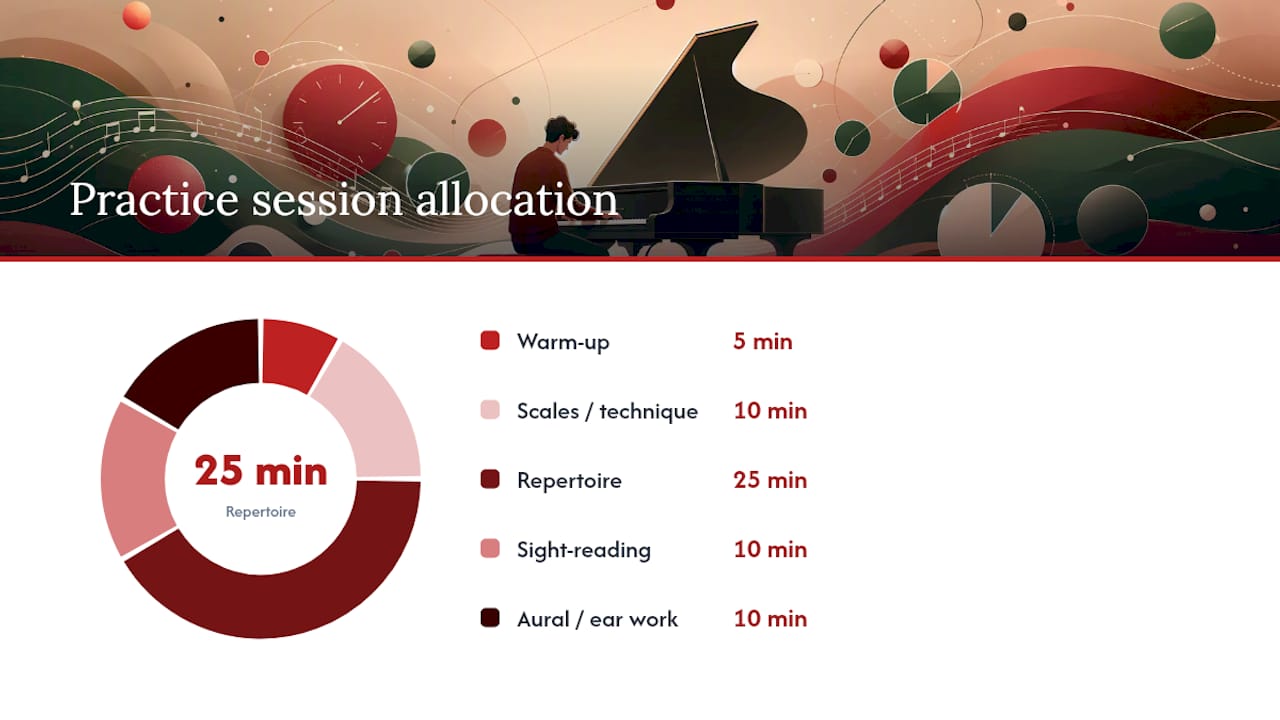
A structured one-hour session splits naturally across warm-up, technique, repertoire, and sight-reading/aural, and those proportions hold at shorter lengths too. When you scale down, repertoire is the last thing to cut; scales are the first.
Exam-focused adjustments. If you are preparing for an ABRSM or Trinity exam, add a five-minute mock run-through at the end of any session of 30 minutes or longer. In the final four weeks before the exam, swap one sight-reading slot per week for a full aural drill that mirrors the actual test format. The ABRSM exam preparation guide at Danpianostudio covers the specific aural and viva requirements in detail.
Pro Tip: Set a physical timer rather than watching a clock. Knowing the timer will tell you when to move on frees your attention for the music instead of the minutes.
How to practise each component of your session
Warm-up
A warm-up is not optional padding. Cold hands and a distracted mind produce sloppy playing that embeds errors rather than correcting them. Spend two to five minutes on:
Gentle hand and wrist rotations away from the keyboard
A posture check: feet flat, bench at the right height, wrists level with the keys, shoulders relaxed
A familiar five-finger pattern or a short piece you already know well, played slowly and with full attention to tone
The goal is to arrive at the keyboard, not just sit down at it. Good posture from the start prevents the tension that causes pain later in a session.
Scales and arpeggios
Scales are not a punishment. They are the fastest way to build finger independence, key awareness, and the muscle memory that makes sight-reading easier. A practical approach:
Choose two or three keys per week rather than cycling through all twelve every session
Practise similar motion first, then contrary motion
Set a metronome at a tempo where every note is clean and even. That is your base tempo
Increase by 4–8 bpm only when you can play three consecutive clean repetitions at the current speed
Arpeggios follow the same logic; add thumb-under preparation as a separate drill if the crossover is uneven
Technical exercises that build real skill go beyond scales alone. Hanon, Czerny, and broken-chord patterns all have a place once basic scale technique is secure.
Pro Tip: Record yourself playing a scale at your target tempo once a week. The recording hears unevenness your ears filter out in the moment.
Repertoire: chunked problem-solving
Running through a piece from start to finish is the single most common way to waste practice time. Instead, treat repertoire work as surgery: identify the problem, isolate it, fix it, then reconnect it to the surrounding bars.
A reliable chunking sequence:
Identify the hardest two to four bars in the piece
Play the right hand alone at 60% of performance tempo
Play the left hand alone at the same tempo
Combine hands at 60% tempo, aiming for three clean repetitions
Add one bar before and one bar after to reconnect the chunk to its context
Play the full phrase at a slightly higher tempo
Rhythmic variants (dotted rhythms, staccato on a legato passage) force your fingers to find the notes independently of momentum. They are particularly useful for fast runs where fingers are “falling” through the passage rather than placing deliberately.
Sight-reading
Daily sight-reading is the component most learners skip and most teachers wish they would not. Even three minutes a day produces measurable gains over a term. The rules are simple:
Choose material one grade below your current level
Set a slow, steady pulse and do not stop for mistakes
Keep your eyes moving ahead of where your hands are playing
Never repeat a passage during a sight-reading drill; the point is forward momentum
Improving sight-reading at the piano requires consistent short exposure rather than occasional long sessions.
Aural work
Aural training is the component that separates players who understand music from those who merely reproduce it. Short daily drills make a significant difference:
Sing back a short melodic phrase your teacher (or a recording) plays
Identify intervals by ear using a reference song for each (a minor third sounds like the opening of “Smoke on the Water”; a perfect fourth like “Here Comes the Bride”)
Clap back a rhythm pattern before playing it
For exam candidates, practise identifying chord types (major, minor, diminished) and cadences in short musical extracts
Pedagogy-backed methods that actually make practice effective
Why deliberate practice beats unfocused hours
Quality of focus matters more than hours spent. Deliberate, metronome-assisted work on a single technical issue produces faster progress than longer unfocused sessions. The mechanism is straightforward: when you practise without a specific target, you reinforce whatever you already do, including the mistakes.
Deliberate practice has three requirements: a specific target, a method for checking whether you hit it, and an adjustment when you do not. “Practise the piece” is not a target. “Play bars 9–16 with the left hand alone at 52 bpm, three clean repetitions” is.
How to use a metronome effectively
Most learners use a metronome at the wrong tempo. They set it at the speed they want to play, stumble through, and call it practice. The correct approach:
Find the tempo at which you can play the passage perfectly. This is often much slower than you expect.
Play three clean repetitions at that tempo.
Increase by 4 bpm.
Repeat until you reach performance tempo.
Once at performance tempo, remove the metronome and play musically. The metronome is a training tool, not a performance crutch.
A physical metronome (Wittner, Korg) or a free app (Metronome Beats, Pro Metronome) both work. The key is using it consistently.
Slow practice: the rules
Slow practice is not just playing slowly. It is playing slowly with full attention to every detail: tone, fingering, weight, and evenness. The criteria for increasing tempo are:
Three consecutive clean repetitions at the current speed
No tension in the hands or wrists
Every note has the intended dynamic and articulation
If any of those conditions are not met, stay at the current tempo. Chasing speed before accuracy is the most reliable way to embed a mistake permanently.
Chunking and hands-separate technique
Hands-separate practice is not just for beginners. Advanced players use it whenever a passage is not clean, because it forces each hand to find its own voice rather than relying on the other for rhythmic or harmonic cues.
A hands-separate re-integration checklist:
Right hand alone: clean, musical, correct fingering
Left hand alone: clean, musical, correct fingering
Hands together at 60% tempo: rhythmic alignment is the only new challenge
Hands together at 80% tempo: add dynamics
Hands together at performance tempo: add expression
Pro Tip: If hands-together playing falls apart at a certain tempo, drop back to hands-separate at that exact tempo. The problem is almost always that one hand is not yet secure enough to share attention.
Setting a session goal and verifying it
A 30-minute session with one clear target, slow repetitions, and a verification step yields steady, measurable improvement. Before you sit down, write one sentence: what will you be able to do by the end of this session that you could not do at the start?
Verification options:
Record a 30-second clip on your phone and listen back
Count three consecutive clean takes of the target passage
Play the passage to a family member or teacher and ask for honest feedback
What to practise when you only have 5–20 minutes
Short sessions are not second-best sessions. Even ten minutes of deliberate practice daily can produce meaningful gains if that time is focused on a specific target with metronome and slow practice. The key is knowing exactly what to do before you sit down.
Micro-session templates
5 minutes: One problem bar, hands separate, three clean repetitions each hand. No warm-up, no run-through. Pure surgery.
10 minutes: 2 min warm-up (five-finger pattern). 6 min on one passage (hands separate then together). 2 min play something you enjoy.
15 minutes: 2 min warm-up. 5 min scales (two keys). 6 min repertoire chunk. 2 min sight-reading (one line).
20 minutes: 3 min warm-up. 5 min scales. 9 min repertoire (chunked, with metronome). 3 min sight-reading.
The 80/20 approach for busy learners concentrates on the small set of activities that produce the largest gains: scales, chords, rhythm, and sight-reading. In a 20-minute session, those four cover more ground than an unfocused 45-minute run-through.
Distributed practice across the day
Three 10-minute sessions spread across a day often produce better retention than one 30-minute block. Attention research supports the idea that short focused sessions repeated across the day preserve concentration and strengthen memory consolidation. A practical split: one session in the morning (scales and technique), one at lunch (a problem passage), one in the evening (a musical run-through of what you worked on).
Habit hacks that keep you consistent
Anchor the habit. Attach practice to something you already do every day: after breakfast, before dinner, immediately after school.
Lower the barrier. Leave the piano lid open and your music on the stand. The two-second rule: if it takes more than two seconds to start, you will find a reason not to.
End on an easy win. Finish every session, however short, with something you play well. This conditions your brain to associate the piano with success rather than struggle.
Pro Tip: Keep a sticky note on the piano with tomorrow’s single practice target written on it. Decision fatigue is real; removing the “what should I practise?” question means you start immediately.
How to plan your week and track progress over time
Daily sessions are the engine; weekly planning is the steering. Without a weekly arc, most learners spend every session on the same comfortable material and wonder why they are not improving.
A simple weekly rotation
Teachers recommend mixing session types across the week: some days for new material, others for consolidation, and weekends for run-throughs to build stamina and performance confidence. A practical template:
Monday / Wednesday / Friday: New material. Introduce a new passage, a new scale key, or a new sight-reading grade.
Tuesday / Thursday: Consolidation. Return to last week’s problem passages with fresh ears. Slow practice, metronome, verification.
Saturday / Sunday: Run-throughs. Play complete pieces from memory or from score. Simulate performance conditions: no stopping, no corrections mid-phrase.
Setting medium-term goals
A four-to-six-week micro-goal gives daily sessions a direction. Examples:
“By the end of six weeks, I will play the first movement of the Clementi Sonatina at 108 bpm, hands together, from memory.”
“By the end of four weeks, I will sight-read Grade 3 pieces at a steady pulse without stopping.”
Break each micro-goal into weekly milestones, then into daily session targets. The daily target is always one sentence, as described in the methods section above.
Progress tracking: what to log
Date | Piece / exercise | Target tempo | Achieved tempo | Problem bars | Clean takes | Notes |
Example | Bach Minuet in G | 80 bpm | 60 bpm | Bars 9–16 | 2/3 | LH crossover uneven |
Log this after every session. It takes 90 seconds and tells you, over four weeks, exactly where your time is going and whether your tempo targets are realistic. For exam preparation, add a column for the specific ABRSM or Trinity marking criteria you are targeting. The piano exam preparation checklist at Danpianostudio gives a full timeline and criteria breakdown.
Copyable minute-by-minute sessions for every level
Beginner (30 minutes)
0–4 min: Posture check, hand stretches, C major five-finger pattern (both hands, slowly)
4–10 min: C major and G major scales, one octave, similar motion, metronome at 60 bpm
10–22 min: Current piece. Identify the hardest four bars. Right hand alone (3 min), left hand alone (3 min), hands together slowly (6 min)
22–27 min: Sight-reading. One short piece, one grade below current level. No stopping.
27–30 min: Play a piece you already know well and enjoy
Beginner exercises that build real technique are worth adding to the scales slot once the basic routine feels comfortable.
Intermediate (45 minutes)
0–5 min: Warm-up, posture, familiar short piece
5–15 min: Two scales (two octaves, similar and contrary motion), arpeggios in the same keys, metronome at 80–100 bpm
15–35 min: Repertoire. Two pieces or two sections. Chunking method on the hardest passage in each. Hands separate, then together, then reconnect to context.
35–42 min: Sight-reading (Grade 4–5 material). Two short pieces, forward momentum only.
42–45 min: Aural drill. Sing back a four-bar melody, identify two chord types by ear.
Advanced (60–90 minutes)
0–8 min: Warm-up, Hanon or Czerny exercise at a demanding tempo
8–20 min: Scales and arpeggios across four keys, contrary motion, chromatic scales, broken chords
20–55 min: Repertoire. Three sections. Complex chunking, rhythmic variants, tempo control from 60% to 95% of performance tempo. One mock run-through of the complete piece under performance conditions (no stopping).
55–70 min: Sight-reading (Grade 6+ or orchestral reduction material)
70–80 min: Aural work: interval identification, chord progressions, dictation exercise
80–90 min: Second piece or technical study
A practical guide to classical piano technique covers the specific technical vocabulary (voicing, weight transfer, rotation) that advanced sessions require.
Exam-focused session (45 minutes, four weeks before exam)
0–5 min: Warm-up
5–15 min: All three exam pieces, one run-through each. Mark any stumbles but do not stop.
15–25 min: Target the two worst moments from the run-throughs. Chunking method, slow practice, three clean takes each.
25–35 min: Scales and arpeggios from the exam syllabus, at exam tempo
35–42 min: Aural practice. Work through the specific test types for your grade (singing back, clapping rhythm, identifying features).
42–45 min: One final run-through of your strongest piece, played as if in the exam room
Common practice mistakes and how to fix them
Running through instead of fixing
Playing a piece from start to finish, stopping at mistakes, and starting again is not practice. It is performance rehearsal without the performance standard. Common mistakes that waste practice time include running through full pieces without isolating problems, chasing speed too early, and failing to verify improvement.
The fix: never start from the beginning when you make a mistake. Go back two bars before the error, isolate the problem, fix it with the chunking method, then reconnect.
Chasing speed too early
Speed is a result, not a method. Playing a passage fast before it is clean at a slow tempo embeds the mistake at speed. The only reliable fix is to drop back to a tempo where you can play it perfectly, however slow that feels, and build from there.
Neglecting posture
If you notice tightness creeping in during a session, stop. Stand up, shake out your hands, and reset your bench height and wrist position before continuing. Persistent discomfort warrants a conversation with a teacher before the next session.
Plateau troubleshooting
When progress stalls, the session design is usually the problem, not the player. Three reliable fixes:
Change the scope. If you have been working on the same four bars for two weeks, zoom out. Play the whole phrase. Sometimes the problem is not the bars themselves but the transition into them.
Vary the tempo. Practise at 50% of performance tempo, then at 110%. The extremes reveal different problems and reset your muscle memory.
Record and listen. What you hear on a recording is almost always different from what you hear while playing. A recording often locates the real problem within seconds.
A teacher’s note on how these routines work in practice
Time-boxed routines are the backbone of how structured piano teaching works at Danpianostudio. In lessons, the same five-component framework is applied to every student, from a seven-year-old working through their first Grade 1 pieces to an adult returning to the piano after a twenty-year gap. The template adapts; the logic does not.
What changes between students is the goal-setting conversation. A beginner needs a teacher to identify which four bars to target and at what tempo. An intermediate student learns to make that diagnosis themselves. An advanced student is expected to arrive at the lesson having already done it. That progression, from teacher-directed to self-directed practice, is the real skill being taught alongside the music.
For exam candidates, the routine shifts in the final six weeks: aural and viva preparation move from the end of the session to the middle, when concentration is sharpest. Mock run-throughs under simulated exam conditions (timed, no stopping, played to a listener) are added once a week from four weeks out.
Any student who wants to share their practice logs is encouraged to do so. A week of logs tells a teacher more about where a student is struggling than a single lesson observation.
Structured piano lessons that support your daily practice
Knowing what to practise is one thing. Having a teacher who designs your sessions, adjusts your targets week by week, and catches the technical habits you cannot hear yourself is another level entirely.
Danpianostudio offers tailored piano lessons in Central London (Camden and King’s Cross) and online, for beginners through to advanced players and exam candidates. Every lesson includes a personalised practice plan for the week ahead, so you leave knowing exactly what to work on, at what tempo, and with what goal. For students preparing for ABRSM or Trinity exams, sessions are structured around the exam timeline with specific aural, scales, and piece targets built in.
Whether you prefer home piano lessons in London or online piano lessons from anywhere in the UK, the approach is the same: structured, specific, and built around how you actually learn. Book an initial consultation through the Danpianostudio website to get a practice plan matched to your level and goals.
Sources
Struggling to structure your piano practise? Here’s our advice — Pianist Magazine
How to practice piano: a structured routine for total beginners — PianoStartGuide
Master your practice: 30‑minute piano structure guide — PianoGeeks
How long should you practise piano each day? — MuzartSchools
80/20 piano practise plan for beginners (20 minutes a day) — K&M Music School
Recommended


Comments