


Pianists: Memorize Pieces from Day One with Four Memory Pathways

Memorise reliably by training four complementary memory pathways, kinesthetic, auditory, visual and analytical, using short chunks and daily mental play from your very first practice session. Pick a phrase of four bars right now and try to play it in your head, away from the keys, before you touch the piano. If you can’t hear it clearly, that’s the gap this article will help you close, and the drills further down (including Danpianostudio’s own studio methods) will show you exactly how.
TL;DR:
Building four independent memory pathways—kinesthetic, auditory, visual, and analytical—ensures more reliable recall under pressure than relying solely on muscle memory.
Chunking into small sections, practicing with varied entry points, and layering mental visualization help embed lasting memory and improve adaptability during performances.
Regular mental practice, including singing lines and visualizing passages, reveals gaps in auditory memory and enhances overall memorization security.
Practicing in different environments, at varied tempos, and with performance-like conditions reduces nerves and strengthens memory resilience.
Tailoring memorization strategies to piece complexity and style, and integrating memory drills into lessons, accelerates learning and prevents reliance on fragile, single pathways.
Table of Contents
Piano memorization techniques: the four types of musical memory
Most memory slips happen because a pianist has only built one pathway to the music, usually the hands. When that single track gets disrupted by nerves, a memory lapse follows because there’s no backup route into the piece.
Reliable recall comes from stacking four independent memory maps, so if one weakens under pressure, the others carry you through. That’s the core finding behind how memory holds up under pressure: a pianist who has laid down several separate maps of a piece recovers far more easily than one relying on repetition alone.
Kinesthetic (muscle) memory: the physical feel of the movement. Build it with hands-separate drilling, slowly, so the motion is deliberate rather than automatic.
Auditory (inner ear) memory: hearing the piece internally before you play it. Test it with a sing-through, humming the melody and inner voices without the instrument.
Visual memory: a mental image of the score and of your hands on the keys. Close your eyes mid-phrase and try to picture exactly where your fingers sit.
Analytical (structural) memory: understanding the harmony and form. Label every cadence, sequence and key change in a section before you memorise it.
Skip analytical memory and you’re gambling that muscle memory never fails you on stage. It usually does, at the worst moment.
Core techniques: chunking, sectional practice and mental play
Chunking is the backbone of every memorisation strategy worth using. Break the piece into segments of two to four bars, phrase by phrase rather than by bar-line convenience. A piece of moderate length will typically split into multiple sections. This sectional approach, recommended in detailed guidance on memorising piano music, gives you small, masterable units instead of one intimidating whole.
Here’s the sequence that turns chunking into secure recall:
Isolate the chunk. Play it hands together at a slow, controlled tempo until it’s clean.
Test it from a cold start. Walk away for a minute, then play the chunk again without warming up into it.
Randomise your entry points. Practise starting from the middle of a phrase, not just the beginning. This is what lets you jump back in after a slip instead of freezing, a technique backed by research on starting from varied points in a piece.
Link two chunks. Once each is secure alone, join them and test the seam specifically, since seams are where most memory failures actually occur.
Layer in mental play. Sit away from the piano and run the chunk in your head, hearing pitches and imagining the finger movements.
Mental play deserves its own routine because it’s the pathway most students neglect. Start with sixty seconds on a single phrase: eyes closed, hear it, feel the fingering in your mind. Over a week, extend that to five minutes covering a whole section. Visualisation research from Cooper Piano notes that if you can’t mentally hear a passage start to finish, there’s a genuine gap in your auditory map, not just a lapse in confidence. Mental practice away from the instrument also frees up rehearsal time you’d otherwise spend at the keyboard, since training away from the piano works the same neural material without physical repetition.
Pro Tip: Test mental play by “playing” a passage in your head at double speed. If you stumble, you’ve found the exact beat where your inner hearing is thin, and that’s precisely where to focus your next physical practice session.
Structuring a practice session around memory work
Practice sessions of appropriate length can carry meaningful memory training without crowding out technique. Here’s a template that works for most repertoire:
5 to 10 minutes: warm-up and technical work, scales or exercises relevant to the piece’s demands.
15 to 20 minutes: chunked practice on one or two new sections, hands separate first, then together.
5 minutes: mental play on a section learned in a previous session, not the one you just drilled.
10 minutes: consolidation, playing through larger spans you’ve already secured, testing random start points.
5 minutes: a slow, deliberate run-through with the score closed, even if it’s shaky.
Spacing matters as much as the session itself. Test a section from memory the day after you learn it, then again two days later, then after a week. If it survives all three checks, it’s genuinely secure rather than temporarily fresh in short-term memory.
Recording yourself once or twice a week adds a layer most students skip. Play a section, listen back immediately, and you’ll hear rhythmic slips and dynamic flattening that your ears miss while you’re focused on the keys. Vary your tempo across the week too, some days at performance speed, some days noticeably slower, so your memory isn’t tied to one narrow speed window.
Performance prep: varied conditions and two-tempo practice
Nerves feed on novelty. The less unfamiliar your performance conditions feel, the less your memory has to fight your nervous system on the day.
Practise on a different piano when you can, a friend’s instrument, a practice room, anywhere the touch and sound differ from your usual setup.
Play through in different rooms, including ones with poor acoustics or an unfamiliar echo.
Perform for one or two people occasionally, even informally, well before the real date.
Record yourself on video, since knowing a camera is running changes your physiology in a similar way to an audience.
Practising at two tempos gives you a margin of safety: rehearse the piece slightly faster and slightly slower than the target, not just at the metronome mark. This builds tolerance for the tempo drift that adrenaline almost always causes, a strategy detailed in analysis of why performance nerves aren’t the real problem.
Before you walk on, a short ritual helps more than trying to eliminate nerves altogether. Reframe the physical sensations, a racing pulse, cold hands, as your body preparing to perform well rather than a warning sign, then breathe slowly for a short period, aiming for several breath cycles per minute. This combination of arousal reappraisal and coherent breathing is a teachable, non-clinical technique you can rehearse in the weeks before a recital, not just invent on the day.
Common memory slips and how to fix them
The most common trap is assuming more repetition equals more security. It doesn’t. Playing a passage fifty times builds muscle memory alone, and muscle memory is precisely the pathway most likely to abandon you under pressure, because it depends on physical routine that adrenaline disrupts.
When a slip happens, or when you suspect a section is weak, work through this:
Sing the passage without the instrument. If you can’t, your auditory map has a hole.
Label the harmony aloud, naming every chord and cadence. Gaps here mean you’re relying on finger habit, not understanding.
Map landmarks every four to eight bars, a chord, a key change, a recurring motif, that you could jump to if lost.
Rebuild from structural points, ties, cadences and phrase endings, rather than restarting from the top every time.
On stage, if a slip occurs, jump to the nearest landmark rather than groping backwards. A calm breath and a confident restart at a known point reads as musical to an audience; a frozen pause does not.
Studio-tested drills from Danpianostudio
Two simple drills produce fast, measurable progress in a single lesson. The first is a four-bar recall test: a student plays a freshly learned four-bar phrase once, then closes their eyes and replays it purely from memory before touching the keys again. The gap between attempt one and attempt two shows exactly where the memory is thin.
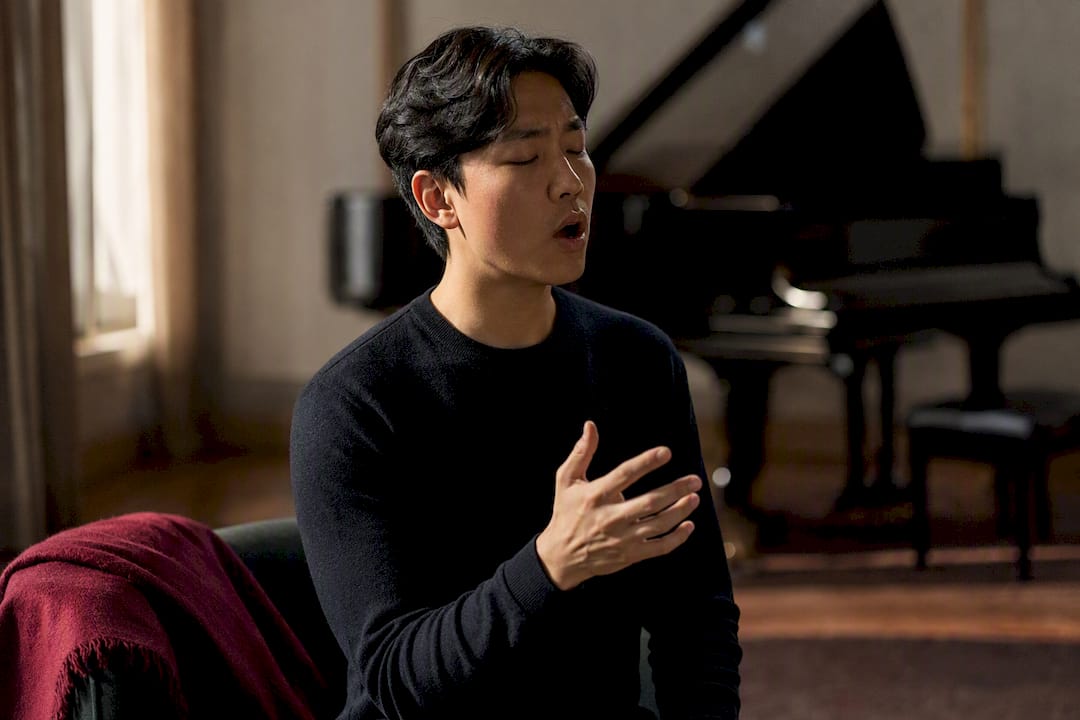
The second is a five-minute vocalisation drill: sing the melodic line, including any inner voices you can manage, with no instrument at all. Students who resist singing usually turn out to have the weakest auditory memory, and this drill exposes that within minutes rather than weeks.
Both drills are applied immediately after a new section is learned, not weeks later, which keeps memorisation running alongside learning rather than trailing behind it. For a fuller walkthrough of these drills, see how to memorise piano music without guesswork, and for how to fit this work into a weekly schedule, how to practise piano effectively covers the broader structure.
Linking memory work to emotional expression and phrasing
Memorisation and musicality aren’t separate jobs, they’re the same job done properly. A phrase memorised purely as a sequence of notes and finger positions rarely sounds expressive, because the pianist’s attention is locked on recall rather than shape.
Tie each chunk to its musical intention as you memorise it, not afterwards. When you learn a rising phrase, decide where the emotional peak sits and memorise the crescendo alongside the notes, so the two are inseparable in your mind. Analytical memory does double duty here: labelling a cadence as a moment of resolution, or a sequence as building tension, gives you a reason for the dynamic shape, not just a shape you’ve been told to add later.
Mental play is especially useful for this. When you visualise a passage away from the piano, imagine it with full dynamics and rubato, not as a flat, mechanical run-through. That way, the expressive version is what gets encoded, not a neutral placeholder you’ll have to “add feeling to” during a stressful final week of practice.
Phrasing also gives you natural landmarks for recall. A musical arc, tension rising into a climax and releasing into resolution, is easier to remember than an arbitrary run of notes, because it mirrors how memory naturally organises narrative. Students who phrase expressively from the first read-through often memorise faster than those who iron out expression to “get the notes right first,” because the shape itself becomes a memory aid.
Adapting your approach to the difficulty and style of the piece
A two-page Classical sonatina and a twenty-minute Romantic ballade don’t call for the same memorisation strategy, and treating them identically wastes practice time.
For shorter, structurally simple pieces, Classical sonatinas, early-grade Baroque dances, analytical memory does most of the heavy lifting. The forms are predictable, so once you understand the harmonic plan, the piece practically memorises itself alongside the notes.
Longer, denser Romantic or twentieth-century repertoire needs heavier reliance on chunking and landmark mapping, simply because there’s too much material to hold as one structural sweep. Break a substantial work into many sections, well above the minimum, and treat each as its own memorisation project with its own landmarks.
Polyphonic writing, Bach fugues especially, rewards a different balance again: memorise each voice separately before combining them, since auditory memory has to track multiple independent lines rather than one melody with accompaniment. Jazz and improvisatory styles shift the weight further still, toward harmonic and structural memory, chord changes and formal sections, rather than fixed note-for-note recall, since the material itself is meant to flex.
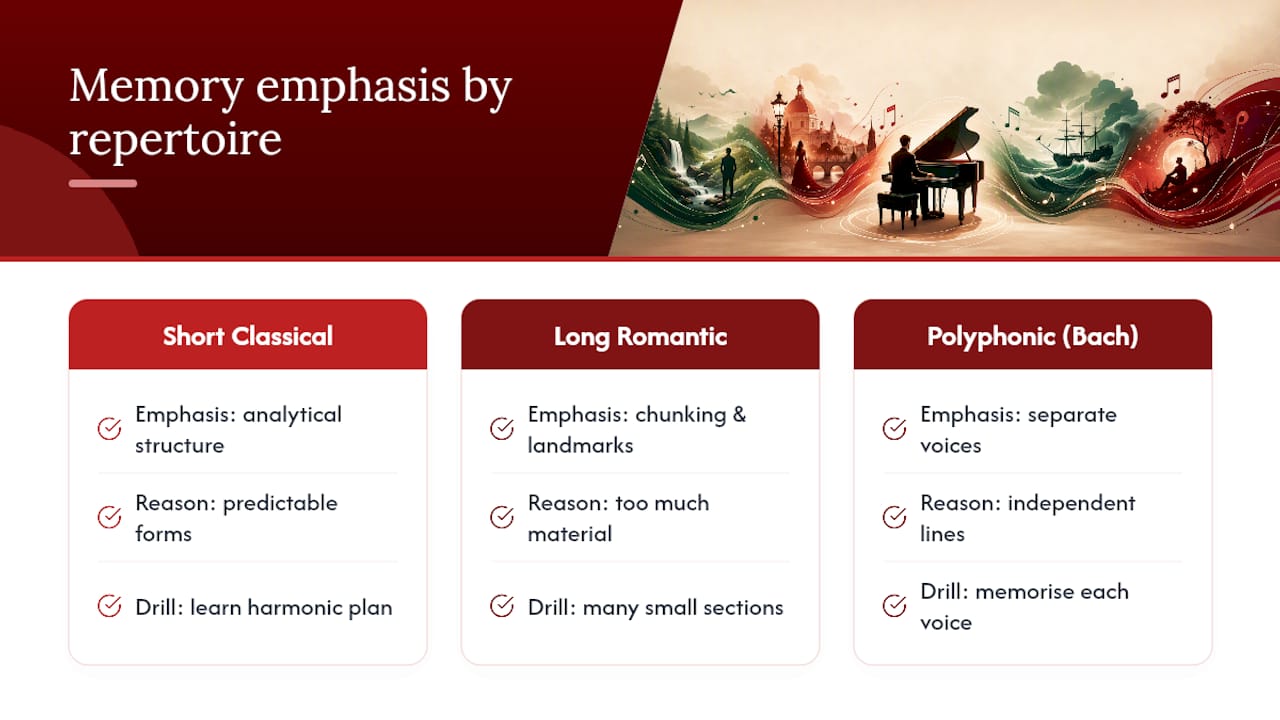
Match the drill to the repertoire rather than running one fixed routine on everything you learn.
Book time with a teacher who builds this into every lesson
Reading about chunking and mental play only gets you so far. Progress speeds up considerably once someone is watching your hands, hearing your gaps, and adjusting the drill on the spot, which is exactly what a weekly lesson does that a solo practice session can’t. Memory work can be built into every piece from the first week it’s learned, using the same four-bar recall and vocalisation drills covered above, whether preparing for an exam or working through repertoire for pleasure.
If you’re based in or near Central London, home piano lessons bring that one-to-one coaching to your own instrument, where drills can be tailored to your exact setup and schedule. For students further afield, online piano lessons cover the same ground remotely, with the same emphasis on building memory pathways rather than hoping repetition does the job. And if it’s easier to reach a music partner for stress management alongside your practice, resources like reducing stress with music pair well with the breathing ritual covered earlier.
Why memorisation deserves the same seriousness as technique
The conventional advice, learn the notes first, memorise later, gets the order backwards. Every source worth trusting on this topic agrees that memorising while you learn saves time rather than costing it, because you build the structural and auditory maps alongside the physical ones instead of retrofitting them onto finger habits that have already calcified. Delay the memory work and you’re essentially learning the piece twice.
What’s underrated is how much of memory security comes from deliberately uncomfortable practice, starting mid-phrase, playing on an unfamiliar piano, testing recall the day after you’ve barely learned something. Comfortable, linear practice from the beginning of a piece every time feels productive and isn’t. It builds one narrow pathway that collapses the moment a performance introduces any variable your rehearsal didn’t cover.
If you take one thing from this, prioritise the auditory and analytical pathways first. Most students already lean on kinesthetic memory by default, so the return on effort is highest wherever you’re currently weakest, and for most pianists, that’s hearing the piece and understanding why it moves the way it does.
— Dan
Sources
Recommended


Comments