


Match Piano Lesson Length to Age and Goals: 20–60 Minutes by Level

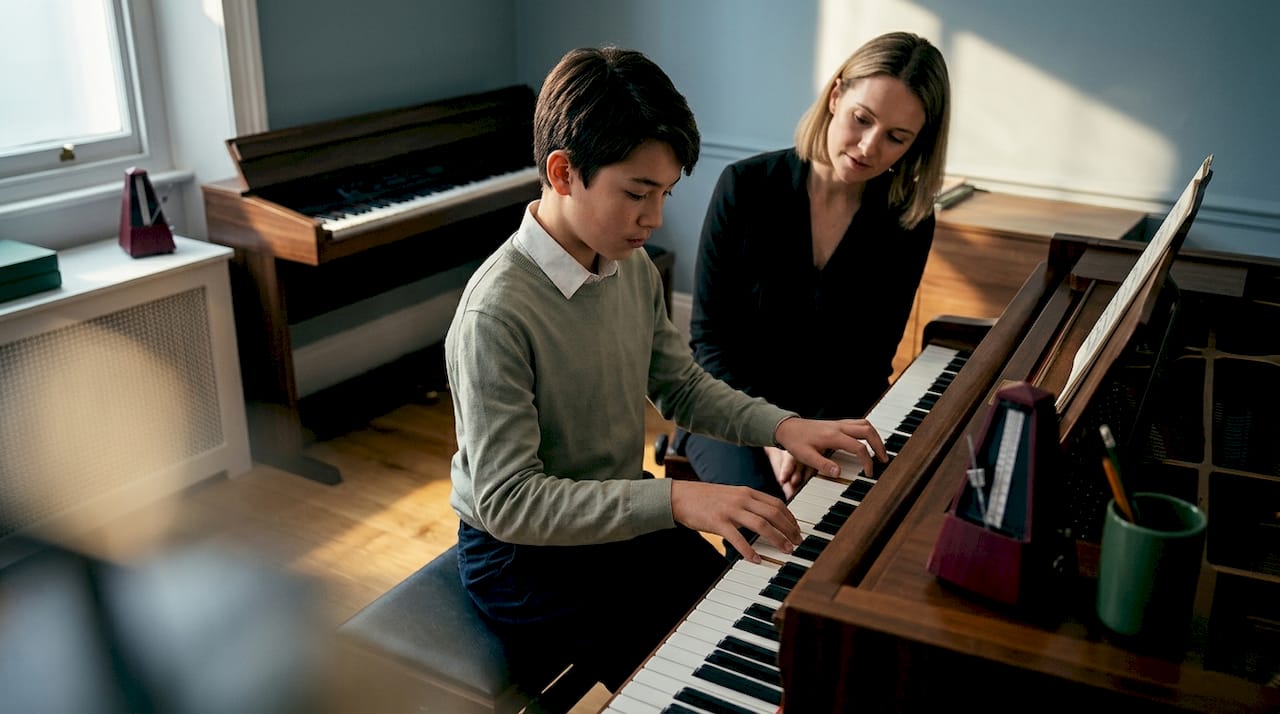
Preschoolers do best with 20–30 minutes, most primary-aged children with 30, and teens, adults and advanced students with 45–60 minutes or more. The simple rule: match minutes to attention span, weekly practice load and the specific goal (casual progress versus exam or performance work), then adjust rather than fixing the number for years.
TL;DR:
Shorter lessons are more effective for preschoolers with limited attention spans, typically lasting 20-30 minutes and focused on rhythm and finger shapes.
As students progress, lesson length should increase gradually, with primary students benefiting from 30-minute sessions and older students or exam candidates often needing 45 to 60 minutes.
Structuring lessons into focused blocks of 8 to 12 minutes each, including warm-up, new material, consolidation, and theory, optimizes attention and learning.
Increasing lesson duration is advisable when students reach repeated plateaus, can’t complete workload, or approach exams requiring extra rehearsal and technical polishing time.
Tailoring lesson length to individual attention span, learning style, and practice habits ensures more productive lessons than relying solely on age-based guidelines.
Table of Contents
Piano lesson length by age and skill level
Duration should track the pupil’s stamina and workload, not a fixed studio policy. A five-year-old and a fifteen-year-old preparing for an ABRSM Grade 5 exam need entirely different amounts of teacher time, and pretending otherwise wastes both.
Teacher guides converge on remarkably similar numbers across this range, which is worth noting given how much else about piano teaching varies by school and by teacher. The pattern below reflects the recommendations most age-by-age guides settle on.
Age or level | Recommended length | Why |
Preschool (3–5) | 20–30 minutes | Play-based tasks, short attention span, focus on rhythm and finger shapes |
Primary | 30 minutes | Steady skill building without overloading concentration |
Older primary | 30–45 minutes | More repertoire and technique to cover as reading skills mature |
Teens & adults | 45–60 minutes | Room for deeper technique, theory, and musical interpretation |
Advanced / exam candidates | 60+ minutes | Extended repertoire, technical polishing, and exam-specific coaching |
A few points behind those numbers matter more than the table itself:
Preschoolers lose focus fast. A 30-minute slot for a four-year-old often means 20 minutes of genuine learning and 10 minutes of managing wandering attention.
Primary-age children can typically sustain 30 minutes of structured work, though many benefits from stretching to 45 once reading and hand coordination click into place.
Teens and adults usually want more than they can get from 30 minutes, because there’s simply more to cover: harder repertoire, real theory, and technique that needs sustained attention to fix.
Advanced and exam-track students frequently need supplementary sessions on top of a longer weekly lesson, not instead of one.
Weekly lessons remain the standard cadence at every level. Length changes with age and ability; frequency changes mainly when exams or rapid progress are the goal, which the later sections cover in more detail.
How to structure any piano lesson length
The minutes matter less than what happens inside them. A well-segmented 30-minute lesson regularly beats a poorly organised 60-minute one, because switching between focused activities keeps a student’s attention where it needs to be rather than letting it drift halfway through.
A reliable template splits any lesson into four blocks:
Warm-up and technique (scales, arpeggios, exercises) — sets the hands up and flags any lingering problems from the week.
New material — the teacher introduces or extends a piece, working through tricky passages hands-separately if needed.
Consolidation and rehearsal — playing through repertoire already in progress, with the teacher correcting in real time.
Sight-reading or theory — a short block that builds skills the main repertoire doesn’t always touch.
Applied to real durations: a 20-minute lesson might run 5/8/5/2 minutes across those blocks; a 60-minute lesson might run 10/20/20/10. The proportions shift, but the shape stays the same.
Pro Tip: Switch activities roughly every 8 to 12 minutes, even within a single block. A ten-year-old’s concentration dips sharply after that window, and moving from scales to repertoire to a quick sight-reading challenge resets it far more effectively than pushing through one task for 20 minutes straight.
Homework should mirror the lesson: two or three specific, short tasks rather than a vague “practise this piece” instruction, and using tools to sell piano sheet music online can provide students with convenient access to supplementary materials.
When should you increase piano lesson time?
A longer lesson is warranted when the current one can no longer hold everything that needs covering, not simply because a student has been having lessons for a while. Watch for these signs:
Repeated plateaux. The same technical issue keeps resurfacing across several weeks because there’s never enough time to fix it properly.
The teacher can’t get through assigned work. If repertoire, technique, and theory are routinely rushed or skipped, the lesson is too short for the workload.
An exam or concert is approaching. Performance polishing and mock run-throughs need dedicated time beyond normal lesson content.
Repertoire complexity has jumped. Longer, harder pieces need longer sessions to rehearse properly rather than being learned in fragments.
Before adding time, ask: how many minutes is the student actually practising each week? Is a teacher recommending it, or is this parental instinct? Sometimes the fix isn’t a longer lesson at all, it’s adjusting practice habits or adding a short supplementary session instead of stretching the main one.
Lesson frequency, practice time, and ideal duration
Weekly lessons are the standard baseline for almost every student, and that’s unlikely to change regardless of how ambitious the goals are. What shifts is what happens around that weekly lesson.
Students preparing for exams or aiming for rapid progress often add a second, shorter session in the weeks that matter most, rather than doubling their main lesson length permanently. That keeps costs proportionate to actual need.
Practice time and lesson length trade off against each other in a fairly predictable way:
Low weekly practice (under 60 minutes total) tends to need longer, more teacher-guided lessons to compensate.
High weekly practice (several hours) often means a shorter lesson is genuinely sufficient, because the student arrives having already solved much of the groundwork.
Beginners should aim for 4–5 sessions of 15–20 minutes a week.
Intermediate students typically need 30–60 minutes daily to keep pace with lesson content.
Adjusting piano lesson length before exams and recitals
Exam and recital preparation is the one situation where lesson length routinely needs to flex upward, temporarily. Technical polishing, mock exam run-throughs, and performance practice all eat time that a standard weekly lesson doesn’t have spare.
In the six to twelve weeks before a graded exam, most teachers recommend one of two adjustments:
Add a short second lesson focused purely on exam pieces, scales, and sight-reading practice.
Extend the regular weekly lesson by 15 to 30 minutes to accommodate mock exam conditions.
ABRSM’s own instrument pages set out the graded repertoire and technical expectations that make this extra time necessary. Higher grades demand more from technique and musicality, and that only gets covered properly with dedicated time, not squeezed into the final five minutes of a normal lesson. Readers preparing for a specific grade may find it useful to look at how to structure exam preparation well in advance rather than cramming in the final month.
Matching lesson length to attention span and learning style
Age gives a useful starting band, but it’s a starting point, not a rule. Two eight-year-olds can have wildly different capacities for sustained focus, and forcing both into an identical 30-minute mould serves neither well.
A student who fidgets and loses concentration after 15 minutes needs a lesson built around frequent activity changes rather than a shorter overall time. A quieter, more methodical learner might comfortably sustain 45 minutes of focused work even at a younger age, provided the material stays varied enough to hold their interest.
Learning style matters just as much as attention span. Some students absorb technique fastest through repetition and drilling, which benefits from slightly longer blocks of uninterrupted practice time within the lesson. Others learn through variety and exploration, jumping between pieces, improvising, and discussing theory, which works better across several shorter segments than one long stretch on a single task.
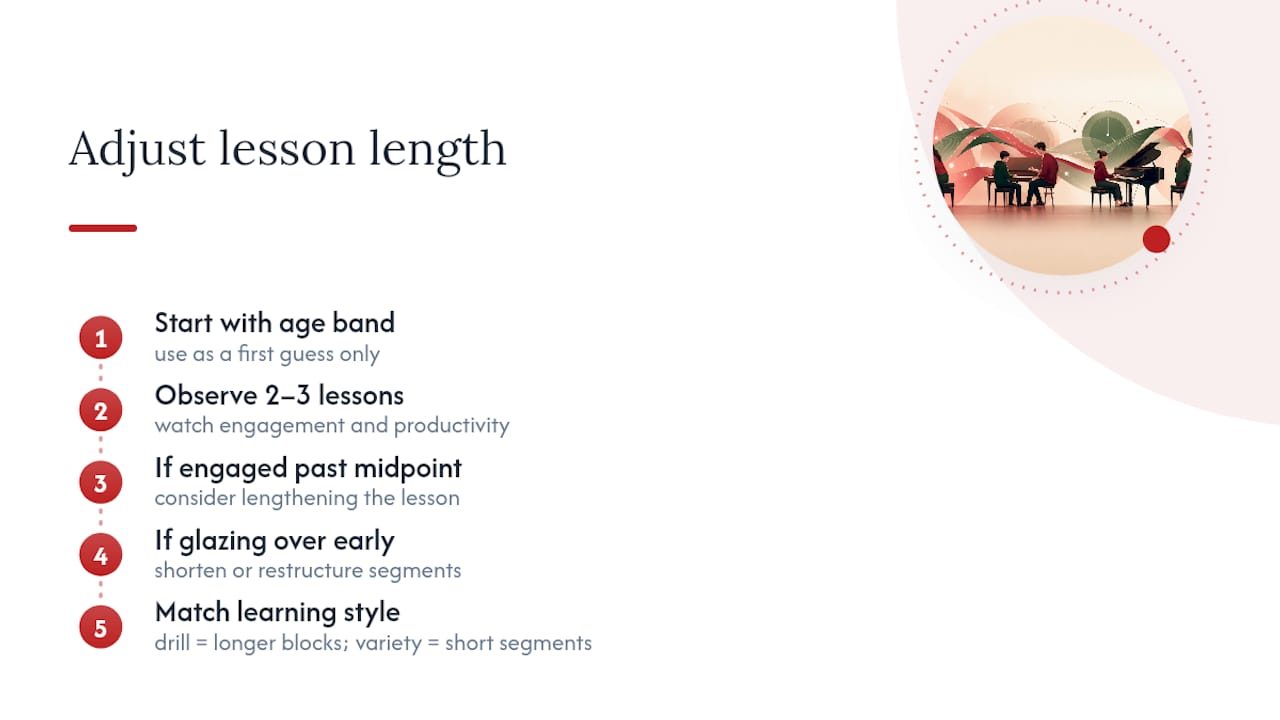
The practical approach is to treat the age-based bands as a first guess, then watch how the student actually responds over two or three lessons. If they’re still engaged and productive at the 30-minute mark, there’s a good case for lengthening. If they’re glazing over at 20 minutes, no amount of extra structure will fix a lesson that’s simply too long for that particular child on that particular day.
Shorter vs longer practice sessions and how they affect lesson length
The connection between home practice and lesson length runs in both directions, and it’s easy to get backwards. Longer lessons don’t automatically produce faster progress. A focused 30-minute lesson with sharp feedback often outperforms a 60-minute one where concentration and accuracy fade in the second half.
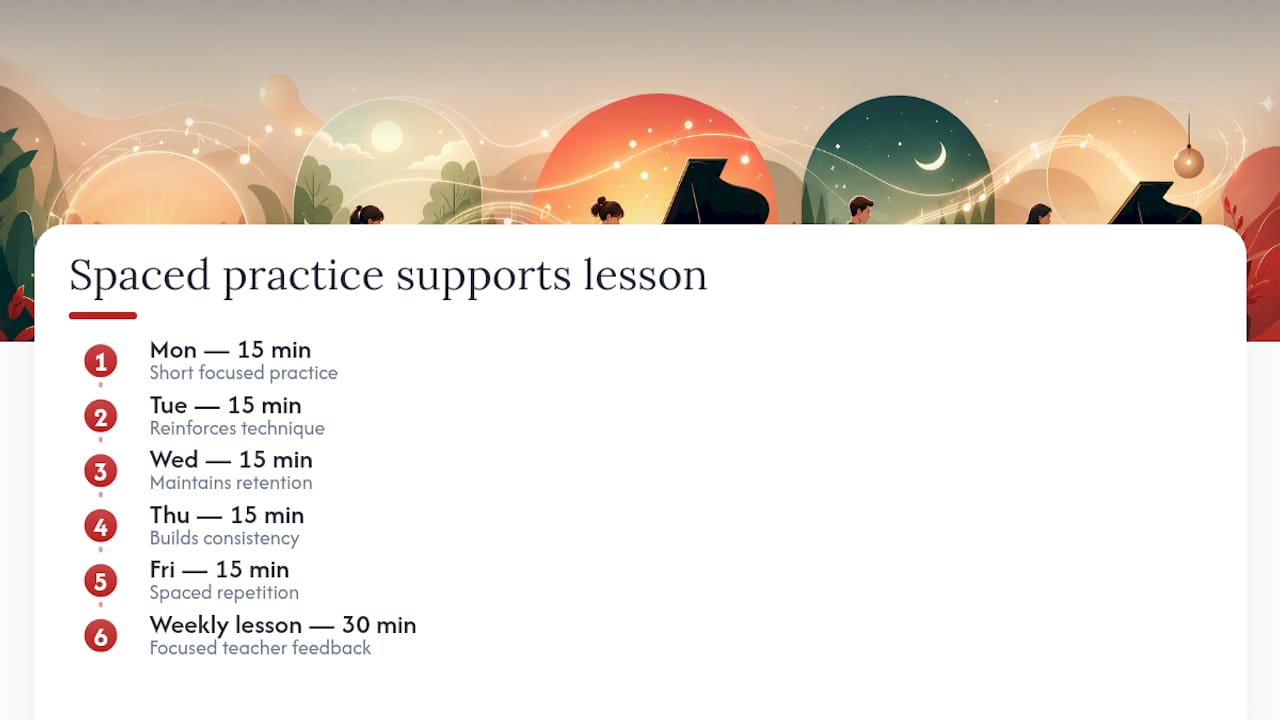
What actually drives the maths is how practice is structured outside the lesson. A student doing five short 15-minute sessions across the week arrives with fresher retention of individual skills, since spaced repetition tends to embed technique better than one long weekend session. That kind of practice pattern usually supports a standard 30-minute lesson perfectly well, because the groundwork has already been laid in smaller, digestible chunks.
Students who practise in fewer, longer blocks (say, two 45-minute sessions a week) sometimes need a longer lesson to compensate, because there’s less regular reinforcement between visits and more needs correcting in one sitting. Adult learners returning to piano after years away often fall into this pattern, fitting practice around work schedules rather than daily habit.
The practical guidance: if practice at home is frequent and short, keep the lesson at the standard band for that age or level. If home practice is infrequent or inconsistent, a longer lesson, or an added short session, gives the teacher more room to do the consolidation work that isn’t happening between visits.
Moving from beginner to intermediate to advanced lesson length
Lesson length shouldn’t jump in one leap from 30 to 60 minutes. The transition works better as a series of smaller steps tied to genuine readiness rather than time served.
Beginners typically start at 30 minutes (or 20–30 for very young children) and stay there while building foundational reading, hand position, and simple repertoire. The first sensible increase, to around 45 minutes, usually comes when a student starts tackling pieces with two independent hands doing genuinely different things, and needs more troubleshooting time per piece.
Intermediate students moving toward 60 minutes are usually the ones adding theory study, sight-reading practice, or a second style (jazz, improvisation) alongside classical repertoire. At that stage, 30 minutes stops being enough to cover everything without something getting rushed every single week.
Advanced students and those on an exam pathway are the group most likely to need 60 minutes as standard, sometimes with a supplementary shorter session layered on top during exam terms. The jump to that level should follow the checklist from earlier in this piece, not a birthday or a term start date.
Dan’s teaching perspective: how lesson length actually gets decided
In practice, the age band is where a conversation starts, not where it ends. A student’s energy in the room on day one tells you more than their date of birth. Some seven-year-olds handle 45 minutes without blinking; some teenagers need 30 minutes broken into sharper segments.
Family schedules matter too. A slightly shorter lesson that actually happens every week beats an ambitious one that gets rescheduled constantly.
— Dan
How Dan Piano Studio can help you choose the right length
There are other ways to work this out on your own, trial and error with a metronome and a lot of patience among them. But if you would rather get it right from the first lesson, Dan Piano Studio offers both formats built around exactly the flexibility this article has been arguing for.
Home lessons suit families who want the consistency of a fixed teaching space and no travel on lesson day, while online piano lessons work well for adults fitting practice around work, or families wanting flexible scheduling without sacrificing structure. Both formats adjust duration to the student in front of them rather than defaulting to a single studio-wide slot, covering a broad range of piano styles and exam preparation.
Choosing between them mostly comes down to logistics rather than teaching quality: home lessons for those who want a dedicated instrument and space, online for anyone prioritising flexibility. If you’re not sure which duration or format fits your stage, get in touch through Dan Piano Studio’s home lessons page or book a starter session to have that worked out properly in the first meeting.
Sources
Recommendations here draw on ABRSM’s piano guidance, age-based duration research from K&M Music School, and Dan Piano Studio’s own guides on choosing lesson duration and beginner lessons.
FAQ
Is 30 minutes enough for piano lessons?
For most beginners and many primary-aged children, yes, especially when paired with regular short practice at home. Once repertoire and theory work expand, 45 to 60 minutes usually becomes necessary.
How long should a piano lesson be for a 7 year old?
Around 30 minutes is the standard recommendation for most seven-year-olds, though some manage 45 if their attention span and reading skills are ahead of the typical pace for their age.
What is the 80/20 rule for piano learning?
Definitions vary across teachers, but it’s commonly used to mean most practice time going toward reinforcing and polishing existing repertoire, with the remainder spent on new material or sight-reading.
How long does it realistically take to learn piano?
There’s no fixed timeline. Progress depends heavily on lesson length, weekly practice consistency, and goals. Steady weekly lessons combined with regular short practice sessions typically produce noticeable results within several months, with genuine fluency building over years rather than weeks.
Should lesson length change when preparing for an exam?
Yes. Most students benefit from either a longer weekly lesson or an added short session in the six to twelve weeks before an ABRSM or Trinity exam, giving room for mock run-throughs and technical polishing that a standard lesson can’t fit.
Recommended


Comments