


Beat piano exam nerves with a 15–20s breathing routine and reappraisal


Piano exam nerves are normal, and the fastest way to protect your playing is a short breathing and recovery routine combined with regular simulated run-throughs in the weeks before. Nerves themselves rarely ruin a grade; losing your place and stopping does. Master one quick calming sequence, one warm-up, and a habit of playing through mistakes rather than restarting, and you have already solved most of the problem.
TL;DR:
Playing for a small audience weekly and recording practice sessions helps simulate exam pressure and build tolerance to nerves.
Practicing pieces at faster and slower tempos provides muscle memory and confidence in managing adrenaline-induced pace changes.
Never stopping after a mistake in practice trains your brain to recover quickly, which is crucial since exams do not offer second chances.
Using a structured breathing routine and brief warm-up in the final moments reduces anxiety and helps reset physical tension before performance.
Reflecting on what went well and how nerves manifested after the exam supports targeted preparation and confidence for future performances.
Table of Contents
Rehearsal tips that actually reduce piano exam nerves
Nerves feed on unfamiliarity. The single biggest shift you can make in the weeks before an exam is turning your practice room into a rehearsal space for pressure, not just notes.
Play for one or two listeners at least once a week. A parent, sibling, or friend sitting quietly nearby raises your pulse just enough to mimic the exam room, and that mild discomfort is exactly what builds tolerance. Recording yourself does something similar. Knowing a microphone is running changes how you play, and treating that recording as a low-stakes pressure test means the real exam feels like something you have already survived several times over, a point Pianist magazine makes when discussing rehearsal strategy.
Two-tempo practice is worth building into every piece. Play a passage slightly faster than performance speed, then slightly slower. This gives you what some teachers call “room up” and “room down”: when adrenaline speeds your internal clock on the day, you already know how the piece feels at that pace and can pull it back, an idea explored by Piano Fantasy.
The habit that changes everything, though, is refusing to restart after a slip in practice. Stopping and going back trains your brain to expect a second chance. Exams don’t offer one.
Play for a small audience weekly, even if it’s just one person in the room
Record sessions regularly and listen back without judging too harshly
Practise each piece at a faster and a slower tempo than your target
Never restart after a mistake in practice; keep going, always
Rotate practice locations or instruments when possible, so the exam room feels less foreign
Pro Tip: Book one lesson a month as a mock exam. Play the full programme start to finish with no stopping, exactly as you would on the day, and treat any wobble as data rather than disaster.
Your final week: a piano exam preparation checklist
The final week is about maintenance, not cramming. Trying to fix technical problems five days out usually backfires and adds nerves rather than removing them.
Keep sessions short and targeted. Spend 20 to 30 minutes on weak bars rather than replaying entire pieces top to tail.
Limit full run-throughs. Play the complete programme no more than once or twice in the final week, and never the night before. Overplaying on exam morning leads to fatigue and shaky fingers, something Pianist magazine’s tips on overcoming nerves flags directly.
Pack the night before. Music (unmarked copy for the examiner), a pencil, your ID, a water bottle, and your travel plan should all be sorted so exam morning has one less decision to make.
Protect your sleep. Go to bed at your usual time and keep your normal caffeine routine. Changing habits on exam day, cutting caffeine, sleeping in, skipping breakfast, adds a variable you don’t need.
A structured, low-drama final week does more for your nerves than any single relaxation trick. Our piano exam preparation checklist covers the same ground in more detail if you want a printable version.
Warm-ups and routines for exam morning
Trembling hands and a dry mouth on exam morning aren’t a sign you’re unprepared; they’re just adrenaline with nowhere to go yet. A short, deliberate routine redirects it.
Start with breathing: inhale for four counts, hold for four, exhale for six, repeated for 15 to 20 seconds, a simple anxiety-reduction technique explained in detail in how books address separation anxiety in kids. This slows your heart rate and releases the shoulder tension that makes hands feel stiff, a technique Herman Piano Studio recommends for exactly this reason.
Warm up your fingers briefly rather than running your whole programme. A few scales, some arpeggios, and one pass through your trickiest two bars are enough. If you have access to a private space, humming or singing quietly for a minute can also help settle your nervous system before you sit down.
Breathe for 15 to 20 seconds using the four count in, hold, six count out pattern
Warm up fingers with scales and one problem passage, not the full programme
Hum or sing quietly in private if you have the space
Time your last coffee for at least an hour before your slot, since caffeine sharpens jitters as much as focus
Pro Tip: In the waiting room, run through your opening bars in your head rather than on an imaginary keyboard on your knee. Mental rehearsal calms the body without the visible fidgeting.
Our five minute piano warm up works well as a repeatable exam-morning routine you can practise using long before the exam itself.
Recovering from mistakes without losing the music
The moment that decides most exam results isn’t the slip. It’s what you do in the half second after it.
Keep the pulse going in your head, even if your fingers fumble. A one-word mental cue such as “beat” or “pulse” is often enough to pull you back in without breaking the phrase entirely. If a passage is falling apart, simplify it on the spot rather than stopping, drop an inner voice, thin a chord, skip an ornament, and rejoin the main line as soon as you can.
This is where two-tempo practice pays off again. Rehearsing slightly slower than performance speed gives you a tempo to fall back to when adrenaline tries to rush you forward, rather than careering into a passage you haven’t secured.
Use a one-word mental cue to rejoin the beat after a slip
Simplify texture rather than stopping when a passage goes wrong
Fall back to your slower rehearsed tempo if you feel yourself rushing
Try a short mantra such as “keep the pulse” before a tricky section
ABRSM’s own guidance on nerves is unambiguous on this point: examiners are marking musical communication and your ability to recover, not scanning for a flawless take. A confident recovery from a wrong note often scores better than a tense, over-careful performance with no mistakes at all.
The psychology trick that turns nerves into fuel
A racing heart and a fluttering stomach before an exam are not signs something is wrong. They’re your body preparing you to perform, and how you interpret that feeling changes what it does to your playing.
Reappraisal is the term performance psychologists use for relabelling that arousal as excitement or usable energy rather than threat. Research on the Goodman method published in Frontiers in Psychology found that performers who consciously reframe anxiety this way shift from avoiding the situation to engaging with it, which tends to improve how expressively they actually play.
In practice: try saying, silently, “I’m excited to play this” instead of “I’m nervous.” It sounds small. It changes how your body reads the same physical signal.
If nerves are consistently overwhelming rather than manageable, that’s different from ordinary exam jitters. A qualitative study on music performance anxiety in student pianists found the condition affects students more heavily than professionals and involves overlapping psychological and environmental factors, which is worth raising with a teacher or, where anxiety is severe, a GP.
How mock exams and targeted coaching help
Simulated performance practice under a teacher’s eye does what solo rehearsal can’t: it applies real, mild social pressure repeatedly, in a setting where mistakes are safe to make. At Dan Piano Studio, mock exams, focused recovery drills, and spot-practice sessions on weak passages are built into exam preparation, alongside our ABRSM exam preparation guidance for students working towards graded assessments.
Nutrition and hydration before your piano exam
What you eat and drink on exam day affects concentration and hand steadiness more than most students expect.
Eat a normal meal two to three hours before your slot, something familiar rather than experimental. A heavy, unfamiliar lunch can leave you sluggish; skipping food entirely tends to produce shaky hands and poor concentration, which is the last thing you want mid-scale passage.
Water matters more than most students realise. Dehydration contributes to the dry mouth and mental fog that many mistake for pure nerves. Sip water steadily through the morning rather than downing a large glass right before you play, which can leave you needing the bathroom at the worst possible moment.
Caffeine deserves care. A normal cup of tea or coffee at your usual time is fine, since disrupting your routine adds a new variable your body has to process. But an extra large coffee “for focus” before an exam usually backfires, sharpening jitters rather than concentration. If you don’t normally drink caffeine, exam morning is not the day to start.
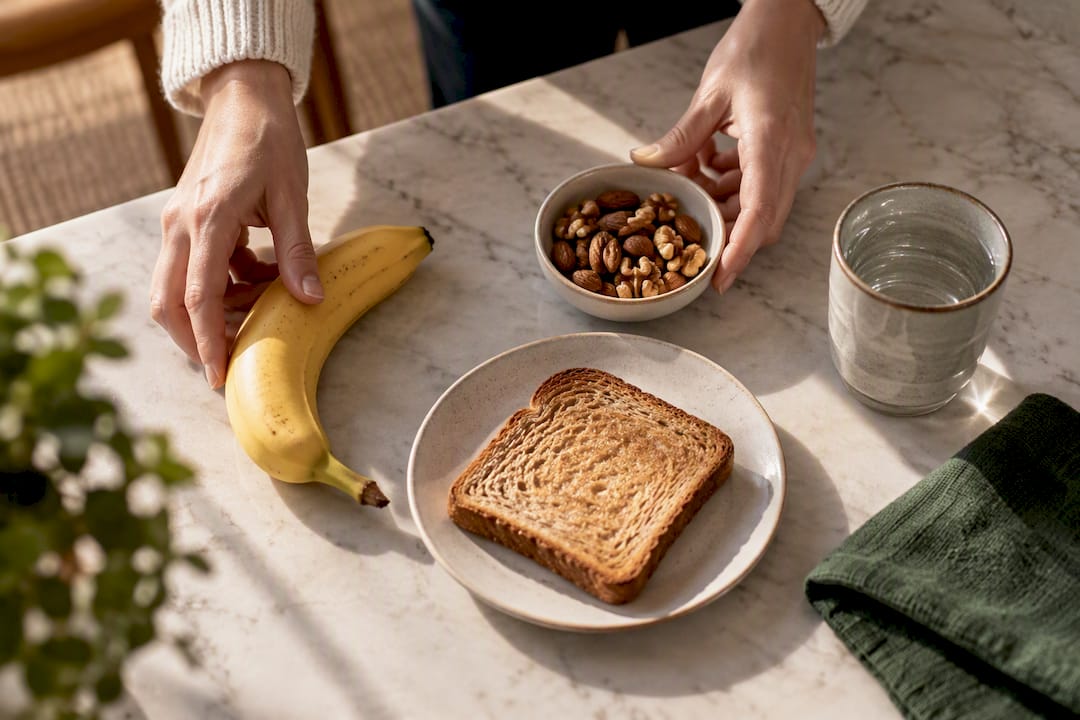
Sugary snacks just before playing can cause a brief spike followed by a dip in energy and focus, right in the middle of your slot. A banana, some nuts, or plain toast beforehand sits far better than sweets or a fizzy drink.
After the exam: what to do with the experience
The habit that separates students who get calmer each year from those who stay anxious is simple: they reflect properly on what just happened.
Write down what actually went well within a day of the exam, while it’s fresh. Most students remember only the slip in bar 34 and forget that the slow movement was genuinely musical. Balancing the memory matters for confidence next time.
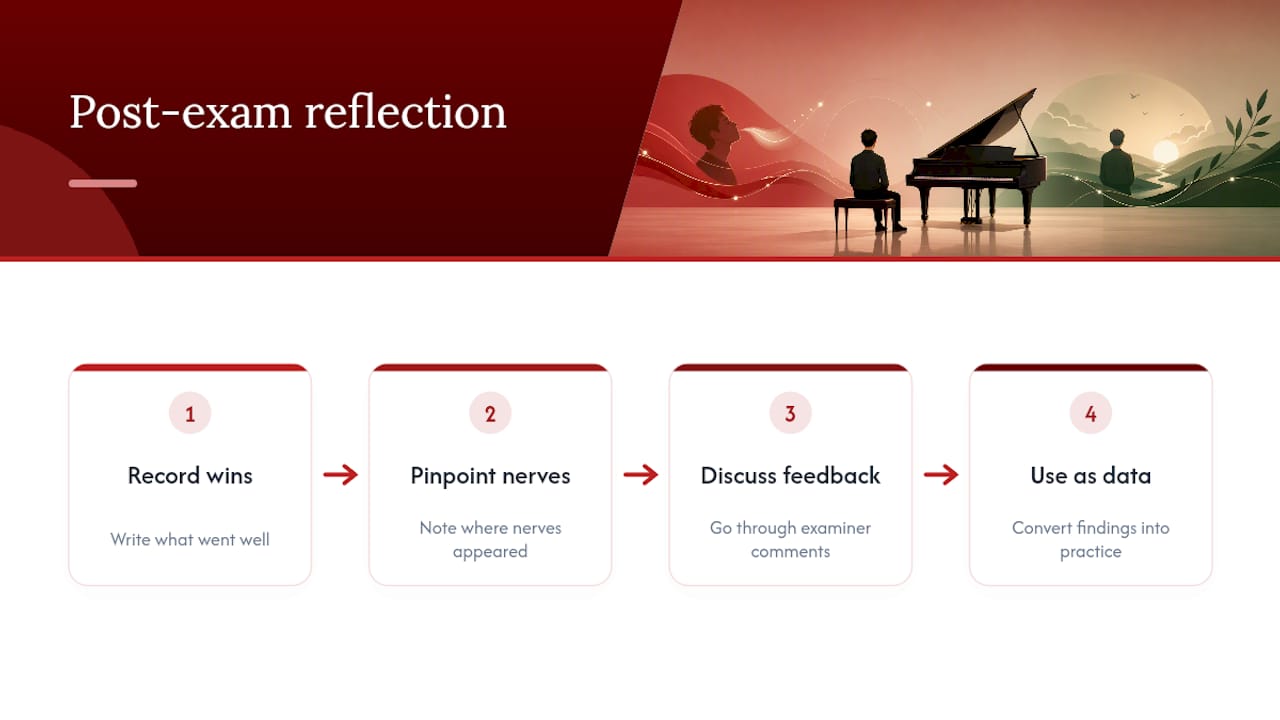
Note where nerves showed up specifically. Was it your hands, your breathing, a rushed tempo in the first line? Naming the pattern means your next preparation cycle can target it directly rather than treating “nerves” as one vague, unbeatable problem.
If you can, ask your teacher to talk through the report once it arrives, focusing on what the examiner’s comments reveal about your communication and recovery, not just the mark. That written feedback is often more useful for the next exam than the grade itself.
Treat each exam as rehearsal for the next one. The students who improve fastest are the ones who use every performance, exam included, as data for the next round of practice.
What I’ve noticed in students who stop dreading exam day
The students who go from dreading the exam room to walking in steady are almost always the ones who played through mistakes in mock sessions rather than avoiding them. Confidence doesn’t come from perfect run-throughs. It comes from proving to yourself, repeatedly, that you can recover.
— Dan
Book exam-focused lessons that build real confidence
High-quality piano lessons often include simulated performance practice, targeted recovery drills, and mock exam sessions with a professional pianist observing how you cope under pressure, not just how cleanly you play at home. Comprehensive exam preparation covers repertoire, sight reading, and the psychological side together, whether you learn in person or online.
If you’re weeks out from an exam and want to test your nerves in a low-stakes setting first, a trial lesson is the simplest way to start, priced from £55 an hour for a studio or online session. For a fuller look at how lessons are structured around exam preparation, jazz, improvisation, and theory, the piano lessons page covers every format on offer. Book your slot now and put a mock exam on the calendar before the real one arrives.
Sources
FAQ
What is the 80/20 rule in piano practice?
It’s a way of stopping students from endlessly polishing the sections they enjoy while ignoring the two bars that actually cause exam nerves.
What is the fail rate for ABRSM exams?
ABRSM does not publish a single universal fail rate, since pass rates vary by grade and instrument. What examiners consistently emphasise is that musical communication and recovery from small slips matter more than flawless accuracy, according to ABRSM’s own guidance.
How can I calm my nerves during a piano exam?
Use a short breathing sequence, four counts in, four counts held, six counts out, for 15 to 20 seconds before you begin. If nerves rise mid-piece, focus on a one-word mental cue like “pulse” to keep the beat moving rather than freezing or restarting.
How do I get rid of nervousness on stage?
Regular exposure through mock exams, recordings, and small audiences is the most reliable long-term fix, since it removes the novelty that fuels most stage fright. Reframing your racing heart as excitement rather than danger, a technique known as reappraisal, also helps performers engage rather than avoid in the moment.
Can lessons specifically help with exam nerves?
Yes. Mock exams and simulated performance practice, where you play full programmes under mild pressure in front of a teacher, train the recovery skills that matter most on the day. Dan Piano Studio builds this directly into ABRSM and Trinity exam preparation.
Recommended


Comments