


Piano duets for beginners: 12 picks to play right now


The single best way to start playing duets is to choose a familiar tune with a clear melody in the primo part and a steady, repetitive accompaniment in the secondo. Four quick picks to get you going: Heart and Soul, Twinkle Twinkle Little Star, Somewhere Over the Rainbow, and Silent Night. All four are available from UK sellers including Musicroom and Hal Leonard, and several have free public-domain editions online.
Quick picks at a glance:
Heart and Soul — the classic two-hand split; primo plays the melody, secondo holds the boogie bass
Twinkle Twinkle Little Star — absolute beginner, works brilliantly as a teacher-and-pupil opener
Somewhere Over the Rainbow — slightly more lyrical; good for a child-and-adult pairing
Silent Night — gentle 3/4 feel, ideal for a first recital or Christmas concert
The full annotated list below covers all 12 pieces with difficulty labels, pairing suggestions, sheet-music sources, and one-line practice tips for each.
Table of Contents
12 easy piano duets for beginners: annotated repertoire with UK sourcing
These twelve pieces cover the full range of beginner needs, from absolute first-lesson starters to early Grade 1 pieces that feel genuinely impressive in performance. Each entry notes the difficulty, best pairing, arrangement type, where to get the music in the UK, and one practical tip.

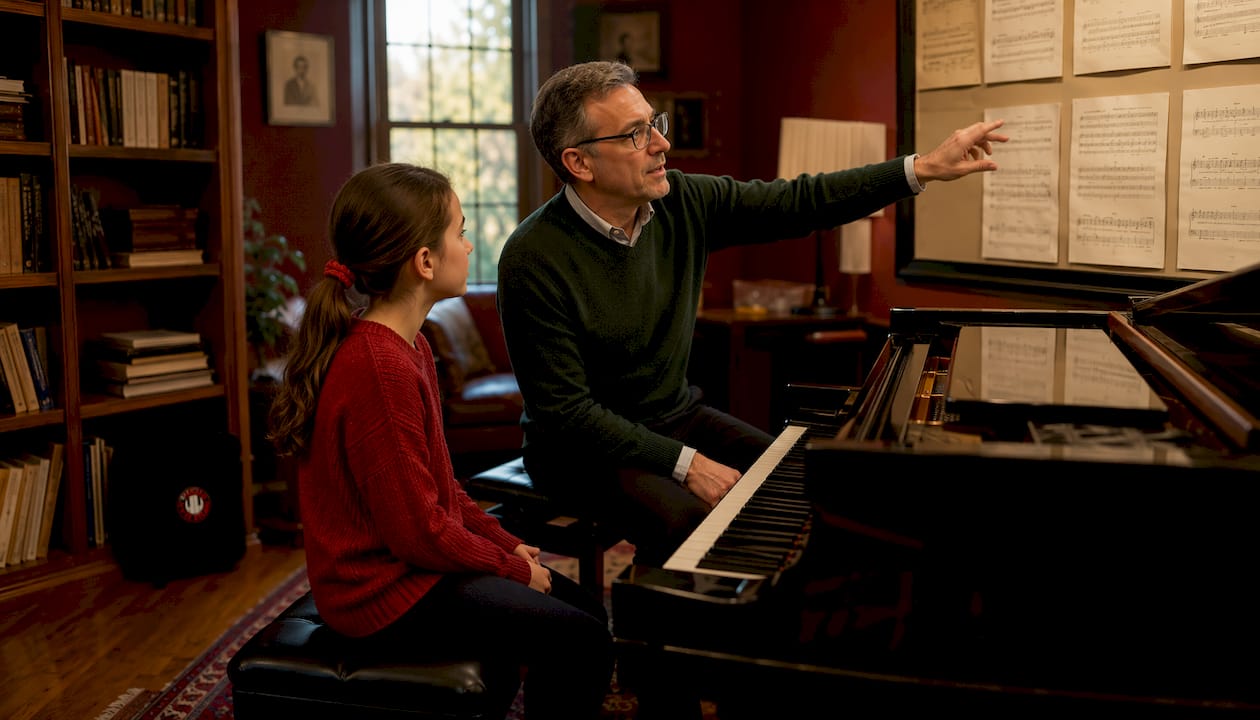
1. Heart and Soul (Hoagy Carmichael)
Difficulty: Absolute beginner | Best for: Two beginners or teacher + pupil | Arrangement: 1 piano, 4 hands
The most-played beginner duet in the world for good reason. Secondo holds a four-chord repeating bass pattern that even a first-week student can manage, while primo carries the melody. Available as a paid arrangement from Musicroom or Sheet Music Direct; free simplified versions circulate widely online. Search YouTube for “Heart and Soul piano duet” to hear dozens of demos.
Practice tip: Teach secondo by rote first so the bass pattern is automatic before adding primo.
2. Twinkle Twinkle Little Star
Difficulty: Absolute beginner | Best for: Child + adult or teacher + pupil | Arrangement: 1 piano, 4 hands
The go-to opener for a first duet lesson. Primo plays the melody in a middle-C position; secondo provides a simple harmonic accompaniment an octave lower. Hal Leonard’s Teaching Little Fingers to Play Easy Duets includes an arrangement pitched at early elementary level. Free public-domain editions are widely available as printable PDFs.
Practice tip: Clap the rhythm together before touching the keys — it sets a shared pulse from the start.
3. Somewhere Over the Rainbow (Harold Arlen)
Difficulty: Early beginner | Best for: Child + adult or two beginners at similar level | Arrangement: 1 piano, 4 hands (simplified)
The wide melodic leaps in the original make this a touch more demanding than Twinkle, but simplified arrangements smooth those out completely. Paid editions from Hal Leonard and Faber are available through Musicroom UK. Search for “Somewhere Over the Rainbow easy piano duet” on YouTube for a clear demo of how the simplified version sounds.
Practice tip: Practise the opening leap in primo hands-separately before combining; it is the one moment that catches beginners off guard.
4. Silent Night (Franz Xaver Gruber)
Difficulty: Absolute beginner | Best for: Teacher + pupil or child + adult | Arrangement: 1 piano, 4 hands
The gentle 3/4 metre makes Silent Night one of the most natural-feeling duets for beginners. The waltz pulse is easy to internalise, and the melody sits comfortably in a five-finger position. The original is public domain, so free printable editions are plentiful. Faber also publishes a graded Christmas duet collection available from Musicroom.
Practice tip: Count aloud “one-two-three” together for the first few run-throughs; the waltz feel clicks quickly once both players feel the downbeat.
5. City of Stars (Justin Hurwitz, from La La Land)
Difficulty: Early Grade 1 | Best for: Older beginner + teacher or two motivated beginners | Arrangement: 1 piano, 4 hands (simplified arrangement)
Modern pop arrangements of City of Stars have made it one of the most-requested pieces in beginner studios. The melody is immediately recognisable, which keeps motivation high. Paid simplified arrangements are available from Sheet Music Direct and Musicroom. Check the publisher’s audio preview before buying to confirm the arrangement matches your student’s level.
Practice tip: The tempo should feel unhurried; resist the urge to rush the sustained notes in the melody.
6. Bouncin’ Boogie
Difficulty: Early beginner | Best for: Two beginners or child + adult | Arrangement: 1 piano, 4 hands
A rhythmically lively piece that teaches swing feel without requiring any jazz theory. The boogie-woogie bass pattern in secondo is repetitive enough for a beginner to lock in quickly, and the bouncy primo melody is genuinely fun to play. Available in several beginner duet collections from Alfred Music, accessible through UK retailers.
Practice tip: Exaggerate the bounce in the wrist from the start; a flat touch kills the groove entirely.
7. Turkish March (Wolfgang Amadeus Mozart, arr.)
Difficulty: Early Grade 1 | Best for: Teacher + pupil or two intermediate beginners | Arrangement: 1 piano, 4 hands (simplified)
The original Rondo alla Turca is Grade 5 territory, but simplified duet arrangements bring it within reach of early beginners. Secondo typically holds a steady march-like bass while primo handles the famous theme. Faber and Hal Leonard both publish accessible versions; Musicroom stocks both. Countless YouTube demos exist for reference.
Practice tip: Keep the march pulse absolutely steady in secondo — any rushing makes the famous theme in primo sound chaotic.
8. Bohemian Rhapsody (Queen, arr.)
Difficulty: Early Grade 1 | Best for: Older beginner + teacher or motivated teen beginners | Arrangement: 1 piano, 4 hands (simplified)
Easy arrangements of Bohemian Rhapsody strip the piece back to its most recognisable sections and spread the texture across both players. The result feels impressive well beyond its actual difficulty. Paid arrangements are available from Musicroom and Sheet Music Direct; always check the difficulty rating on the product page before purchasing, as editions vary considerably.
Practice tip: Learn the opening ballad section first and treat the rock section as a second stage — they are almost two separate pieces in terms of feel.
9. Ode to Joy (Ludwig van Beethoven)
Difficulty: Absolute beginner | Best for: Teacher + pupil or two absolute beginners | Arrangement: 1 piano, 4 hands
Public domain and universally known, Ode to Joy is the safest possible first classical duet. The melody moves almost entirely by step, which makes it ideal for a student who is still building confidence with reading. Free editions are available from IMSLP and numerous printable-PDF sites. Hal Leonard also publishes it in beginner duet collections.
Practice tip: Use it as a sight-reading exercise: both players read their parts cold, then refine together.
10. Can Can (Jacques Offenbach)
Difficulty: Early beginner | Best for: Two beginners or child + adult | Arrangement: 1 piano, 4 hands
The Can Can’s driving rhythm is its own built-in metronome, which makes it unusually forgiving for beginners who struggle to keep time independently. Simplified duet arrangements are available from Alfred Music and Hal Leonard via Musicroom. The piece also works well as a recital showpiece because the audience always recognises it.
Practice tip: Start at half the intended tempo and only increase speed once both parts are completely secure.
11. Für Elise (Ludwig van Beethoven, arr.)
Difficulty: Early Grade 1 | Best for: Teacher + pupil | Arrangement: 1 piano, 4 hands (simplified)
The opening motif of Für Elise is one of the most recognisable in all of piano music, which means students feel an immediate sense of achievement. Simplified duet arrangements give the famous right-hand motif to primo while secondo provides harmonic support. Available from Faber and Hal Leonard via Musicroom.
Practice tip: The repeating motif in primo can become mechanical; encourage the student to shape each phrase slightly differently.
12. Jingle Bells (James Lord Pierpont)
Difficulty: Absolute beginner | Best for: Child + adult or two absolute beginners | Arrangement: 1 piano, 4 hands
A reliable crowd-pleaser and a natural choice for a first recital or Christmas concert. The melody is so familiar that students rarely need to count; the challenge is keeping secondo steady underneath. Public domain, so free printable editions are everywhere. Hal Leonard’s beginner duet collections include several arrangements at different levels.
Practice tip: Assign secondo to the stronger player initially; the steady bass is deceptively easy to rush.
How to pick the right duet for your student or duo
Match the melody complexity and rhythmic steadiness to the weaker player, not the stronger one. A duet that stretches the less experienced player too far will stall both of them. Familiar tunes are almost always the right starting point because recognition replaces some of the cognitive load of reading.
Melodic clarity matters more than harmonic interest at the beginner stage. If the primo melody moves mostly by step and sits within a five-finger position, a beginner can focus on tone and timing rather than navigation. Pieces that jump around the keyboard — even in simplified arrangements — are better saved for early Grade 1 and beyond.
Hand independence is the hidden difficulty factor. Some secondo parts look simple on the page but require the left hand to hold a bass note while the right plays an inner voice. Check both staves before assigning a piece. Arrangements that keep secondo in a single-hand position, or that use middle-C centred layouts with primo an octave higher and secondo an octave lower, tend to work best for genuine beginners.
Length and performance suitability are worth considering early. A 32-bar piece that takes three weeks to polish is far more satisfying than a 64-bar piece that never quite gets finished. For a first recital, aim for something under two minutes that both players can perform from memory or near-memory.
Primo vs secondo: who plays what?
The general rule is to give the melody (primo) to the student and the accompaniment (secondo) to the teacher or stronger player. This lets the beginner feel like the star while the more experienced player holds the harmonic and rhythmic framework together. Once the piece is secure, swap parts: playing secondo teaches a student to listen and support rather than lead, which is one of the most valuable ensemble skills there is.
For two beginners at similar levels, assign secondo to the student with slightly stronger rhythmic instincts. A steady bass is harder to maintain under pressure than it looks.
A step-by-step rehearsal plan and teacher tips for beginner duets
The single most effective rehearsal principle is chunk, separate, combine. Break the piece into four-bar or eight-bar sections, practise each part hands-separately at a slow tempo, then combine at a tempo where both players can count aloud. Only increase speed once the slow version is clean.
Practice checklist
Chunk the piece into manageable sections (4–8 bars maximum for absolute beginners).
Hands separately for each player before any attempt at combining.
Set a slow tempo with a metronome; 60–70% of the target speed is a good starting point.
Count aloud together, especially through rests — rests are where beginners lose each other.
Agree on cues: who counts in, who gives the tempo, and how to restart after a mistake.
Balance check: secondo should generally play softer than primo so the melody sings through.
Pedalling: handled by the teacher or the more experienced player until the student is ready.
Sample 4-week micro-plan
Week | Goal | Practice target |
1 | Learn parts separately by section | 10 minutes per day, hands separately |
2 | Combine sections at slow tempo | metronome at reduced speed |
3 | Run full piece, address weak spots | focus on joins between sections |
4 | Performance tempo, recital run-through | 20 minutes, including a full play-through with no stops |
Pro Tip: Use rote or finger-number learning for the very first duet a student encounters. Early duet teaching works best when students experience ensemble playing before full sight-reading is required — the cognitive load of reading and listening simultaneously is simply too high at the absolute beginner stage.
Teacher tips for the studio
Keep a duet book on the shelf. A studio duet library gives you a ready reset when a student is stuck, bored, or needs a confidence boost mid-lesson. Hal Leonard’s Teaching Little Fingers to Play Easy Duets is a practical starting point.
Pair strategically. A stronger student paired with a weaker one often benefits both: the stronger student learns to listen and adapt; the weaker one is pulled forward by a steadier partner.
Use a simple sight-reading warmup. Before tackling the duet, spend two or three minutes reading a short, unfamiliar piece together. It sharpens the listening and reading skills that duet playing demands. A set of beginner piano exercises works well as a warm-up frame.
Low-stakes performance preparation
For a first recital duet, keep the staging simple: both players bow together, sit comfortably with enough bench space, and agree in advance who counts in. Practise the count-in at home so it feels natural. The shared focus of a duet means individual nerves are distributed between two people, which makes the first performance experience far less daunting than a solo.
Where to get duet sheet music in the UK (free and paid)
UK readers have solid options across every price point. The key is matching the source to the piece: public-domain classics can be printed free; modern pop arrangements always require a licensed purchase.
Free public-domain sources:
IMSLP (Petrucci Music Library) — the largest free sheet-music archive online; covers all public-domain duet repertoire including Mozart, Beethoven, and Schubert. Print quality varies by edition.
Mutopia Project — free, typeset public-domain scores; smaller catalogue than IMSLP but consistently clean engraving.
Free piano sheet music resources — partner resources such as free piano PDFs can supplement what IMSLP offers for beginner-level pieces.
Paid publisher editions (UK-accessible):
Musicroom / Sheet Music Direct — the largest UK-facing sheet-music retailer; stocks Faber, Hal Leonard, Alfred Music, and more. Digital PDFs available instantly; physical copies posted within the UK.
Faber Music — strong beginner and graded duet catalogue; editions are well-engraved and graded clearly for ABRSM alignment.
Hal Leonard — extensive beginner duet collections including Teaching Little Fingers to Play Easy Duets and Very Beginning Duets (Pace Piano Education series). Available via Musicroom.
Lesson arrangements:
Platforms such as Sheet Music Plus carry lesson-specific arrangements written for equal-level beginners, often in C major with both parts in middle-C position. These are particularly useful when neither player is significantly more advanced.
Comparison: sheet-music source types
Source type | Cost | Engraving quality | Audio preview | Beginner suitability |
Free public-domain PDF | Free | Variable | Rarely included | Good for classical pieces; check edition carefully |
Paid publisher edition | £3–£12 per piece | High, graded clearly | Often available | Excellent; graded and teacher-tested |
Lesson arrangement | £5–£10 per piece | Good | Sometimes included | Very good; written specifically for beginners |
Always obtain an authorised copy for modern pop arrangements — pieces by living composers or those published after 1928 are under copyright, and free versions circulating online are almost always unlicensed.
Why duet playing genuinely helps beginners: the evidence
Ensemble playing accelerates rhythmic control, sight-reading, and active listening in ways that solo practice simply cannot replicate. The core reason is structural: when you play with a partner, you cannot stop and restart without affecting someone else, so you learn to read ahead, maintain pulse, and listen simultaneously.
Key findings from the research:
Duet playing improves rhythmic stability and cooperative musicianship; academic review concludes it should be a regular part of lessons, not an occasional add-on.
Sight-reading gains are rapid when duets are used consistently, because students must read ahead to stay with a partner.
Shared performance reduces individual pressure, helping nervous students build confidence in a low-stakes environment.
Teacher modelling during duet playing allows demonstration of tone and phrasing in real time without stopping the student — a significant pedagogical advantage over verbal instruction alone.
Duets shift students from practising in isolation to making music with a partner, which combats practice burnout and sustains motivation across the long beginner plateau.
Partner lessons using a 20-20-20 structure — 20 minutes individual work, 20 minutes duet, 20 minutes shared theory or rhythm — balance technical growth with ensemble skills effectively.
At Danpianostudio, duets are built into lessons from the earliest stage. The teacher takes the secondo part, which means the student always has a musical partner holding the harmonic framework while they find their feet with the melody. As students progress, parts are swapped and peer pairings introduced.
This approach aligns with what the research describes: modelling during duet playing is one of the most efficient forms of musical instruction available to a piano teacher.
Key takeaways
The most effective approach to beginner piano duets is to start with a familiar tune in a four-hand arrangement, assign the melody to the student, and use chunked slow-tempo practice before combining parts.
Point | Details |
Start with familiar tunes | Recognition reduces cognitive load; Heart and Soul, Twinkle, and Silent Night are proven openers. |
Match difficulty to the weaker player | A duet that stretches the less experienced player too far stalls both; always grade down, not up. |
Chunk and practise separately | Learn each part in 4–8 bar sections, hands separately, before combining at a slow metronome tempo. |
Use duets for low-stakes performance | Shared focus distributes nerves; a duet recital is a gentler first performance than a solo. |
Danpianostudio builds duets into lessons | From the first lesson, the teacher plays secondo so students experience ensemble music immediately. |
A teacher’s note on duets
Duets are the single most underused tool in beginner piano teaching. The moment a student plays with another person, something shifts: they listen differently, they count more carefully, and they care about the result in a way that solo practice rarely produces. At Danpianostudio, the teacher-student duet is a standard part of lessons from week one, not a special occasion. The improvement in rhythmic steadiness and musical confidence that follows is consistent and fast. If you are a teacher looking to introduce duets, or a beginner who wants to try playing with a partner, a trial lesson is the simplest way to see what a structured duet approach actually feels like in practice.
Duet-focused piano lessons in London and online
Danpianostudio offers duet-focused beginner lessons both in-studio in Central London (Camden, King’s Cross) and online, making it straightforward to work on ensemble playing regardless of where you are. From the very first session, the teacher plays alongside the student in a four-hand arrangement, which means you hear what the finished piece should sound like while you are still learning your part. Lessons suit children learning alongside a parent, adult beginners, and teacher-student pairings at any level. If you are outside London, the online lesson format works well for duet coaching with screen-sharing and real-time feedback. For families who prefer lessons at home, home visit lessons are available across London. Get in touch to book a first duet lesson and find out which pieces suit your current level.
Useful sources and UK links
Hal Leonard — Teaching Little Fingers to Play Easy Duets — ten familiar children’s songs arranged as early elementary equal-level duets; available via Musicroom UK.
Hal Leonard — Very Beginning Duets (Pace Piano Education) — simple duets based on Kinder Keyboard tunes; suitable for the earliest stage of duet learning.
Alfred Music — Let’s Duet — beginner duet collection using middle-C centred layouts; good for small hands and first-year students.
Alfred Music — Partner Piano Lessons blog — practical overview of the 20-20-20 lesson structure and partner lesson benefits.
IMSLP Petrucci Music Library — free public-domain scores for all classical duet repertoire; search by composer or title.
Musicroom UK — UK’s main sheet-music retailer; stocks Faber, Hal Leonard, and Alfred Music duet collections with digital and physical options.
Free beginner piano exercises guide — a complementary resource on beginner piano exercises that supports duet practice and rhythmic development.
Danpianostudio — Piano Lessons London — studio landing page for lesson enquiries, booking, and further information on duet-focused teaching in Central London and online.
Modern pop arrangements (City of Stars, Bohemian Rhapsody, and similar) are under copyright; always purchase an authorised edition from a licensed retailer rather than downloading unlicensed PDFs.
Recommended



Comments