


Online vs In Person Piano Lessons

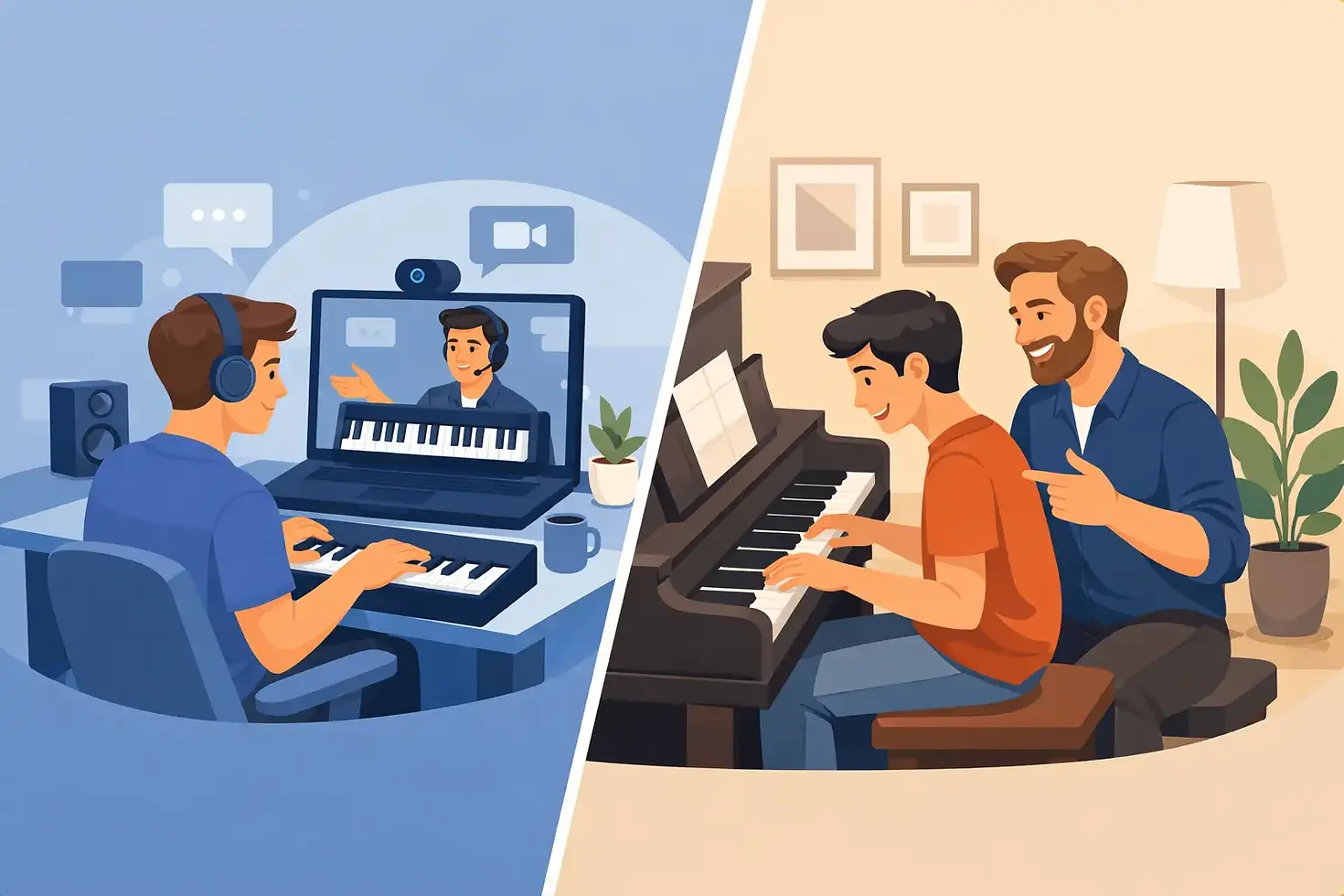
A lot of students ask this after their first serious look at lessons: is online really as effective as sitting beside a teacher at the piano? When comparing online vs in person piano lessons, the honest answer is that both can work very well - but not always for the same student, at the same stage, or for the same goal.
That is worth saying clearly at the start. There is no single “best” format for everyone. A seven-year-old beginner, an adult returning to piano after twenty years, and a Grade 6 student preparing for ABRSM all need slightly different things. The right choice depends on how you learn, what kind of guidance you need, and how piano study fits into your week.
Online vs in person piano: what really changes?
The biggest difference is not quality. It is how teaching is delivered and how a student experiences it.
In person lessons offer immediate physical presence. A teacher can notice small details very quickly, from hand shape and wrist tension to posture at the bench and pedal use. For some students, especially younger beginners, that shared room creates focus. The lesson feels distinct from the rest of the day, and that can help concentration.
Online lessons shift the teaching space into the student’s own home. That changes the rhythm of learning in useful ways. Students play on their own instrument every week, in the exact environment where they will practise. There is no travel time, which makes regular study easier to maintain. For busy families and working adults, that convenience is not a small bonus. It is often the reason lessons happen consistently rather than being postponed.
A good teacher can teach musicality, technique, theory, reading and exam preparation in either format. What changes is the method, not the standard.
When online piano lessons work brilliantly
Online teaching suits more students than many people expect. It is especially strong for older children, teenagers and adults who can follow verbal instruction and make small adjustments independently. It also works well for students who already have some basic coordination at the keyboard and want structured progression.
There is a practical advantage too. Because the student is already at home, practising tends to feel more connected to the lesson. The keyboard, books and routine are all in one place. Instead of thinking of piano as something done only at the teacher’s house or studio, the student builds a habit in their real day-to-day setting.
For adult learners, this can be a major reason for success. Adults often balance work, family and other responsibilities. If an online lesson removes a journey across town, that saved hour can become practice time. The result is often better consistency, and consistency matters more than many students realise.
Online lessons can also be excellent for exam pathways. ABRSM and TRINITY preparation relies on clear structure, repertoire planning, technical development, ear training and theory understanding. All of that can be taught very effectively online when lessons are organised well and expectations are clear.
Where in person lessons still have an edge
In person teaching can be particularly helpful at the earliest stages. A complete beginner sometimes needs very close guidance with posture, keyboard geography, finger preparation and general confidence at the instrument. Younger children may also respond better to the energy of shared physical space, where attention can be directed more naturally.
There is also a subtle musical benefit in the room itself. Sound is heard directly, without microphone compression or internet lag. That matters when a teacher is listening closely for tone, voicing, pedalling and balance between hands. In advanced classical and jazz playing, those details become increasingly important.
Some students simply learn better face to face. They feel more motivated when they travel to a lesson, sit at an acoustic piano, and work alongside a teacher in person. That preference is valid. Motivation is not separate from learning - it is part of it.
The question parents usually mean to ask
When parents ask whether online or in person is better, they are often really asking something else: will my child stay engaged and make proper progress?
That depends less on the screen and more on the lesson design. A focused, personal online lesson with clear goals is far better than an unfocused in person lesson. Children need pacing, encouragement, structure and achievable targets. If those are present, online lessons can be highly effective.
That said, age and temperament matter. A very young child who struggles to sit still may benefit from in person lessons, at least at first. An older child who is comfortable with a screen and enjoys routine may thrive online. There is no need to force one model if the student’s response suggests another.
Online vs in person piano for adult beginners
Adults are often surprisingly hard on themselves when starting piano. They worry about reading music, hand coordination, and whether they are “too late” to learn properly. In that situation, the best lesson format is often the one that makes it easiest to begin and easiest to continue.
For many adults, online wins on practicality. It removes commuting, fits neatly around work, and allows lessons to happen from home without extra fuss. That lower barrier can make the difference between wishing to learn piano and actually learning it.
In person lessons may suit adults who want the atmosphere of a dedicated music space or feel they need closer real-time correction with technique. If someone is returning after years away and wants to rebuild touch, posture and confidence at an acoustic instrument, face-to-face lessons can feel reassuring.
The key point is this: adults progress well when lessons are consistent, personalised and free from unnecessary pressure. The format should support that, not complicate it.
What about jazz, classical and exam preparation?
Both online and in person formats can support serious study in classical and jazz piano, but the teaching needs to be adapted properly.
For classical students, online lessons can cover repertoire, technique, scales, sight-reading and interpretation very successfully. In person teaching may offer an extra layer of detail when working on tonal control, pedalling and fine gradations of sound, especially at higher levels.
For jazz students, online lessons are often particularly practical. Improvisation, voicings, rhythm work, lead sheet reading and harmonic understanding translate well to the online setting, provided the lesson is musically organised and the audio setup is sensible. Since jazz relies so strongly on listening and conceptual understanding as well as physical playing, online teaching can be very effective.
For graded exams, either format can work. What matters most is a structured plan, regular feedback, and a teacher who understands how to prepare repertoire and supporting tests in a calm, methodical way.
The hidden factor: your home setup
Online lessons are only as smooth as the setup allows. That does not mean you need expensive equipment. But it does mean the basics matter.
A reliable internet connection, a device placed so the teacher can see the keyboard and hands clearly, and a reasonably quiet room make a noticeable difference. If the camera angle is poor or the sound keeps dropping out, the lesson becomes harder than it needs to be.
In person lessons remove those technical variables, which is part of their appeal. If a student finds technology stressful, that may tilt the decision towards face-to-face teaching.
How to choose without overthinking it
If you are deciding between the two, start with your real constraints and your real goals. If travel is likely to make lessons irregular, online may be the stronger choice. If your child is very young and needs hands-on guidance with focus and physical setup, in person may be the better starting point. If you are preparing for an exam and need expert one-to-one structure, either can work well with the right teacher.
It also helps to think beyond convenience and ask: where am I most likely to practise well? The best lesson is not simply the one that feels nicest for thirty or forty-five minutes. It is the one that supports steady work between lessons.
At Dan Piano Studio, that is the principle behind both in person and virtual teaching. The goal is not to push students into a format for its own sake, but to help them build real musical progress in a way that fits their life and supports long-term development.
If you are still unsure, that is perfectly normal. Choosing piano lessons is not about picking the “modern” option or the “traditional” one. It is about finding the setting in which you, or your child, can listen carefully, practise regularly, and enjoy getting better week by week.


Comments