


What online piano lessons actually cost in the UK

Updated: 6 days ago
Expect to pay roughly £20 to £35 for a 30-minute online piano lesson, £30 to £50 for 45 minutes, and £40 to £70 for a full hour, with qualified, experienced teachers sitting near the top of each band. London-based tutors, including those working across central London, Camden and King’s Cross, often charge at the upper end of these ranges even online, since demand and living costs push local rates up regardless of the lesson happening over a screen. If you’re weekly and budget-conscious, a rolling subscription or lesson pack usually beats paying per session one at a time.
30 minutes: £20 to £35, typical £25
45 minutes: £30 to £50, typical £38
60 minutes: £40 to £70, typical £55
These figures broadly match UK-wide piano lesson pricing, which puts private sessions between roughly £15 and £60 per half hour depending on experience and location.
Key Takeaways
Online piano lesson costs in the UK depend more on teacher experience and lesson length than on the online format itself, with 30-minute sessions typically running £20 to £35 and hour-long lessons £40 to £70.
Point | Details |
Budget by lesson length | Expect £20 to £35 for 30 minutes, £40 to £70 for a full hour, with London rates near the top. |
Convert to annual spend | A weekly 30-minute lesson totals roughly £1,200 a year; a weekly hour nears £2,640. |
Check the real per-lesson rate | Packs of ten often save 10 to 15%, but only if cancellation and expiry terms are fair. |
Weigh format against goals | Subscriptions suit budget-first beginners; live one-to-one teaching suits exam candidates. |
Dan Piano Studio as a benchmark | Its published online lesson pricing sits mid-to-upper range, reflecting exam coaching and tailored planning. |
Table of Contents
Online piano lessons cost: price ranges explained
The maths gets more useful once you convert a single lesson price into a weekly habit. A weekly 30-minute lesson at £25 comes to £100 a month and roughly £1,200 a year, assuming term breaks are skipped or made up. Stretch that to 45 minutes at a typical £38, and you’re looking at around £152 a month, or £1,824 annually. A full hour with an experienced teacher at £55 pushes monthly spend to £220, close to £2,640 a year.
Two examples make the pattern concrete:
A seven-year-old beginner having one 30-minute lesson a week at £25 spends about £1,200 a year, plus a modest outlay on a keyboard and method books in year one.
An adult preparing for a Grade 5 ABRSM exam typically needs 45 to 60 minutes weekly with a more experienced teacher, pushing annual costs closer to £2,000 to £2,600 once exam coaching and extra term-time sessions are factored in.
Industry pricing guides suggest teacher experience, lesson length and platform type explain most of the variation you’ll see between quotes, rather than the fact that a lesson happens online versus in a studio. That’s useful to know before you assume the cheapest listing is automatically the best deal.
What actually drives the price up or down
Price differences rarely come down to guesswork, as discussed in Factors That Influence the Cost of Swim Lessons. A handful of concrete factors explain almost every gap between a £20 lesson and a £60 one.
Qualifications and years teaching. A conservatoire-trained teacher with a decade of experience and ABRSM examining background will charge more than a recent graduate, and that premium is usually earned through faster student progress.
Lesson length isn’t linear. A 60-minute lesson rarely costs exactly double a 30-minute one, because prep time, feedback notes and follow-up resources don’t scale in proportion to the extra 30 minutes.
Platform fees versus direct booking. Marketplace sites take a commission, which can add 15 to 25% to what you’d pay booking a teacher directly.
Specialist tuition costs more. Jazz improvisation, competition prep, or advanced music theory coaching commands a premium over standard classical instruction.
Pro Tip: Before comparing quotes, check whether a teacher’s rate already includes a written lesson summary or practice plan. Some don’t charge extra for it, others treat it as a paid add-on, and that difference can be worth £5 to £10 a week on its own.
Choosing between one-to-one, group and app-based lessons
Format matters as much as price when you’re weighing up value. Here’s how the main options stack up against each other.
Live one-to-one lessons run £20 to £70 per session depending on length and experience, with packs of five or ten often bringing the effective rate down by 5 to 15%.
Group online lessons typically cost £10 to £20 per student per session, roughly half the one-to-one rate, but feedback gets split across the group and progress tracking is looser.
Subscription platforms and courses (structured video lessons, not live tuition) usually run $15 to $50 a month for full course access, which converts to a modest monthly cost regardless of how often you practise.
App-based courses like the ones reviewed by PianoDreamers sit in a similar single-to-low-double-figure pound range monthly, aimed at self-paced beginners rather than exam candidates.
The trade-off is straightforward: subscriptions and group lessons win on cost, one-to-one lessons win on personalisation and exam readiness. If you’re prepping for ABRSM or Trinity exams, a live teacher who can adjust technique in real time is difficult to substitute with pre-recorded content.
Lesson packs, subscriptions and how discounts actually work
Most teachers offer some version of a bulk discount, and understanding how it’s structured saves you from comparing apples to oranges.
Five-lesson packs typically shave 5 to 8% off the per-lesson rate compared with paying weekly.
Ten-lesson packs often bring 10 to 15% savings, and are the most common commitment length for parents booking a school term.
Twenty-lesson or full-term packs can reach 15 to 20% off, though you’ll usually need to pay upfront.
Subscription-style courses work differently again: you pay a flat monthly fee, commonly in the same range as one live lesson, for unlimited access to structured content rather than personal feedback.
Pro Tip: Always ask what happens if you need to cancel a lesson mid-pack. Some teachers roll it forward, others forfeit it, and that policy can matter more than the headline discount.
The cheapest per-lesson rate isn’t automatically the best value. A £20 lesson with no follow-up notes, no practice plan and no flexibility on missed sessions can cost you more in wasted practice time than a £30 lesson that includes proper structure.
How to judge value, not just the price tag
Comparing online piano teachers on price alone misses the point. Run through this checklist before booking anything beyond a trial:
Does the teacher hold a recognised qualification or conservatoire background, and can they demonstrate ABRSM or Trinity exam results?
Is there a clear, written lesson plan or curriculum, rather than an ad hoc approach each week?
What’s the tech set-up, and have they specified browser or software requirements for a stable video call?
What’s the cancellation and refund policy, in plain terms, before you commit to a pack?
Do they offer a trial lesson, and is the pricing for follow-on lessons stated upfront rather than “contact for a quote”?
Watch for red flags: vague pricing that only appears after you enquire, no trial option at all, or an inability to point to any real student progress. Transparent pricing, visible testimonials, and a clear answer on exam support are the trust signals worth weighing most heavily.
A simple five-point scoring rubric helps compare two or three shortlisted teachers side by side:
Point | Details |
Price fit | Does the rate sit within your monthly budget once packs or subscriptions are applied? |
Experience | Do their qualifications and years teaching match the level you or your child need? |
Exam support | Can they demonstrably prepare students for ABRSM or Trinity grades? |
Tech quality | Is their video and audio set-up stable enough for real-time feedback? |
Trial availability | Can you test fit for one lesson before committing to a pack? |
Dan Piano Studio as a working example of transparent pricing
Dan Piano Studio runs online lessons for children, adults, beginners and advanced pianists, covering classical piano, jazz, improvisation, music theory, and ABRSM and Trinity exam preparation, alongside in-person teaching across central London, Camden and King’s Cross. Lessons are built around each student’s goals rather than a fixed curriculum, which matters if you’re weighing exam prep against casual hobby playing.
Published pricing on the studio’s blog sits within the mid-to-upper range set out earlier in this guide, reflecting the experience level and exam-coaching credentials on offer.
Lessons cover both structured technique work and creative development, so the price reflects preparation time as well as time on camera.
The studio’s own comparison of traditional versus digital lesson costs gives readers a direct reference point against the ranges discussed above.
A teacher’s rate should reflect not just the minutes on a video call, but the preparation, exam knowledge and follow-up that shape whether a student actually improves.
What else you’ll need to budget for
The lesson fee is rarely the whole story. A few additional costs come up consistently once you start lessons in earnest, and skipping them tends to cause frustration a few months in.
An instrument matters more than most beginners expect. You don’t need an acoustic piano to start, but a decent 88-key weighted keyboard costs somewhere between £150 and £500, and cheaper unweighted keyboards under £100 tend to make technique harder to build properly. Budget this as a one-off cost in year one rather than an ongoing expense.
Sheet music and method books typically add £10 to £30 every few months, more if you’re working towards a specific exam grade and need the official ABRSM or Trinity syllabus pieces.
Video call reliability is worth a small investment too. Most lessons run fine on standard broadband and a laptop camera, but a dedicated microphone (£20 to £60) noticeably improves how well a teacher can judge dynamics and touch, which matters far more in piano than in most other online-taught subjects.
Practice apps and theory software are optional but common. Some teachers include access to structured platforms as part of their fee; others expect you to subscribe separately, typically £5 to £15 a month. Always ask whether this is bundled before assuming a quoted lesson price is the full picture.
Exam fees sit outside lesson costs entirely. ABRSM and Trinity exam entry runs from roughly £40 for early grades to over £100 for higher grades, and this is paid directly to the exam board, not the teacher.
How payment, cancellation and refunds usually work
Most UK-based online piano teachers request payment upfront, either per lesson, per pack, or as a rolling monthly subscription. Bank transfer and card payment through booking platforms are the two most common methods, with some teachers also accepting payment via invoicing software for regular students.
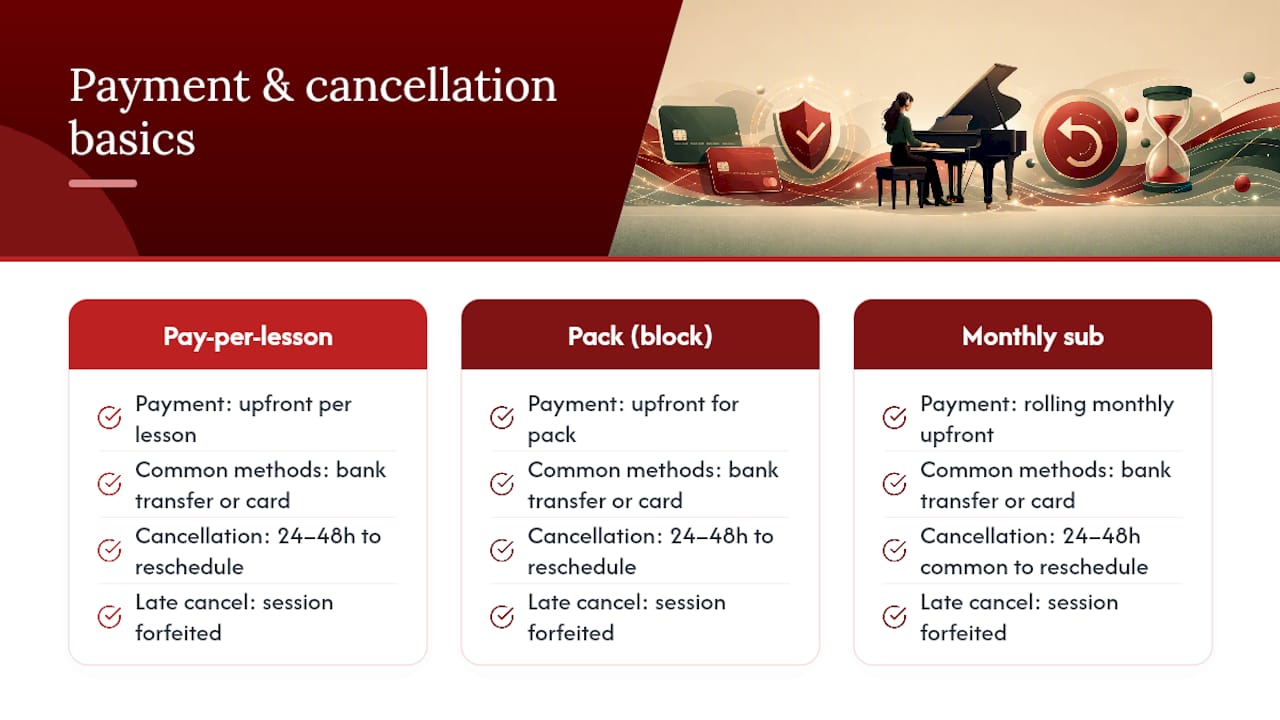
Cancellation policies vary more than pricing does, and this is where reading the fine print pays off. A common structure requires 24 to 48 hours’ notice to reschedule a lesson without losing it; cancel later than that and the session is typically forfeited. Lesson packs usually carry an expiry window, often three to six months, so an unused pack doesn’t sit as credit indefinitely.
Refunds on prepaid packs are less standardised. Some teachers offer a pro-rated refund for unused lessons if a student stops entirely; others only offer credit toward future sessions rather than cash back. Trial lessons are the safest way to test this relationship before committing to a larger pack, since most platforms and independent teachers offer one at a reduced rate or free specifically so you can check fit before paying for ten sessions upfront.
Before booking a pack, get the cancellation window, the pack expiry date and the refund policy in writing, ideally in the same email or booking confirmation that states the price. Verbal agreements about “flexible cancellation” tend to become disputes exactly when you need the flexibility most.
Why value beats the lowest price every time
The conventional advice on this topic, hunt for the cheapest hourly rate, gets the priority backwards. Price variation in online piano lessons mostly reflects real differences in preparation, exam knowledge and follow-up structure, not inflated fees. A teacher charging £45 who sends a practice plan and tracks exam progress is very often better value than one charging £22 with no structure at all.
What’s overrated is the idea that online lessons are inherently a downgrade from in-person teaching. The pricing gap between the two is usually modest, and the format itself doesn’t determine whether a student improves. What matters far more is whether the teacher can actually demonstrate exam results and give feedback that changes technique week to week.
If you take one thing from this guide, prioritise the trial lesson before anything else. It costs little, reveals more about fit than any price list can, and stops you locking into a pack based on a rate alone.
— Dan
Book online piano lessons with clear, upfront pricing
Danpianostudio publishes its rates openly rather than making you request a quote, so you can compare against the ranges in this guide before you ever book a call. Lessons are built around your actual goal, whether that’s a first Grade 1 ABRSM attempt, jazz improvisation, or getting back into playing as an adult after years away, rather than a fixed one-size curriculum.
If you’re weighing online tuition against a home visit, the studio also runs in-person lessons across central London, Camden and King’s Cross for readers who’d rather have a teacher in the room. For most readers coming from this guide, the sensible next step is to check current availability and pricing on the online piano lesson page and book a first session to test fit before committing to a pack.
Sources
Recommended


Comments