


Modal Interchange for Piano: 3 Reharmonisations You Can Play Today


Modal interchange is the practice of borrowing chords from parallel modes while keeping the same tonic, so a piece in C major can reach for chords built on C minor without ever leaving the key. It works by shifting colour, not key, which is why a single borrowed chord like iv or ♭VI can turn a bright progression melancholic in one beat. This guide gives you the piano voicings, worked reharmonisations, and ear-training drills to make that shift under your own fingers.
TL;DR:
Borrowed chords mainly come from parallel minor or other modal scales, with iv, ♭VI, and ♭VII being the most common choices in major keys.
These chords do not create strong dominant resolutions or change the key center but instead add color and emotional variety.
Voicing borrowed chords with quartal shapes and holding the pedal can preserve modal color and prevent accidental tonal shifts.
Recognizing borrowed chords by ear involves playing diatonic progressions and then immediately replacing chords with their borrowed counterparts repeatedly.
Modal interchange differs from modulation and secondary dominants because it maintains the same tonic, altering only the chord quality for color rather than function or key center.
Table of Contents
What is modal interchange piano technique, exactly?
Modal interchange, sometimes called modal mixture or borrowed chords, means pulling a chord from a parallel mode into your progression while the tonal centre stays exactly where it was. If you are in C major, C minor is your parallel mode: same root, different quality of third, sixth, and seventh. Borrow the iv chord (F minor) from that parallel minor, drop it into a C major progression, and your ear registers a sudden shadow without any sense that the song has changed key.
That distinction, same tonic, different mode, is what separates modal interchange from modal interchange as borrowing chords from parallel modes generally gets described as in guitar and songwriting circles too, but pianists benefit from thinking of it in terms of stacked triads and sevenths rather than just “sad chords.” The mechanism is always the same: keep C as home, raid C minor’s chord palette for colour.
Modulation is a different animal entirely. When a song modulates, the tonic itself moves. A verse in C major that shifts to a chorus in E flat major has changed its centre of gravity; C is no longer home. Modal interchange never does this. The bass note, the resolution point, the “gravity” of the piece, stays anchored on the same root throughout.
Secondary dominants cause a similar confusion for students, but they work on a completely different principle. A secondary dominant (like D7 leading to G in the key of C) borrows a function, not a mode. It temporarily treats another chord as if it were a new tonic, creating a mini “V to I” pull, a tonicisation, before snapping back. Modal interchange borrows colour rather than pull. It rarely creates a strong dominant resolution; instead it just recolours a chord that would otherwise sit diatonically.
Here is the practical checklist to tell them apart at the keyboard:
Modal interchange: same tonic, chord borrowed from a parallel mode, no strong dominant pull created.
Modulation: tonic changes, usually confirmed by a cadence in the new key that sticks around.
Secondary dominant: temporary dominant function pointing at a chord other than the tonic, then resolving away.
Tonicisation: a brief secondary dominant move that never fully establishes a new key centre.
Get this distinction solid before you start experimenting, because mislabelling a secondary dominant as a borrowed chord will send your reharmonisation attempts in the wrong direction entirely.
Which chords get borrowed most often on piano?
Every parallel mode offers a slightly different flavour of borrowed chord, but a handful of show up again and again in pop, film, and jazz writing because they hit the ear hardest for the least theoretical risk.
In a major key, the most commonly borrowed chords are iv, ♭VI, and ♭VII, all lifted straight from the parallel minor. In the key of C major, that means:
iv (F minor): replaces the bright IV (F major), instantly reads as nostalgic or wistful.
♭VI (A♭ major): a lush, almost cinematic chord that often precedes a return to the tonic.
♭VII (B♭ major): gives a rock or gospel lean, frequently used as a pre-tonic move instead of a dominant.
♭III (E♭ major): less common but effective as a colour chord between me and iv-type movement, often heard in soul and neo-soul voicings.
Minor keys borrow in the opposite direction, reaching up into the parallel major or into harmonic and melodic minor for brighter or more exotic colours:
IV (major, borrowed from Dorian or major): brightens a minor-key progression without losing its minor identity.
V (major, from harmonic minor): strengthens a cadence that would otherwise feel soft in natural minor.
♭II (from Phrygian, sometimes called the Neapolitan): a dramatic, almost gothic colour used sparingly for maximum effect.
vii° (from harmonic minor): diminished colour chords useful as brief connective tissue between stronger chords.
A compact index helps more than a wall of prose here, because you will want to glance at this while you are actually at the keyboard:
Source mode (parallel to C major/minor) | Common borrowed chords | Typical emotional colour |
C natural minor | iv, ♭VI, ♭VII, ♭III | nostalgic, cinematic, epic |
C Phrygian | ♭II, ♭III, iv | dark, dramatic, exotic |
C harmonic minor (from C minor home) | V, vii° | tense, classical, unresolved |
C major (from C minor home) | IV, V | uplifting, hopeful contrast |
C Mixolydian | ♭VII | bluesy, rock, unresolved lift |
Keep this table nearby during practice sessions. Most working reharmonisations lean on no more than two or three of these borrowed chords per piece, so knowing the emotional signature of each one lets you choose deliberately rather than by accident.
How do you find the source mode for a chord you want?
Locating the source mode for a borrowed chord is a matter of building the parallel scale on your existing tonic and reading off what is already sitting there.
Identify your tonic and current mode. If you are in C major, your parallel modes all start on C too but with different interval patterns: C Dorian, C Phrygian, C natural minor, C Mixolydian, and so on.
Build the triads or seventh chords of the parallel mode you want to borrow from. Stack a triad on each scale degree of C natural minor and you get Cm, DO, E♭, Fm, Gm, A♭, B♭, all candidates for borrowing into C major.
Compare against your home key’s diatonic chords. Any chord that differs from the diatonic version (F major becomes Fm, A minor becomes A♭ major) is a genuine borrowed chord; anything identical is not worth calling modal interchange.
Choose based on the colour you want, not just theoretical correctness. Want warmth and lift? Borrow from the parallel major (Mixolydian’s ♭VII, Lydian’s raised IV feel). Want melancholy or drama? Borrow from natural minor or Phrygian.
Parallel modes share a tonic; relative modes share a key signature but sit on different tonics. C major and C minor are parallel. C major and A minor are relative, sharing the same seven notes but centred differently. Modal interchange always works with parallel relationships, never relative ones, because the whole point is keeping the same home note while changing its surrounding chord quality.
A quick heuristic worth memorising: darker, flatter degrees (♭III, ♭VI, ♭VII) come from natural minor and Phrygian; brighter, sharper alternatives (raised IV, major V in a minor key) come from Lydian, Mixolydian, or harmonic minor. Pick your mode by the mood you are chasing, then borrow the specific chord that mode offers.
Which piano voicings keep the modal colour intact?
Voicing choice matters as much as chord choice here, because a poorly voiced borrowed chord can accidentally sound like a passing tonicisation rather than a deliberate modal shift.
Quartal voicings, chords built from stacked fourths instead of thirds, help enormously. Because fourths avoid the strong third-and-seventh tension that defines functional harmony, they let a borrowed chord sit in its modal colour without pulling toward a resolution. Pianists working in modal jazz lean on fourths and a persistent bass tonic precisely because that combination sustains ambiguity rather than forcing a cadence, and the same trick transfers directly to modal interchange passages.
Practical voicing shapes worth learning by hand position:
Left hand: hold the tonic as a pedal point (low C, sustained or rest ruck softly) under the borrowed chord’s upper structure. This anchors the ear to “we haven’t left home” even while the chord above shifts dramatically.
Right hand, for iv (Fm in C major): try F, A♭, C stacked as a close triad, or invert to A♭, C, F for a smoother line from the preceding IV chord.
Right hand, for ♭VI (A♭ in C major): voice as A♭, C, E♭ in second inversion (E♭ on top) if the melody is descending, which keeps the top voice moving stepwise rather than leaping.
Right hand, for ♭VII (B♭ in C major): a quartal shape, B♭, E♭, A♭, works nicely as a connective chord before resolving back to C, especially in a rock or gospel context.
Inversions do real work in this context beyond just smooth voice leading; they can disguise how “foreign” a borrowed chord actually is. A root-position Fm jumps out as a clear minor iv. The same chord in first inversion (A♭ in the bass, F and C above) can slip past almost unnoticed, arriving via a stepwise bass line from the previous chord. If you want subtlety, invert. If you want the borrowed chord to announce itself, use root position and even double the root.
Pedalling matters more than most players assume. Holding the sustain pedal through a borrowed chord blurs it into the surrounding harmony, useful for a wash of colour in a ballad, but a clean pedal change on the beat the chord lands can sharpen its impact for a more dramatic reveal. Our piano pedalling techniques guide covers this kind of listening-led pedal control in more depth if you want to work on it deliberately.
Pro Tip: Avoid stacking a leading-tone tension (like a major seventh chord built on the borrowed root) under a modal interchange chord unless you genuinely want a tonicisation effect. That extra tension is usually what accidentally turns a borrowed colour chord into a secondary dominant in disguise.
Worked reharmonisation examples you can play today
Theory only sticks once your hands have done it. These three walkthroughs move from the simplest possible pop swap to a jazz-level reharmonisation, each with the chord-by-chord logic spelled out.
1. The classic pop swap: I–V–vi–IV becomes I–V–vi–iv
Play C–G–Am–F first, the most recorded chord progression in modern pop, entirely diatonic and pleasant. Now replace the final F major with F minor.
C (I): home, bright.
G (V): standard dominant motion, no change.
Am (vi): relative minor, still diatonic.
Fm (borrowed iv): this is where the colour shift lands. Voice it as F, A♭, C in your right hand, keep C sustained faintly in the bass under the chord change so the ear never loses the tonic.
The effect: a progression that sounded optimistic suddenly tips into bittersweet in its final chord, a device you will recognise instantly once you have played it, because countless recorded songs use exactly this IV to iv swap to add a nostalgic lift right before repeating the loop.
2. Minor-key backdoor motion: i–iv–♭VII–i
Start in A minor with Am–Dm–Am, straightforward and diatonic. Now insert a ♭VII (G major) between the iv and the return to i.
Am (i): home.
Dm (iv): diatonic, unremarkable.
G (♭VII, borrowed from A Mixolydian or A natural minor): voice as G, B, D in root position, or invert to D, G, B for a smoother top line descending toward the tonic.
Am (i): resolution.
This is the “backdoor” progression, so called because ♭VII to i resolves to the tonic without ever using a dominant V chord. It avoids the strong pull of a leading tone, giving a softer, more modal-sounding cadence than a standard V–i. Try following the ♭VII with a ii–V built from the borrowed material (Dm7 to G7) before landing on Am for a slightly jazzier version of the same idea; that ii–V–i shape using the backdoor ♭VII is a staple of both jazz standards and film scoring.
3. A jazz-flavoured combination: modal interchange plus backdoor ii–V
Take a simple C major turnaround, C–Am–Dm–G7–C, and rework the final approach using borrowed material.
C (Imaj7): voice as a rootless shell, E, G, B, D in the right hand, C sustained low in the left.
Am (vi7): stays diatonic, connective.
F♭m7 or more practically, borrow ♭VI: insert A♭maj7 here instead of moving straight to Dm. Voice it A♭, C, E♭, G, a lush quantal-leaning shape that surprises the ear after two straightforward diatonic chords.
Dm7 (ii, from the ♭VII of C, functioning as a backdoor ii): now approaching from a borrowed chord rather than a diatonic one, this ii feels freshly recontextualised.
G♭7 or ♭VII7 (B♭7, backdoor dominant): replaces the expected G7. Voice as B♭, D, F, A♭ (a dominant seventh built on the borrowed ♭VII), which resolves to C with none of the aggressive pull a straight G7 would supply.
C (Imaj7): final resolution, quieter and more ambiguous than a standard V–I landing.
Chord by chord, what happened: you borrowed ♭VI to disrupt the expected diatonic motion, then used a backdoor dominant (♭VII7) instead of the expected V7 to resolve home. Neither borrowed chord threatened the tonic, C remained home throughout, but the harmonic journey there became considerably richer. This is modal interchange doing genuine compositional work rather than just decorating a single beat.
How do you train your ear to hear borrowed chords?
Reading about borrowed chords and actually recognising one by ear under performance pressure are different skills entirely, and the gap between them closes fastest with deliberate, repeated contrast.
The single most effective drill, according to piano pedagogy research on aural skills, is disarmingly simple: play a progression once diatonically, then immediately replay it with the borrowed chord substituted, back to back, so your ear catches the exact moment the colour shifts. This works because your brain naturally compares the two versions when they arrive close together; isolated listening to just the borrowed version teaches you far less.
Build a short daily routine around that principle:
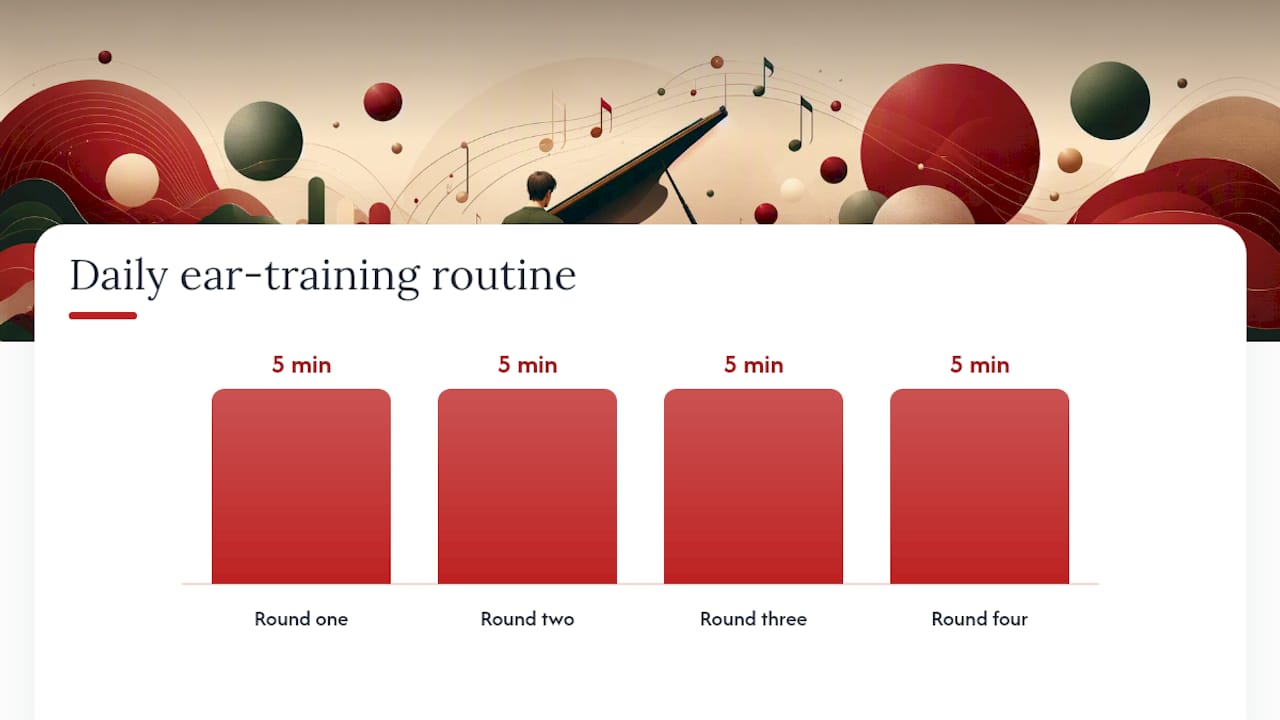
Round one (5 minutes): play I–V–vi–IV, then immediately I–V–vi–iv, in C major. Repeat in three different keys.
Round two (5 minutes): play i–iv–♭VII–i, then i–iv–IV–i (diatonic minor version) back to back in A minor.
Round three (5 minutes): sing or hum the root of each borrowed chord before you play it, testing whether you can predict the colour shift before your hands confirm it.
Round four (5 minutes): improvise freely over a static tonic pedal (just hold C in the left hand) and drop in iv, ♭VI, and ♭VII chords in the right hand in random order, naming each one out loud as you play it.
Aim for a slow tempo, around 60 beats per minute, for the first two rounds; speed defeats the purpose when you are still building recognition. Once you can name a borrowed chord within a second of hearing it, increase tempo and start mixing borrowed chords into progressions you already know from repertoire rather than the drilled examples above.
Technical drills reinforce the ear-training rather than replacing it. Practise right-hand voicing patterns in isolation, moving smoothly between root position, first inversion, and second inversion for each of iv, ♭VI, and ♭VII, so your fingers already know the shape before your ear even asks for it. Left-hand bass drones, simply holding or softly restriking the tonic under each shape, train the crucial skill of anchoring modal colour without letting the bass wander into implying a new key.
Pro Tip: Record yourself improvising with borrowed chords over a static left-hand tonic, then listen back after a day away from the material. Distance reveals whether a borrowed chord genuinely added colour or just sounded like a mistake, a distinction that is surprisingly hard to judge in the moment while you are still playing.
Once these drills feel automatic, folding modal interchange into real improvisation gets much easier. Start by adding just one borrowed chord per chorus of a tune you already know well, rather than trying to saturate an entire improvisation with borrowed colour on day one.
Where does modal interchange meet modal jazz?
Modal interchange and modal jazz share vocabulary but solve different problems, and mixing them up leads to some confused practice sessions.
Modal interchange, as covered throughout this guide, borrows individual chords from parallel modes while staying inside a functional, tonal framework; you still have a sense of home, cadence, and resolution. Modal jazz works differently: it reduces the frequency of chord changes altogether, sustaining a single mode’s colour for extended stretches rather than moving through a chain of functional chords. Miles Davis’s Kind of Blue is the standard reference point, entire sections built on a single Dorian or Mixolydian sonority with minimal harmonic motion underneath.
John Coltrane’s modal-era recordings push this further still, often staying on one mode for an entire chorus and relying on melodic and rhythmic development rather than harmonic movement to create interest. The distinction between modal interchange and full modal harmony comes down to this: interchange borrows a chord and moves on, modal harmony often removes the functional chord progression entirely in favour of a static, sustained modal centre.
Practically, both techniques share the same toolkit at the piano: quartal voicings, a sustained bass tonic, and a general avoidance of strong dominant-to-tonic pull. If you want to study the overlap directly, a focused listening list helps more than more reading:
Kind of Blue (Miles Davis), especially “So What” and “Flamenco Sketches,” for sustained modal colour over minimal chord motion.
Coltrane’s mid-1960s modal recordings, for how far a single mode can be stretched melodically before harmony needs to move at all.
Any recording using a backdoor ii–V progression, for a direct bridge between functional jazz harmony and modal colour.
Our guide to jazz piano harmony goes further into how these modal voicings translate into comping patterns if you want to take this beyond listening and into your own playing. For a broader sense of how different harmonic devices map onto mood and genre, this breakdown of instrumental jazz mood categories is worth a read alongside your listening list.
How I sequence modal interchange lessons for students
Students learn this fastest when theory comes last, not first. I start with sound: play the diatonic progression, then the borrowed version, and ask what changed emotionally before naming a single chord. Only once a student can hear the shift do we label it, iv, ♭VI, ♭VII, and connect it to the parallel mode it came from.
Voicings come next, because a badly voiced borrowed chord teaches the wrong lesson entirely. Then reharmonisation, taking a progression the student already plays comfortably and reworking one chord at a time. Ear-training and repertoire study run alongside, never after, because isolating them from playing kills the momentum.
The most common pitfall I see is overuse. A student discovers ♭VI once and suddenly every four bars gets one, which flattens the very effect they are chasing. The fix is simple: reserve borrowed chords for a single moment of emphasis per phrase, and let the surrounding diatonic harmony do the rest of the work. Pair that restraint with solid chord inversion habits and the borrowed chords start sounding intentional rather than accidental within a couple of weeks.
— Dan
Guided lessons for working modal interchange into your playing
Reading about borrowed chords gets you halfway there; having someone listen to your voicing and correct your voice leading in real time gets you the rest of the way, usually far faster. Lessons build modal interchange, reharmonisation, and improvisation work directly into jazz and theory lessons, rather than treating it as a bolt-on topic, so feedback on your specific voicing choices happens the same lesson you try them.
Beginners and returning players tend to benefit most from structured home piano lessons in Central London, Camden, or King’s Cross, where a teacher can hear exactly which chord voicing is muddying your progression and correct it on the spot. If you are further along and comfortable with jazz vocabulary already, online piano lessons work well for targeted reharmonisation coaching without needing to travel. Either format covers classical technique, jazz improvisation, and exam preparation alongside this kind of harmonic work, tailored to what you are actually trying to play. Get in touch through Dan Piano Studio to book a lesson and start working borrowed chords into pieces you already know.
Sources
A handful of sources back the theory and practice in this guide, and each is worth a closer read on its own:
FAQ
What does modal interchange mean?
Modal interchange means borrowing a chord from a parallel mode, one sharing the same tonic but a different set of intervals, while keeping the overall key centre unchanged. In C major, borrowing Fm (iv) from C minor is a textbook example.
What is the “forbidden chord” on piano?
There is no single universally forbidden chord, but a strong secondary dominant or aggressive dominant-to-tonic cadence can wreck a modal mood by pulling the ear back toward functional resolution. Favouring quartal voicings, drones, and avoiding dominant cadences keeps borrowed chords sounding modal rather than tonal.
Is John Coltrane’s music modal?
Yes, much of Coltrane’s mid-1960s output sustains a single mode across extended sections rather than moving through frequent chord changes, a defining trait of modal jazz. That approach differs from modal interchange, which borrows individual chords briefly within an otherwise functional progression.
What is a modal interchange chart or table?
A modal interchange chart maps each parallel mode to the chords it can lend a given key, alongside the emotional colour each borrowed chord tends to produce. The compact index earlier in this guide (mode, borrowed chords, emotional colour) is one practical version pianists can keep at the keyboard.
How is modal interchange different from a key change?
Modal interchange keeps the tonic fixed and only swaps the mode a chord is drawn from, so the piece never leaves home. A genuine key change, or modulation, shifts the tonal centre itself, usually confirmed by a cadence that establishes and holds a new tonic.
Recommended



Comments