


Pianists: Fix a Weak Left Hand in 4 Weeks With 10 Minutes a Day

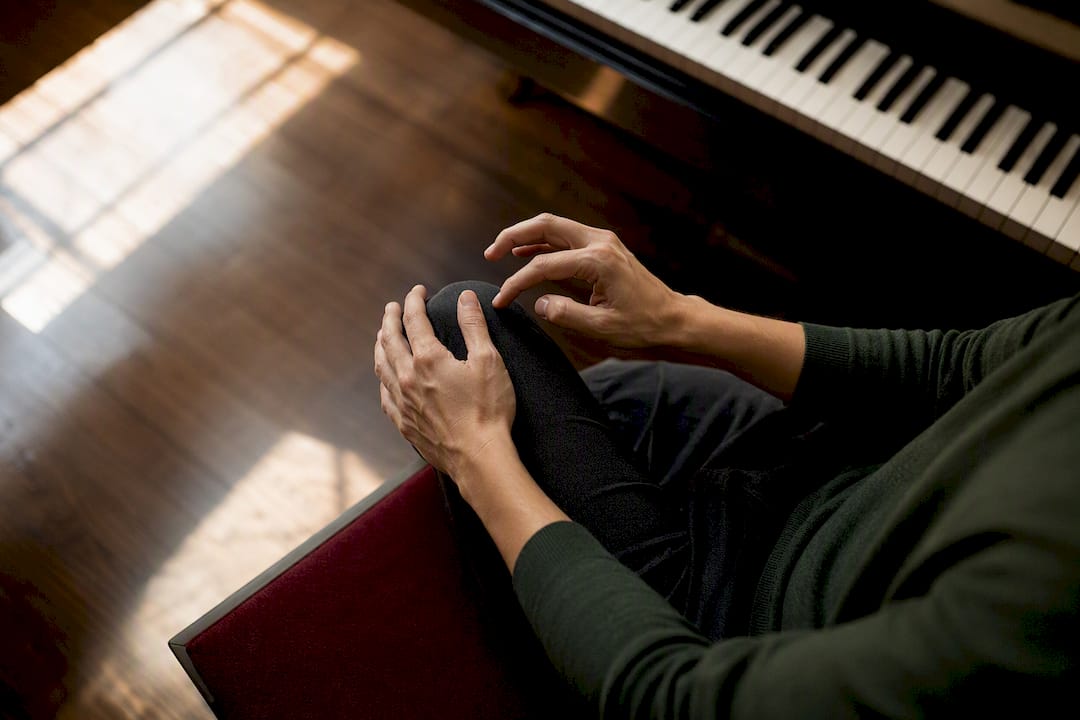
Left-hand weakness at the piano is almost never about muscle strength. It is a coordination and familiarity gap, caused by years of the right hand doing the melodic, decision-heavy work while the left hand runs on autopilot. Fix it by recording yourself, isolating the left hand, and running a slow, focused 10 to 15 minute daily routine. Most players notice a real difference within a few weeks to a couple of months.
TL;DR:
Fixing left-hand weakness requires targeted coordination exercises, not just more repetition or muscle strength training.
Identifying whether the issue is uneven rhythm, hesitant jumps, muddy voicing, or mirrored movement guides specific practice strategies.
Incorporating short daily routines focusing on control, independence, voicing, and jumps accelerates progress within four to six weeks.
Proper posture, hand position, and mental rehearsal significantly influence left-hand control, often more than muscle training.
Professional diagnosis and tailored instruction can prevent practicing the wrong drills and speed up improvement effectively.
Table of Contents
What does “weak left hand” actually mean in piano playing?
Before fixing anything, work out what “weak” really means for your playing. The word covers at least four separate problems, and each needs a different fix.
Uneven rhythm: the left hand rushes or drags compared with the right, especially in accompaniment patterns.
Hesitant jumps: bass notes or wide leaps land late, or you glance down every time.
Muddy voicing: the left hand either disappears under the melody or barges over the top of it.
Mirrored movement: the left hand copies the right hand’s shape and phrasing instead of playing its own line, a sign the two hands share one motor programme rather than two.
That last point matters more than most players realise. The brain tends to default to symmetrical, right-dominant movement patterns, which is exactly why the left hand feels like it is “just following” rather than acting independently, as Piano Chronicles explains in its breakdown of left-hand exercises. You are not weak. You are undertrained on that side, and the two are not the same problem.
Three simple self-tests will tell you which category you fall into. Record both hands together at a slow tempo and listen back critically. Then play hands separately, left alone, at half speed, and note where it stumbles. Finally, tap the rhythm of each hand’s part on a tabletop, away from the keyboard, to strip out finger mechanics and expose the rhythm problem underneath.
Pro Tip: Record with your phone propped up rather than just listening live. Hearing a recording back, without the visual feedback of watching your own hands, exposes rhythmic unevenness that your ears miss in the moment.
Left hand exercises that target control, rhythm, voicing, and jumps
Pick exercises based on what your self-test revealed, not a generic list. Here is a working toolbox organised by the problem it solves.
1. One-hand control exercises. Play slow scales and Hanon-style patterns with the left hand alone, at a tempo where every note is even in tone and timing. Berens’ Die Pflege der linken Hand, Op.89), a set of studies written specifically for the left hand, is worth adapting here. Play each study slowly and musically rather than as mechanical repetition. Listen for a consistent tone from finger to finger, particularly between the third and fourth fingers, which is where most players hear a dip in evenness.
2. Rhythm and independence drills. Tap contrasting rhythms, one per hand, on your knees before you touch the keyboard. Once that feels stable, move to the piano and play simple mismatched patterns, such as triplets in the right hand against straight quavers in the left, at a tempo slow enough that neither hand copies the other. This retrains the separate motor programmes that let each hand run independently rather than mirroring, a point backed by research into hand independence training.
3. Voicing and balance work. Play the left-hand part alone and really listen to its shape, not just its notes. Then try “right-hand miming”: place the right hand silently on the keys and play only the left hand aloud. This forces you to hear the left-hand line in isolation, a technique described in detail by Practising the Piano. Exaggerate dynamic contrasts between the two hands, playing the left hand noticeably softer than usual, then record and compare.
4. Jumps and accuracy. Map your landing points before you play, physically finding the note with a silent touch first. Practise with a deliberate pause before each jump, then gradually shorten the pause as accuracy improves. Using chord inversions and learning how to transpose chord charts without losing your mind to adapt fingerings makes wide leaps far more manageable while your hand relearns the distance.
A useful trick across all four categories: play a passage rapidly with your stronger hand first, then immediately repeat it with the weaker hand at the same tempo. The strong hand effectively teaches the weak one through immediate imitation, a method laid out on Piano Fundamentals.
Rotate these across the week rather than doing all four every day:
Monday and Thursday: one-hand control and Berens-style studies
Tuesday and Friday: rhythm and independence drills
Wednesday and Saturday: voicing work with right-hand miming
Sunday: jumps and accuracy, plus a light recap of the week
Pro Tip: Keep each micro-routine to 5 to 15 minutes. Motor learning responds better to short, focused daily sessions than to one long weekly grind.
A 4-week plan to build left-hand independence
Turning these exercises into a schedule is what actually moves the needle. Here is a week-by-week structure built around measurable checkpoints rather than vague “practise more” advice.
Week 1: diagnose and build slow control. Record yourself on day one, run the self-tests, then spend 10 to 15 minutes daily on one-hand scales and Berens-style studies at a tempo where every note is even.
Week 2: rhythm and voicing. Add tapping drills and mismatched-rhythm exercises, plus right-hand miming sessions to isolate voicing. Keep tempo slow; accuracy over speed.
Week 3: integration with repertoire. Bring the isolated skills into an actual piece, hands together, at a reduced tempo. Watch for the old habits creeping back in under pressure.
Week 4: speed and polish. Increase tempo gradually with a metronome, in small steps of 4 to 6 beats per minute, only moving up once the previous tempo is clean.
Measure progress with concrete markers rather than a feeling. Set a metronome target for each exercise and note the highest clean tempo you hit. Record yourself weekly and check for evenness against week one’s recording. Track an objective task, such as playing a specific jump cleanly five times in a row at target tempo, and log the date you first manage it.
Basic hand independence often shows clear gains within four to eight weeks of daily targeted practice, with fuller integration into repertoire taking three to six months. Short daily sessions beat occasional long ones for this kind of motor learning, which is why 10 minutes a day consistently outperforms an hour once a week.
When should you see a teacher or a doctor about left-hand weakness?
Most left-hand problems are technique problems, but not all of them. Knowing the difference protects your hands.
See a doctor if you notice persistent pain, tingling, numbness, or a weakness that does not ease with rest. Piano-related discomfort should never be pushed through.
See a teacher if progress stalls despite correct, consistent practice, if the same technical fault keeps recurring across different pieces, or if your playing falls apart specifically under performance pressure.
A good lesson should start with a proper diagnosis of which category your weakness falls into, followed by exercises matched to that diagnosis and a realistic weekly target. If you do see a doctor, bring specifics: which movements trigger discomfort, how long you have practised daily, and whether the sensation is pain, numbness, or simple fatigue. That detail speeds up an accurate assessment considerably.
How a piano teacher actually diagnoses left-hand problems
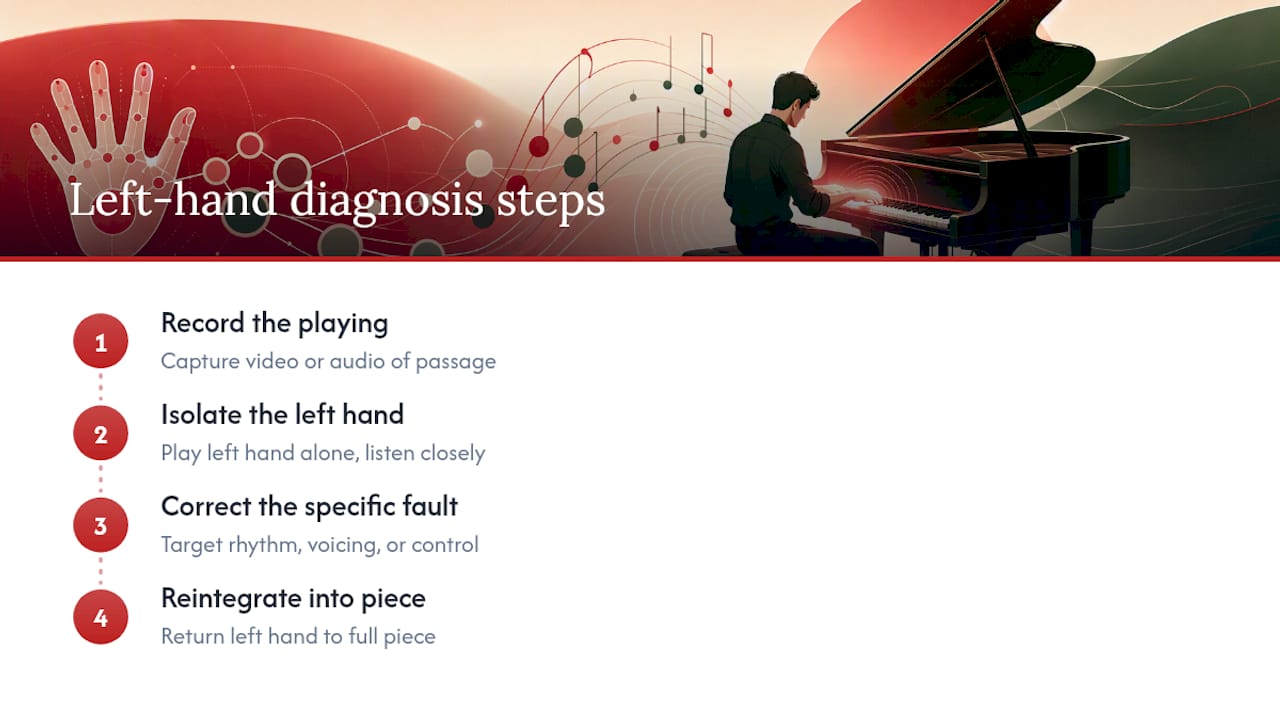
Diagnosing a weak left hand properly means working through four steps in order: record the playing, isolate the hand, correct the specific fault, then reintegrate it into the full piece. Skipping straight to “more practice” without isolating the actual fault wastes weeks.
One recurring pattern among students: a player who sounded rhythmically unstable in a Chopin nocturne turned out to have a rock-solid left hand rhythmically, but a voicing problem, the accompaniment was simply too loud under the melody. Right-hand miming and targeted dynamic contrast work resolved it within a few weeks, not months.
For further reading on related technique, see how to improve finger independence, a practical guide to classical technique, and effective practice strategies.
Warm-up routines that build left-hand strength and flexibility
A proper warm-up prepares the left hand for controlled work rather than diving into fast repertoire cold. Start with slow, five-finger patterns played with a relaxed wrist, moving chromatically up and down the keyboard for two or three minutes. This wakes up the small intrinsic muscles of the hand without straining them.
Follow with gentle wrist rotations away from the keyboard, rolling the wrist in slow circles, to release tension before you start. At the keyboard, play simple broken chords across the full range of the hand, focusing on a loose, dropped wrist rather than a rigid one. Stiffness in the wrist is one of the most common hidden causes of left-hand fatigue, and it rarely announces itself until later in a practice session.
Move next into legato scale fragments, four or five notes at a time, listening for a smooth connection between fingers rather than gaps or bumps. This is a good moment to bring in material from a set of beginner-friendly piano exercises, which cover foundational patterns that translate directly into a left-hand warm-up.
Finish with a short stretch sequence for the fingers and forearm, ten to fifteen seconds per stretch, particularly if you have been sitting at a desk beforehand. A cold hand asked to jump straight into fast octaves is far more likely to tense up than one that has had five genuine minutes of graded warm-up. Ten minutes total is enough. The goal is readiness, not fatigue before you have even started the real practice.
Does posture affect left hand weakness at the piano?
Posture and hand position affect left-hand control more than most players expect. Sit at a height where your forearms are roughly level with the keys, neither pushed up nor angled down, since an incorrect bench height forces the wrist into compensating positions that tire the hand faster on the side doing less habitual work, usually the left.
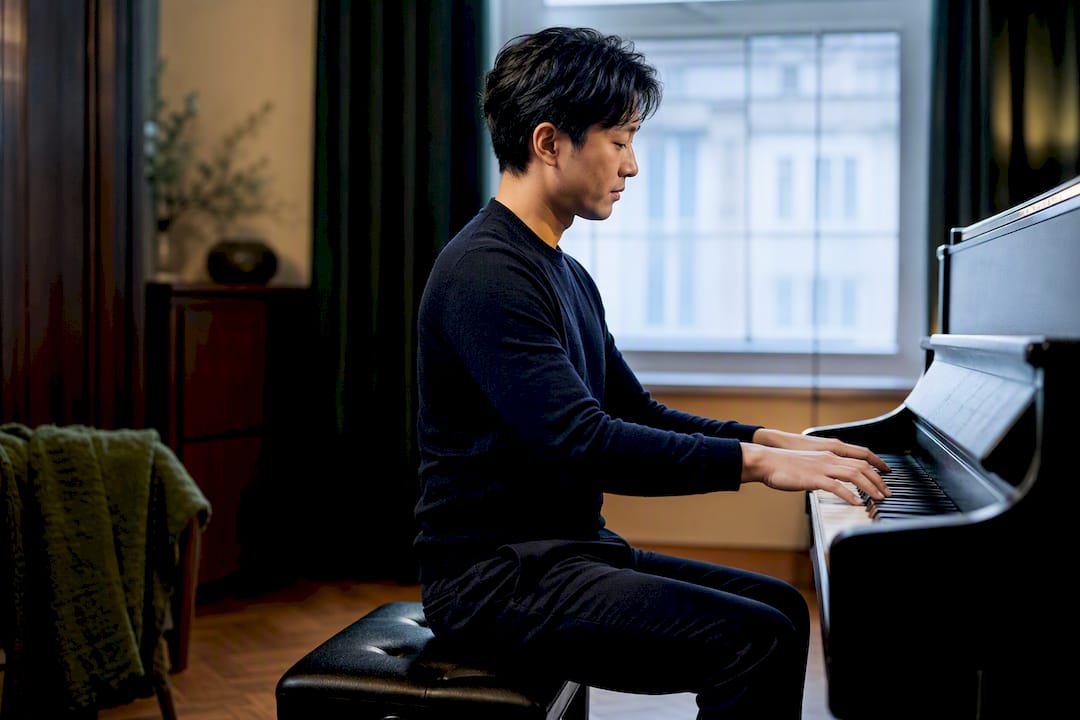
Keep your left wrist in a relatively neutral line with your forearm rather than collapsed downward or cocked upward. A dropped wrist restricts the small muscles that control finger independence, which shows up exactly as the “muddy voicing” or “uneven rhythm” symptoms already covered. Position your bench close enough that you are not reaching forward with locked elbows for left-hand bass notes, since that reach adds unnecessary tension right where you need relaxation most.
Check your seat position relative to the centre of the keyboard too. Players who sit slightly to the treble side, favouring the right hand visually, often develop a left hand that has to stretch and twist awkwardly for lower notes. Centring yourself on middle C corrects this quietly, without any exercise required. Small adjustments here remove a surprising amount of the physical strain that gets mistaken for muscular weakness.
Can mental practice improve left hand coordination?
Mental practice, rehearsing a passage in your head without touching the keys, genuinely strengthens left-hand coordination, and it costs nothing but attention. Sit with the score, or recall the passage from memory, and mentally “play” the left-hand part slowly, visualising exactly which finger touches which key and in what order.
This works because much of what feels like weakness is really a gap in the motor plan, not the muscles carrying it out. Away-from-keyboard tapping drills, already covered in the exercises section, are one version of this. A quieter version is simply closing your eyes and imagining the left-hand pattern at performance tempo, checking whether you can picture every movement without hesitation. If you stumble mentally, you will stumble physically.
Use mental practice in short bursts, two or three minutes, ideally right before or after a physical practice session rather than instead of one. It is particularly useful for jumps, since visualising the landing point before attempting it physically reduces the hesitation that causes late or missed notes. Many players skip this entirely because it feels unproductive compared with playing, but it is one of the few free tools available for retraining the coordination problem at its actual source, the brain’s motor plan, rather than the fingers themselves.
Which pieces are best for building left-hand strength?
Certain repertoire is written specifically to put the left hand under the spotlight, which makes it useful practice material rather than just a nice piece to learn. Berens’ Die Pflege der linken Hand, Op.89 sits at the top of that list, a full set of studies composed purely for left-hand development, ranging from simple to genuinely demanding.
Beyond Berens, look at Chopin’s études and nocturnes where the left hand carries wide arpeggiated accompaniments, since these force accuracy across large stretches without the safety net of a slow tempo. Bach’s two-part inventions are excellent for independence specifically, because each hand carries genuinely separate melodic material rather than one hand simply accompanying the other.
For a gentler entry point, look at simple boogie-woogie or blues bass patterns, which repeat a manageable left-hand figure enough times that the motor pattern locks in quickly. Left-hand-alone arrangements of well-known melodies, often found in intermediate method books, serve the same purpose as Berens but with more musical variety. Whatever you choose, the goal is repertoire where the left hand is doing real technical or musical work, not just holding down a chord, so the practice you put in transfers directly to the weakness you are trying to fix.
Why most left-hand advice misses the real problem
Most advice on this topic treats left-hand weakness as a strength deficit and prescribes more repetition, which is exactly backwards. The evidence points to a coordination gap, and repetition without a specific diagnosis just reinforces the existing motor habit rather than replacing it.
What gets underestimated is how much voicing problems masquerade as rhythm problems. A student who sounds unsteady is often perfectly steady but poorly balanced, with the left hand drowning the phrasing rather than mistiming it. Right-hand miming exposes that distinction in about thirty seconds, yet it is one of the least-used techniques among self-taught players.
Prioritise diagnosis before exercise selection. A week spent correctly identifying whether the fault is rhythm, voicing or coordination saves a month of practising the wrong drill. That is the gap between advice that sounds sensible and a routine that actually closes the distance between your two hands.
— Dan
How Dan Piano Studio can help you fix a weak left hand
Self-diagnosis gets you far, but a second pair of ears catches things you cannot hear in your own playing. A focused lesson at Dan Piano Studio starts with a proper assessment of your left hand, identifies exactly which of the four problem categories you fall into, and builds a tailored 4-week target plan with specific homework between sessions.

Lessons run both in person and online, so a tailored left-hand programme works whether you prefer sitting at a real piano with a teacher beside you or joining from home. Expect a clear structure rather than vague encouragement: an initial diagnosis, exercises matched to your actual fault, and weekly checkpoints so you can see the improvement rather than just hope for it.
If you want that kind of targeted feedback rather than guessing at exercises alone, book a home piano lesson or try an online piano lesson and bring a recording of your playing to the first session.
Sources
Recommended


Comments