


Keyboard vs digital piano: what London families should buy

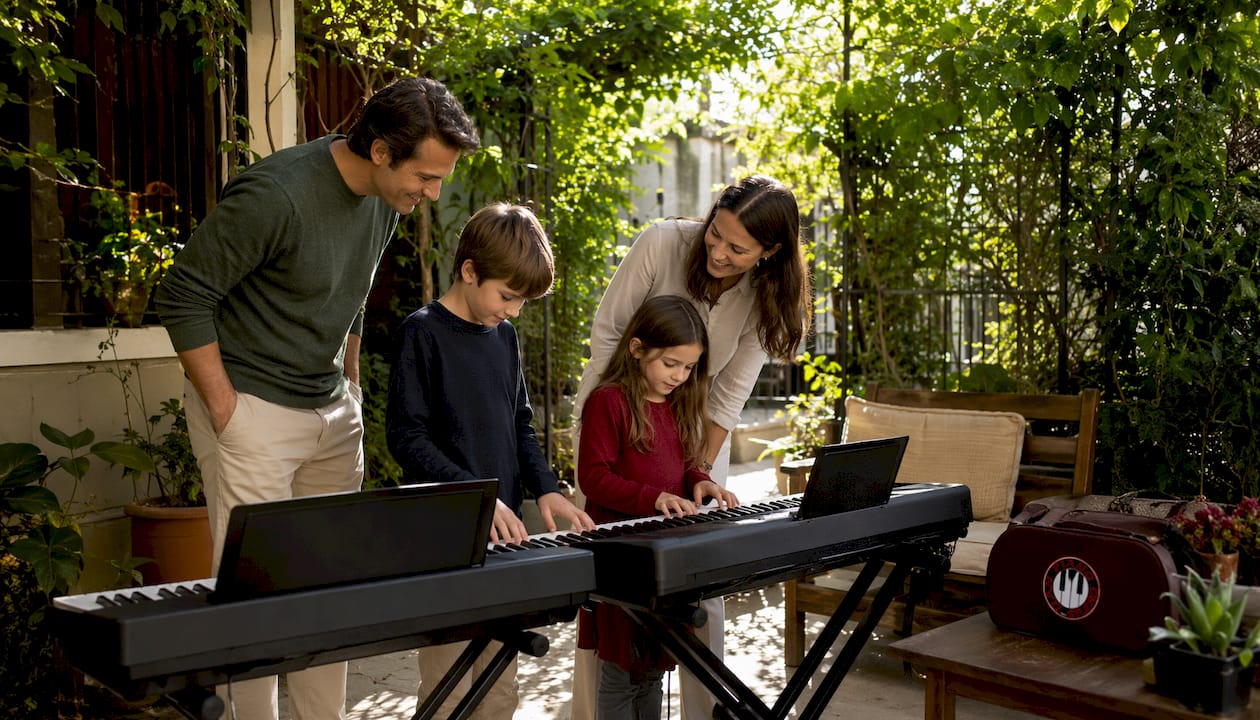
For most students preparing for ABRSM or Trinity exams, a digital piano with 88 graded hammer keys is the right first instrument. That single choice affects technique, exam readiness, and how quickly a student progresses with a teacher at Danpianostudio.
Technique transfer: 88 weighted keys with graded hammer action replicate the resistance of an acoustic piano, building the finger strength and control that classical and jazz repertoire demands.
Practice features: headphone output, onboard recording, metronome, and USB/MIDI connectivity all support structured daily practice and teacher-led feedback, whether lessons are in-person or online.
Household fit: digital pianos require no tuning and stay in tune regardless of seasonal humidity changes, cutting maintenance costs and lesson disruption entirely.
Table of Contents
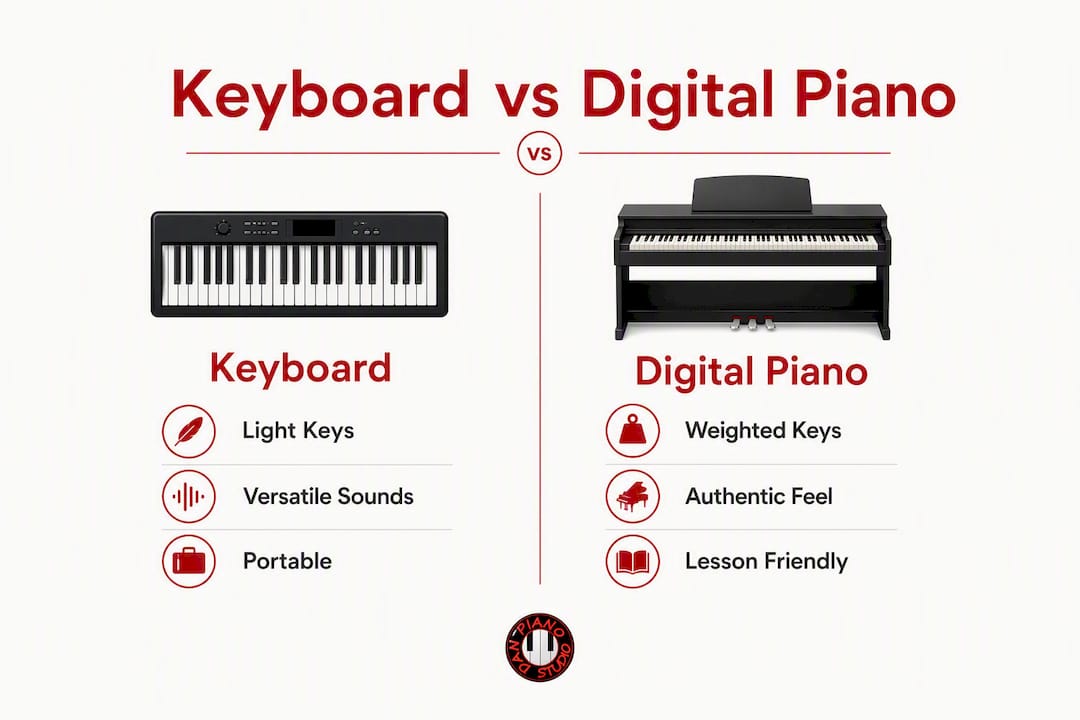
How do keyboards and digital pianos compare for lessons and exams?
Dimension | Keyboard | Digital piano |
Best for | Beginners exploring music, production, band use | Classical/jazz lessons, ABRSM/Trinity exam prep |
Keys | 61–76 | 88 |
Key action | Synth or semi-weighted (spring-assisted) | Fully weighted, graded hammer action |
Sound focus | Hundreds of voices, auto-accompaniment | High-quality acoustic piano samples |
Polyphony | Variable; often adequate | 64–256 notes; handles complex exam repertoire |
Practice features | Basic; headphone jack common | Recording, metronome, twin headphone sockets, lesson modes |
Connectivity | USB/MIDI on mid-range models; sustain pedal socket varies | USB/MIDI standard; sustain pedal socket standard |
UK price range | £80–£300 | ~£350 upwards |
Weight/portability | Lightweight; battery-powered options | Mid-weight; mains-powered |
Maintenance | None | None (no tuning required) |
Lesson/exam verdict | Reasonable short-term for young beginners | Recommended for all exam-focused students |
What specs do teachers actually expect for classical and jazz lessons?
The minimum acceptable instrument for structured lessons is not a matter of preference. Teachers preparing students for graded exams need specific hardware to do their job properly.
Non-negotiable minimums:
88 keys: exam repertoire at Grade 4 and above regularly uses the full keyboard range. A 61-key instrument simply cannot play certain pieces.
Fully weighted, graded hammer action: this is the single most important spec. Graded weighting means bass keys are heavier than treble keys, exactly as on an acoustic piano. It builds the finger independence and dynamic control that examiners assess.
Touch sensitivity (velocity response): without it, every note sounds at the same volume regardless of how hard you play. Dynamic shaping is a core ABRSM and Trinity criterion.
Sustain pedal socket: legato phrasing and much of the standard repertoire is unplayable without a sustain pedal.
Decent polyphony: 64 notes minimum; 128 or above handles layered chords and sustained passages without notes cutting out mid-phrase.
Headphone jack: non-negotiable for flat-sharing families and evening practice.
USB/MIDI: connects to lesson apps, recording software, and supports teacher feedback during online piano lessons.
Pro Tip: Look for twin headphone sockets. During in-person lessons, a teacher and student can listen together privately and identify technical issues in real time, without disturbing anyone else in the house.
When does a keyboard actually make sense?
A keyboard is not the wrong answer for every family. The question is whether the student’s goals match what a keyboard can deliver.
A young child aged five or six who is genuinely uncertain whether they want to pursue piano is a reasonable candidate for a starter keyboard. The lower cost and lighter weight make it easy to try without a large financial commitment. If enthusiasm holds after six months, upgrading to a digital piano is straightforward.
Singer-songwriters, band players, and students with a strong interest in music production have different priorities. They need a range of sounds, auto-accompaniment features, and MIDI controller functionality that keyboards handle well. For them, choosing between classical and jazz pathways matters more than key action weight.
The limitation becomes clear around Grade 3–4. Students who have practised on unweighted or semi-weighted keys often struggle when they sit at an acoustic piano for an exam or lesson. Finger control developed on light synth keys does not transfer cleanly to the heavier, graded resistance of a real instrument. Most teachers recommend switching to a fully weighted instrument by Grade 2 at the latest if classical exams are the goal.
Why digital pianos are generally the better choice for lessons
Instrument choice should follow the student’s goals, and for classical or jazz technique, the case for a digital piano is straightforward.
Graded hammer action builds genuine finger strength and independence, the foundation of reliable technique at every grade.
Expressive dynamics are only possible with velocity-sensitive, weighted keys. Shaping a phrase in Chopin or a jazz ballad requires the instrument to respond to touch, not just register a keypress.
Realistic piano samples with adequate polyphony mean the student hears what their technique actually sounds like, which matters for self-correction and musical ear training.
Recording and playback let students review their own playing between lessons, catching errors before they become habits.
“Digital pianos do not require tuning and are less sensitive to temperature and humidity than acoustic pianos,” notes JP Piano Tuning, a professional piano tuning service. For London families in flats or terraced houses, that consistency is a genuine practical advantage: no seasonal pitch drift, no emergency tuner call before an exam.
At higher grades, specifically beyond Grade 4 or 5, some teachers recommend supplementing digital practice with occasional access to an acoustic piano to develop the subtler tonal control that advanced repertoire demands. A digital piano gets students there; an acoustic refines them further.
A practical buying checklist for London families
Before purchasing, measure the intended space and check these basics.
Item | What to check |
Floor space | Minimum 150 cm wide for a console model |
Doorway width | Most console digital pianos need at least 70 cm clearance |
Power socket | Mains-powered; position near a socket |
Bench | Adjustable height bench; standard fixed benches suit adults only |
Sustain pedal | Confirm a dedicated socket, not just a built-in half-pedal |
Headphones | Closed-back headphones (e.g. Sony MDR series) reduce bleed |
Warranty | Aim for two years minimum; check UK after-sales coverage |
UK price bands: entry-level digital pianos with graded hammer action start around £350; mid-range models with better samples and polyphony typically fall between £600 and £1,200; furniture-style console models run higher. Keyboards start from around £80 but rarely meet lesson-grade specs below £300; most models suitable for beginner lessons have 61–76 keys.
Try instruments in person at a London music shop before buying. Alternatively, book a short consultation lesson at Danpianostudio, where you can discuss specs with a teacher who prepares students for ABRSM and Trinity exams before committing to a purchase.
Setting up and maintaining your instrument at home
Position the piano away from direct sunlight and radiators. Temperature swings will not affect a digital piano’s tuning, but they can warp wooden cabinet models over time.
Set-up steps:
Place the instrument on a stable stand or its own furniture cabinet, not on a wobbly table.
Set bench height so the student’s forearms are roughly parallel to the floor, elbows at key level.
Connect the sustain pedal before the first lesson and confirm it responds correctly.
Route the power cable safely away from foot traffic.
Test headphone output and, if applicable, USB/MIDI connection to a tablet or laptop.
Maintenance for a digital piano is minimal: wipe keys with a dry or slightly damp cloth, keep liquids away, and have a technician check internal connections if any keys stop responding. Acoustic pianos, by contrast, need professional tuning two to four times a year and are sensitive to humidity. That ongoing cost is worth factoring into any budget comparison.
Pro Tip: Short daily sessions of 20–30 minutes beat a single long weekly session. Use the onboard recorder to capture a run-through at the end of each practice, then listen back before the next session. It takes two minutes and catches more errors than a teacher can spot in a single lesson.
Quick buying guide: what to look for and what to avoid
Must-have specs:
88 keys
Graded hammer action (not “weighted” or “touch-sensitive” alone)
Sustain pedal socket
Headphone jack
USB/MIDI port
Acceptable compromises on a tight budget:
Slightly lower polyphony (64 notes is workable; below 32 is not)
Fewer built-in sounds (irrelevant for classical students)
Portable slab design rather than a furniture cabinet
Red flags:
“Weighted” in the listing without specifying graded hammer action; sellers often use “weighted” to describe touch-sensitive or semi-weighted keys that feel nothing like an acoustic piano.
No sustain pedal socket, or only a built-in rocker switch.
Polyphony below 32 notes.
No headphone output.
For online purchases, check the returns policy before buying. Most major UK retailers offer 30-day returns on instruments; confirm this covers opened boxes. A best classical piano for beginners guide can help narrow down specific models once the spec checklist is met.
Key takeaways
For exam-focused students in London, a digital piano with 88 graded hammer keys is the correct instrument choice, and no amount of budget saving on a keyboard justifies the technique gap it creates.
Point | Details |
88 keys are non-negotiable | Exam repertoire at Grade 4 and above requires the full keyboard range. |
Graded hammer action builds real technique | Weighted keys develop the finger strength and dynamic control examiners assess. |
No tuning needed | Digital pianos stay in tune year-round, cutting household costs and lesson disruption. |
Keyboards suit specific goals | Young explorers, band players, and producers benefit from a keyboard’s range and portability. |
Danpianostudio advises before you buy | A consultation lesson at Danpianostudio helps families choose the right instrument for their exam pathway. |
A teacher’s perspective on instrument choice
The most common mistake families make is buying an instrument that suits the price rather than the goal. A keyboard at £150 feels like a sensible hedge when a child has just started lessons. Six months later, when the student is working on Grade 1 pieces and struggling to control dynamics on a weighted piano at the exam centre, that saving starts to look expensive.
Weighted keys are not a luxury feature. They are the mechanism by which a student learns to play piano rather than just press keys. Every ABRSM and Trinity examiner assesses tone production, dynamic shaping, and articulation. None of those qualities can be practised reliably on synth-action keys.
At Danpianostudio, lessons in Central London and online cover classical piano, jazz, and full ABRSM and Trinity exam preparation. Part of that preparation is making sure students practise on an instrument that matches what they will encounter in an exam room. Twin headphone sockets and recording tools are not extras; they are how a teacher and student diagnose problems together, whether the lesson is in Camden or on a screen.
The digital piano versus acoustic question matters less at the early stages than most parents think. A good digital piano with graded hammer action is a serious instrument. The gap only opens meaningfully at Grade 5 and above, and even then, occasional access to an acoustic is usually enough to bridge it.
Danpianostudio: lessons and instrument advice for London families
Choosing the right instrument is easier when a teacher is involved from the start. Danpianostudio offers piano lessons in Central London and online for children, adults, beginners, and students preparing for ABRSM and Trinity exams. Classical piano, jazz, improvisation, and music theory are all covered, with lessons tailored to each student’s pace and goals.
Before you buy, book a trial lesson or short consultation. Dan can advise on the right spec for your child’s current level, flag which models offer genuine graded hammer action in your budget, and set up a practice routine that works from day one. Book your first lesson at danpianostudio.com and start with the right instrument under your fingers.
Useful sources and further reading
ABRSM — the UK’s leading music exam board; check syllabus requirements and approved repertoire lists to confirm which grades require specific technical standards.
Trinity College London — alternative graded exam pathway; useful for comparing exam formats and instrument requirements alongside ABRSM.
JP Piano Tuning: digital vs acoustic — professional tuner’s perspective on maintenance differences; supports the no-tuning advantage cited in this article.
Roland: six benefits of learning on a digital piano — manufacturer guidance on practice features including recording, twin headphone sockets, and metronome use.
MusicRadar: digital piano vs keyboard — accessible overview of key action types, voice counts, and portability differences; useful for first-time buyers.
Yamaha: digital piano vs keyboard — manufacturer explanation of graded weighting, polyphony, and instrument design goals; backs the goal-matching advice in this article.
Best Digital Piano: digital piano vs keyboard buying guide — detailed spec comparisons including key counts, weight ranges, and action types; supports the comparison table figures.
Recommended



Comments