


Jazz jam sessions in London: where players and listeners go


Six venues anchor London’s weekly jam circuit right now: Vortex Jazz Club on Sundays, Grow Hackney’s Stratos jam on Thursdays, Toulouse Lautrec on Tuesdays, The Jago and Effra Tavern for community nights, and The Distillers in Hammersmith monthly. Cover charges are modest. Vortex, for instance, charges £6 at the door but lets participating musicians in free. For a bigger annual fix, the EFG London Jazz Festival pulls in touring acts every autumn.
Check tonight’s line-up before you leave the house:
Musicians wanting a slot: message the host on Instagram in advance, or simply arrive early and put your name down.
Listeners: turn up around doors, not after the first set, if you want a seat.
Everyone: Jazz Near You’s London calendar is the fastest way to confirm a jam is actually running tonight.
Key Takeaways
Regular preparation and knowing each venue’s format matter more for a good jam experience than raw talent alone.
Point | Details |
Start with community nights | Grow Hackney and The Jago welcome beginners; Vortex and Toulouse Lautrec expect sharper playing. |
Check listings same day | Use venue pages for last-minute changes and Jazz Near You for planning ahead. |
Arrive early and introduce yourself | Speak to the host or house band before the first set to secure a slot. |
Keep solos short | Support the soloist and rhythm section rather than chasing long stage time. |
Build skills before you go | Danpianostudio’s jazz lessons target comping and ii–V–I fluency that jams demand directly. |
Table of Contents
Weekly and monthly jazz jam sessions in London worth bookmarking
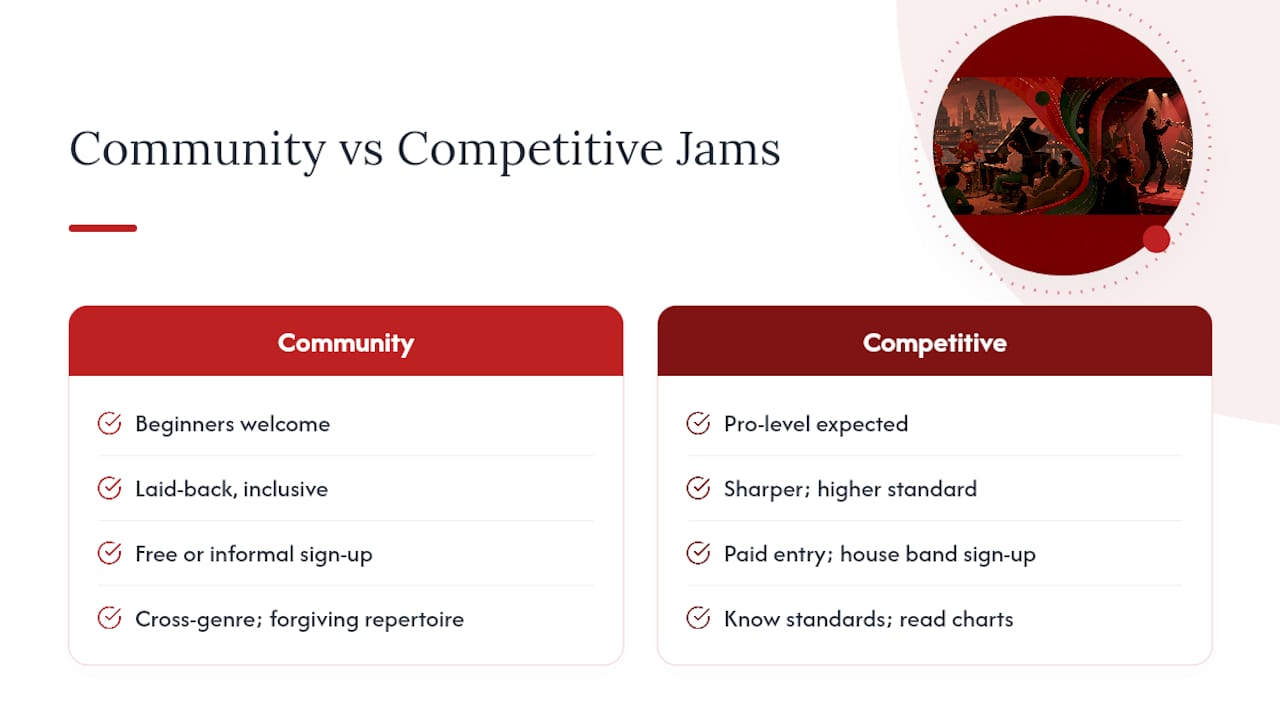
London’s jam scene splits roughly into two moods: the community nights where anyone with an instrument and a bit of nerve gets a turn, and the sharper, more competitive rooms where the house band expects you to already know your changes. Knowing which is which before you turn up saves an awkward evening.
Vortex Jazz Club, Dalston runs its jam every Sunday, doors at 7:45pm and music from 8:15pm. Entry is £6, free for members and for musicians taking part. This is one of the more respected rooms on the circuit, so expect a higher standard of playing and come with tunes you can actually deliver.

Grow Hackney’s Stratos jam happens every Thursday from 7pm to 11pm in a warm, canalside space. Entry is free for jammers, and the resident band takes requests to join via Instagram beforehand, which is worth doing if you are nervous about walking in cold.
Toulouse Lautrec in Kennington runs a Tuesday jam with a rotating theme each week: New Orleans one week, Latin the next, then funk, then blues. The full monthly schedule sits on the venue’s jam sessions page, so check before committing to a particular style.
The Jago in Dalston and Effra Tavern in Brixton both lean firmly community. SOAS’s rundown of London’s weekly jam spots singles these out, alongside The Haggerston and the Orii Jam, as nights where cross-genre playing and beginners are actively welcomed rather than tolerated.
The Spice of Life in Soho has hosted jazz jams for years and sits right in the West End, handy if you’re coming from work or a show.
Morocco Bound Bermondsey runs MB Jazz monthly, a forward-thinking improvised music night focused on original compositions rather than standards. If you’re bored of playing “Autumn Leaves” for the hundredth time, this is where to head.
The Distillers, Hammersmith hosts a monthly jam in its upstairs function room with a resident house trio, sets usually starting around 7:30pm. Contact the venue directly for sign-up details.
A quick rule of thumb: Vortex and Toulouse Lautrec reward players who already read charts fluently and know their standards. Grow Hackney, The Jago, and Effra Tavern are far more forgiving of nerves and rough edges.
How should a musician approach joining a jam session?
Arrive early, find the host or house band before the first set, and introduce yourself with a couple of tunes you can play confidently in any key. That single habit does more for your reputation than any solo will.
Sign-up systems vary by venue, so know which you’re walking into:
House band then open floor — most common at Vortex and Toulouse Lautrec; the resident band plays first, then calls players up.
Sign-up board — write your name and instrument on arrival, then wait your turn.
Message the host beforehand — Grow Hackney’s Stratos jam explicitly invites this via Instagram, which suits anyone unsure of the house rules.
What to bring: two or three tunes you know cold, written chart references for anything obscure, spare cables if you’re plugging in, and a clear sense of your set length, usually two or three tunes per turn.
Pro Tip: Keep your first solo short. Nobody remembers a jam player for playing sixteen choruses. They remember the one who left space for everyone else and made the rhythm section sound good.
Etiquette matters more than chops here. Listen properly while others play rather than scrolling your phone, support the soloist with your comping, and never step on a vocalist’s line. Our guide to jazz piano chords for beginners is a solid place to shore up the basics before your first night out.

What should you expect as an audience member at a jazz jam?
Most nights run on a low, informal cover, often around £5 to £10, sometimes free before a certain hour. Vortex sets its standard at £6, waived for musicians and members, which gives a decent sense of the going rate across similar rooms.
Turn up close to the doors time rather than after the first set if you want a table, and don’t expect much in the way of formal seating at pub-based jams like Effra Tavern. A drink at the bar is the simplest way to support the room. During solos, hold the applause and chatter until the phrase actually resolves. Photography is generally fine for personal use, but ask before filming a full set, especially at smaller community nights where players may not want footage circulating.
Where to check tonight’s jazz jam listings in London
Venue pages are your most reliable source for last-minute changes, cancellations, or theme swaps. Toulouse Lautrec’s own schedule, for instance, tells you exactly which theme is running each Tuesday.
For scanning multiple venues at once, Jazz Near You’s London calendar aggregates jam and gig listings across the city, though occasional lags mean a venue’s own page still wins for same-day accuracy. Eventbrite catches ticketed one-off nights that regular jams don’t bother listing. Instagram is where most house bands post reminders and last-minute changes, so following Grow Hackney or your favourite venue directly is worth the five minutes it takes.
Use Jazz Near You for planning a week ahead, and the venue’s own page or social feed for confirming tonight is actually happening.
How lessons prepare you for a jazz jam session
Structured tuition shortens the gap between knowing jazz theory and actually surviving your first jam. Comping patterns, ii–V–I fluency, and quick transposition are the three skills that separate a confident player from one frozen mid-tune when the key changes without warning.
Danpianostudio’s jazz lessons in Central London, Camden, and King’s Cross, plus online courses for improvisation and theory, focus directly on these gaps. Our piece on learning jazz piano online breaks down a practical routine you can start this week.
If you can only work on one thing before your next jam, make it ii–V–I patterns in every key. Nothing shows up more often in standards, and nothing exposes weak preparation faster.
A newcomer’s route through London’s jam scene
I’d start at the community nights, Grow Hackney or The Jago, before ever setting foot in a room like Vortex. The variety in this city genuinely surprised me: some nights feel like a rehearsal room with an audience, others feel like an exam. Listen more than you play early on. Relationships with hosts get you further than any solo ever will.
Get jam-ready with tailored jazz piano lessons
The venues above will sharpen your ear over time, but the fastest route to sounding confident on a Thursday at Grow Hackney or a Sunday at Vortex is targeted practice between now and your next visit. Danpianostudio runs jazz piano tuition across Central London, Camden, and King’s Cross, plus online lessons for anyone who can’t get to a studio in person, built around exactly the skills jams demand: comping, improvisation, and fast key changes.
Lessons are shaped around where you actually are, whether that’s your first attempt at a blues in F or tightening up ii–V–I lines you already half know. If you’d rather work from home first, our jazz piano instruction page explains how the approach translates into real ensemble playing. Book a home piano lesson or start with a trial lesson to see what a focused session before your next jam actually feels like.
Frequently asked questions
Are jazz jam sessions in London free to attend? Most charge a small cover, often around £5 to £10. Vortex sets its standard at £6, waived for members and playing musicians, which is fairly typical across similar venues.
Do I need to be a professional to play at a London jam? No. Community nights like Grow Hackney’s Stratos jam and The Jago actively welcome beginners, while Vortex and Toulouse Lautrec suit players who already know standards confidently.
How do I sign up to play at a jazz jam? It depends on the venue. Some use a sign-up board on arrival, others run a house band then open floor, and some, like Grow Hackney, prefer you message the host on Instagram beforehand.
What should I bring to my first jam session? Two or three tunes you know well in any key, chart references for trickier pieces, and any cables or accessories your instrument needs. Confidence in a handful of standards beats a long repertoire you’re shaky on.
Where can I check what’s on tonight? Jazz Near You’s London calendar aggregates listings across venues, but the venue’s own page or Instagram is more reliable for last-minute changes or cancellations.
Sources
Recommended


Comments