


Pianists: Hear Functional Harmony on Piano in 2–3 Weeks with Playable Drills

Functional harmony maps every chord to a role relative to a tonal centre: tonic (home), predominant (tension building), or dominant (tension demanding resolution). The fastest way to hear this at the keyboard is a simple loop: play C–Am–Dm–G7–C, then transpose it through all 12 keys. Do that for a week and you will start hearing pull rather than just naming chords, sharpening your ear, your voicing choices, and your ability to analyse a score at sight.
TL;DR:
Transposing the common C–Am–Dm–G7–C loop through all 12 keys weekly sharpens ear recognition of pull and voice leading.
Playing root, guide-tone, and voicing ladder exercises in multiple keys helps internalize functional roles and smooth transitions.
Proper voicing spacing, omission, and resolution prevent harsh intervals like extended 11ths, simplifying handling non-diatonic chords.
Analyzing progressions with attention to bass movement, cadences, and inner voice motion improves accurate harmonic function identification.
Focused drills on guide tones, transposition, and voice leading accelerate hearing and executing functional harmony in jazz, classical, pop, and blues styles.
Table of Contents
What is functional harmony on piano? Tonic, subdominant and dominant explained
Functional harmony in major keys: cadences, guide tones and the circle of fifths
Minor keys, borrowed chords and when a chord stops being “functional”
Jazz piano application: mastering the ii–V–I and its voicings
A step-by-step workflow for Roman numeral analysis at the piano
Weekly practice drills to internalise functional harmony faster
Historical context and evolution of functional harmony in piano music
Non-diatonic chords: modal interchange and altered dominants explained
Functional harmony beyond jazz: classical, pop and blues piano
Learn functional harmony faster with structured piano lessons
What is functional harmony on piano? Tonic, subdominant and dominant explained
Every chord in a tonal piece does one of three jobs. Tonic chords feel settled and act as home base. Subdominant (also called predominant) chords create motion away from that stability, leaning towards tension. Dominant chords generate the strongest pull of all, demanding a return to tonic. This three-way grouping, sometimes called the tonic → predominant → dominant cycle, is the backbone of nearly all Western tonal music, and it is exactly what Berklee’s Harmony 2 course materials use to organise chord vocabulary for jazz and classical students alike.
In a major key, each function has typical members:
Tonic group: I (the home chord), iii, and vi, all sharing tones with the tonic triad and carrying a settled quality.
Subdominant/predominant group: ii and IV, both a step or third from tonic, pulling the ear away from rest.
Dominant group: V and vii°, both containing the leading note, which is what generates that strong urge to resolve back to I.
Why does this grouping hold together? Shared tones and root relationships. The vi chord shares two notes with I, so it can substitute for tonic without disrupting the sense of “home.” The ii chord shares two notes with IV, which is why Berklee’s materials describe ii7 as an alternate subdominant rather than a separate category.
Try this at the keyboard: play I, then IV, then V, then back to I, listening only to the bass line. Notice how the roots move by a fourth or fifth each time. That fifth relationship, not the chord symbols themselves, is what makes the motion feel purposeful. Root motion by fifths is the engine behind nearly every functional harmony piano exercise you will meet, from simple hymn cadences to complex jazz turnarounds.
Functional harmony in major keys: cadences, guide tones and the circle of fifths
Cadences are where function becomes audible. Two patterns do most of the work in major-key writing: the authentic cadence (V–I, or its extended form ii–V–I) and the plagal or “amen” cadence (IV–I). The ii–V–I is worth memorising above all others, because it appears constantly in classical repertoire and forms the single most common progression in jazz standards.
What actually carries the sense of resolution isn’t the chord symbols. It is guide-tone movement, meaning the third and seventh of each chord resolving smoothly into the next. In a ii–V–I in C major (Dm7–G7–Cmaj7), the F in Dm7 slides down to become the third of G7, and the F in G7 resolves down to E, the third of Cmaj7. That half-step and whole-step motion in the inner voices is what your ear actually tracks, even if you consciously hear “chord changes.”
Three exercises build this skill quickly:
Play root-position triads in a I–IV–V–I loop, listening for the bass leaping by fourths and fifths.
Isolate the guide tones: play just the third and seventh of each chord in a ii–V–I, moving hand position as little as possible.
Transpose the same ii–V–I through the circle of fifths, one key per day, so your fingers learn the shape rather than memorising twelve separate chord sets.
The circle of fifths itself is a practical map, not just theory decoration. Descending dominant chains, ii–V–I preceded by another ii–V a fifth away, extend this logic into longer sequences, a technique Yamaha’s own explanation of functional harmony describes as one of the simplest ways to build extended progressions and set up target chords further down the line.
Pro Tip: Practise the ii–V–I with your right hand playing only guide tones and your left hand playing roots. Once that feels automatic, add the fifth and any extensions. Voicing complexity should come after the guide-tone motion is secure, never before.
Minor keys, borrowed chords and when a chord stops being “functional”
Minor keys complicate the dominant function because the natural minor scale doesn’t contain a leading note. The seventh degree sits a whole step below the tonic, producing a weak v chord that barely pulls anywhere. To recreate a proper dominant pull, composers raise that seventh degree, borrowing from the harmonic or melodic minor scale to produce V or V7, complete with the leading-note tension that natural minor lacks.
This single adjustment explains a huge amount of minor-key harmony. A piece in A minor will often show a G natural in its key signature but a G sharp appearing specifically in dominant chords, because that raised note is doing the work of creating resolution.
Chromatic colour complicates matters further, and this is where students often over-label:
Secondary dominants (a V7 of a chord other than the tonic, such as V7/ii) intensify motion towards a specific target chord without changing key.
Modal interchange (borrowing a chord from the parallel minor or major, like a borrowed iv chord in a major key) adds colour without necessarily setting up a cadence.
Passing and neighbouring chords decorate the line between two functional chords and shouldn’t be assigned tonic, predominant, or dominant status at all.
The test is simple: does the chord resolve somewhere specific, driven by voice leading, or is it decorative? A borrowed iv chord in a major-key ballad often just adds a darker shade before returning to the same predominant or tonic function the diatonic IV would have served. Academic work on tonal theory cautions against reducing every chord to a rigid label, since root motion, scale-degree, and functional theories each capture different aspects of what’s actually happening, and relying on your ear alongside Roman numerals gets you further than dogmatic labelling alone.
Jazz piano application: mastering the ii–V–I and its voicings
If you learn one progression from this entire guide, make it Dm7–G7–Cmaj7. It is the jazz equivalent of scales for a beginner violinist: everything else builds on it. The practice sequence recommended by music theory courses moves through four stages, each adding a layer of realism without losing the underlying guide-tone motion.
Root position seventh chords. Play Dm7, G7, and Cmaj7 exactly as spelled, hands together, slowly. This confirms you know the chord tones before you start rearranging them.
Close voicings. Keep the same notes but stack them within an octave, so your hand doesn’t leap between chords.
Shell voicings. Drop to just the root, third, and seventh (sometimes root and seventh only), which is what most working jazz pianists actually play under a melody or soloist.
Rootless voicings. Remove the root entirely (a bass player or your own left hand covers it), leaving the third, seventh, and any extensions or alterations, which is standard practice for comping in a group setting.
Guide tones dictate what happens when you add extensions. The 9th, 13th, or an altered 5th or 9th on the dominant chord can all sit comfortably above the third and seventh, provided those two notes still resolve smoothly into the next chord. Get the guide tones right first; extensions are decoration, not structure.
Two drills cement this faster than anything else. First, sing the guide tones (just the third and seventh) while playing the full voicing, forcing your ear to track the resolving line consciously. Second, do a guide-tone reduction: strip a full jazz voicing down to only those two notes and play the progression that way, then rebuild the full chord and compare how much of the emotional pull survives in the stripped-down version. If you’re new to seventh chords and voicing types generally, a beginner’s guide to jazz piano chords is worth working through before tackling rootless voicings.
Pro Tip: Transpose the shell voicing version of Dm7–G7–Cmaj7 through all 12 keys before you touch the rootless version. Shell voicings force your ear to hold onto the guide tones without the safety net of extra notes to hide behind.
For a deeper dive into voicing types and how to practise them systematically, this practical guide to jazz piano voicings walks through the same progression with additional fingering guidance.
A step-by-step workflow for Roman numeral analysis at the piano
Analysing a score by function goes wrong most often when students assign meaning from a chord’s spelling alone rather than its context. A reliable workflow avoids that trap by working through the same five steps every time:
Establish the key. Look at the key signature, but confirm it by checking where the piece actually resolves, not just what’s written at the start.
Label every chord with Roman numerals, including inversions, before you decide what any of them mean functionally.
Mark the cadences first. Find every V–I, ii–V–I, and IV–I moment, since these anchor points make the rest of the analysis easier to interpret.
Inspect the bass and inner voices. Function often reveals itself in stepwise or fifth-related bass motion rather than in the chord symbol itself.
Test every chromatic chord. Ask whether it is a secondary dominant, a borrowed chord, a passing chord, or evidence of a modulation, before assigning it a functional label.
Passing (P) and neighbouring (N) chords deserve their own notation rather than a Roman numeral treated as equal to a structural chord. Many editors put these in parentheses or mark them “P” or “N” to signal they’re decorative, not load-bearing.
The most common error is treating every seventh chord as inherently dominant just because it contains a seventh. A ii7 chord is a predominant, not a dominant, despite sharing the seventh-chord label. Function comes from scale-degree root and resolution behaviour, not chord quality alone.
Weekly practice drills to internalise functional harmony faster
Progress with functional harmony piano work comes from repetition across keys, not from reading more theory. A realistic weekly plan looks like this:
Day 1 to 2: Play C–Am–Dm–G7–C in root position, then transpose by ascending fifths through all 12 keys, once per day at a slow, even tempo.
Day 3: Repeat the same progression using a guide-tone reduction, playing only the thirds and sevenths in your right hand.
Day 4 to 5: Build a voicing ladder: root position, then close voicing, then shell voicing, then rootless, working through the ii–V–I in three or four keys per session.
Day 6: Pick a short piece or standard and run the full analysis workflow on eight to sixteen bars.
Day 7: Improvise freely over the same starter progression, using only what you’ve drilled that week.
For extra progression material to slot into this routine, six chord progressions worth learning early gives additional starting points beyond the basic I–vi–ii–V loop.
Drill | Focus | How you’ll know it’s working |
Root position transposition | Fifth relationships, key familiarity | You can play the loop in any key without stopping to think |
Guide-tone reduction | Voice leading, third/seventh resolution | The stripped-down version still sounds like it resolves |
Voicing ladder | Comfort with jazz voicing types | Rootless voicings feel natural, not like guesswork |
Full analysis pass | Roman numerals, cadence spotting | You can label a new piece in under ten minutes |
Measuring progress here isn’t about speed. It’s about whether your ear predicts the next chord before your eyes read it, and whether your voice leading stays smooth even when you’re moving fast.
The ‘forbidden chord’ myth and how to fix harsh voicings
There is no single chord that piano teachers universally ban. What gets called a “forbidden chord” is almost always a voicing problem specific to a style, not a rule about the chord itself. Berklee’s own harmonic theory teaching acknowledges that these avoidances are contextual rather than absolute.
The classic example: a diatonic 11th sitting directly above a major 7th. Played close together, that combination clashes badly against the chord’s third, producing a muddy half-step dissonance most ears find harsh in a jazz ballad context.
Three fixes solve it reliably:
Space it out. Move the 11th up an octave, away from the clashing third, and the harshness disappears.
Omit it. Drop the 11th entirely if the extension isn’t essential to the voicing’s colour.
Resolve it. Treat the clashing tone as a passing note that moves quickly to a consonant interval rather than sitting still.
For more on handling extensions without stumbling into these clashes, this guide to voicing 9ths, 11ths, and 13ths covers the same territory with specific drills.
Historical context and evolution of functional harmony in piano music
Functional harmony as a codified system emerged from the work of theorists analysing common-practice era composition, but the sound itself predates the theory by centuries. Baroque keyboard composers built entire pieces around predictable tonic-predominant-dominant cycles, often without any formal Roman numeral vocabulary to describe what they were doing instinctively.
The Classical era, particularly through Haydn and Mozart’s keyboard writing, tightened this cycle into the phrase structures still taught today: a clear tonic opening, a predominant push, a dominant arrival, and a tonic return, often within four or eight bars. Beethoven’s piano sonatas pushed against these boundaries, stretching predominant sections and delaying dominant resolution for dramatic effect, while still keeping the underlying function audible.
Romantic composers, particularly Chopin and Liszt, introduced far more chromaticism, borrowed chords, and extended dominant chains, testing how far a listener’s ear could stretch before losing the sense of a tonal centre altogether. This is where secondary dominants and modal interchange stopped being occasional colour and became structural tools.
By the early 20th century, jazz pianists absorbed this same functional framework but reorganised it around the ii–V–I cell as a repeatable building block, adding sevenths, extensions, and alterations that classical harmony had used more sparingly. The theoretical vocabulary changed, but the underlying tonic-predominant-dominant logic, the same one behind that first C–Am–Dm–G7–C loop, never actually left.
Non-diatonic chords: modal interchange and altered dominants explained
Non-diatonic chords aren’t a break from functional harmony. They usually take on a functional role borrowed from a related scale rather than existing outside the system entirely.
Modal interchange borrows a chord from the parallel major or minor key while staying in the same overall tonic. A minor iv chord appearing in a major-key ballad, for instance, still functions as a predominant, exactly as the diatonic IV would, just with a darker colour thanks to the lowered third. Reharmonisation examples using borrowed chords show how this works in practice across a handful of common progressions.
Altered dominants modify the fifth or ninth of a dominant chord (flat five, sharp five, flat nine, sharp nine) to intensify the pull towards resolution without changing which chord it’s resolving to. The dominant function stays exactly the same. Only the colour and tension level shift.
Secondary dominants, covered briefly earlier, work the same way: a V7 chord borrowed to target a scale degree other than the tonic, intensifying motion towards that specific chord for a moment before the harmony returns to its original key centre.
Tritone substitution deserves a specific mention here, since it’s one of the more disorienting-sounding altered dominant techniques until you understand the logic. Replacing a dominant chord with another dominant chord a tritone away preserves the same guide tones (the third and seventh swap roles) while completely changing the bass note and colour. Drills for hearing tritone substitution are worth working through once the basic ii–V–I feels automatic.
The common thread across all three techniques: none of them abandon function. They borrow, alter, or intensify it.
Voice leading principles for functional piano harmony
Good voice leading is what makes functional harmony actually sound functional rather than just theoretically correct on paper. Three principles do most of the work.
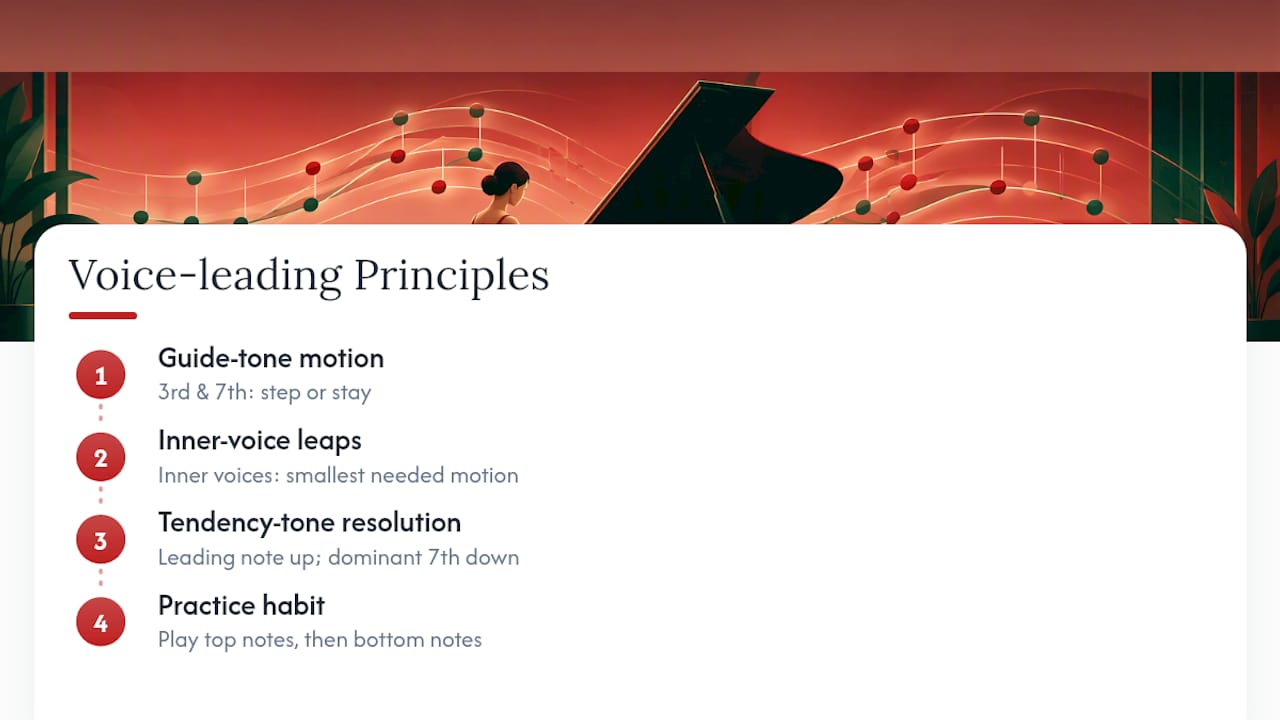
Keep guide tones moving smoothly. The third and seventh of each chord should move by step or stay in place wherever possible, rather than leaping. This is the same principle covered in the jazz voicing drills earlier, but it applies just as strongly to classical hymn-style writing.
Avoid unnecessary leaps in inner voices. The soprano and bass can move more freely, since the ear tracks them as the outer boundaries of the texture. Inner voices (alto and tenor equivalents on piano, meaning whatever sits between your outer hands) should generally move the smallest distance needed to reach the next chord.
Resolve tendency tones in the correct direction. The leading note wants to rise to tonic. The seventh of a dominant chord wants to fall. Breaking this expectation isn’t forbidden, but it should be a deliberate choice, not an accident of fingering convenience.
At the piano specifically, voice leading gets harder to track because both hands often double notes or split voices across registers in ways a four-part vocal score never would. The fix is the same one recommended for jazz guide-tone practice: isolate the moving lines by playing just the top note of each chord in sequence, then just the bottom, checking that each line makes sense on its own before judging the full texture. This single habit catches more voicing problems than any amount of visual score-reading.
How modulation works within a functional harmony framework
Modulation, meaning a genuine shift to a new tonal centre rather than a brief chromatic detour, works by temporarily reassigning a chord’s function before locking in the new key. The most common technique is the pivot chord: a chord that exists diatonically in both the old key and the new one, reinterpreted along the way.
Take a move from C major to G major. The chord Am functions as vi in C major, but that same Am chord (or more precisely, the shared tones around it) can also be heard leading naturally towards ii in G major. Once a dominant chord specific to G major appears, typically D7, the new key is confirmed and the old tonic no longer feels like home.
Secondary dominants often set up modulations before they become full key changes. A V7/V chord (D7 in the key of C) can either resolve back to the original tonic as a moment of colour, or it can persist and pull the music fully into G major if the composer keeps reinforcing it. The difference between a secondary dominant and a modulation is really a question of how long the new tonal centre is sustained and confirmed by its own cadence.
Direct modulation (an abrupt shift with no pivot chord) exists too, and it’s common in pop and gospel-influenced piano writing, where a song simply steps up a key for a final chorus. It sacrifices the smoothness of a pivot for immediate impact. Both techniques still rely on the same tonic-predominant-dominant logic. Modulation just means that logic has picked a new home.
Using functional harmony to improvise with confidence
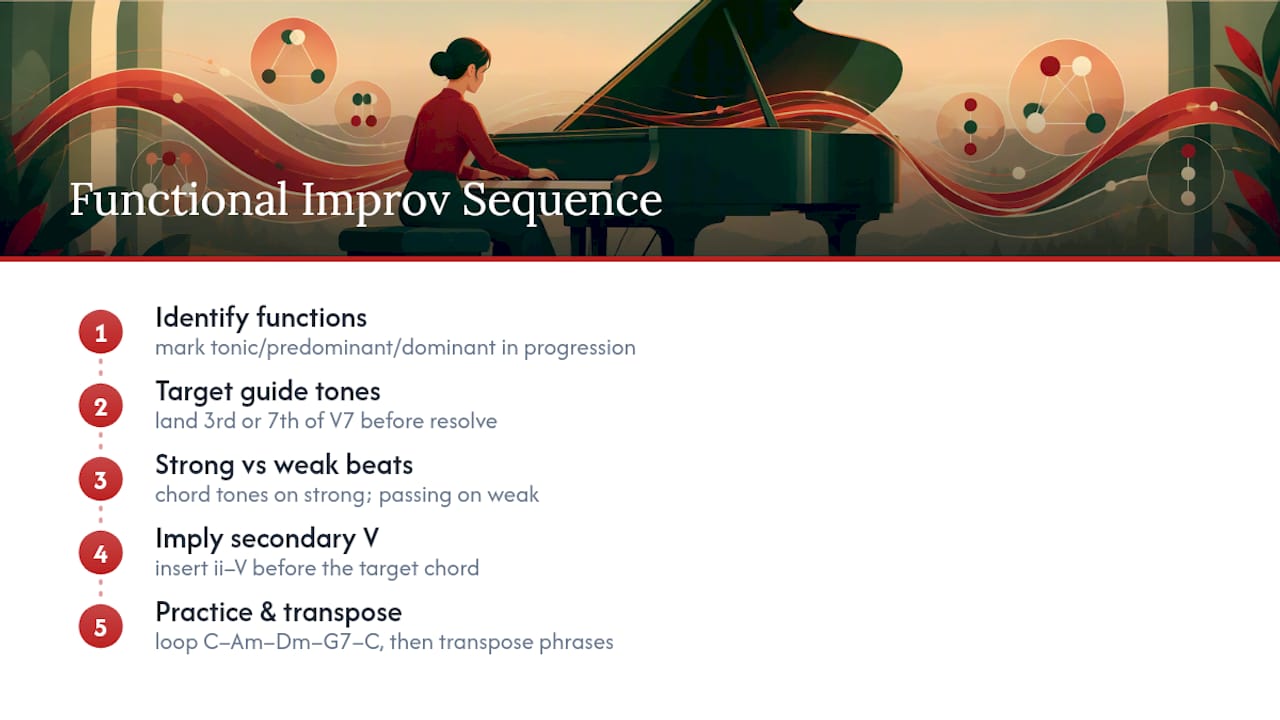
Improvisation gets far easier once you stop thinking note-by-note and start thinking function-by-function. Before you improvise over any progression, identify which chords are tonic, which are predominant, and which are dominant, because that tells you where the harmonic tension is building and where it’s about to release.
Target the guide tones of the dominant chord in your improvised line just before it resolves. Landing on the third or seventh of a V7 chord right before moving to tonic creates the same satisfying pull a well-voiced chord progression does, just expressed melodically instead of harmonically.
Use chord tones on strong beats and passing or scale tones on weak beats. This single rule, borrowed directly from voice-leading practice, keeps improvised lines sounding intentional rather than random, because your strongest melodic notes always land on notes that reinforce the underlying function.
Don’t be afraid to imply a secondary dominant even when the written harmony doesn’t have one. A ii–V–I outline can be inserted ahead of nearly any target chord in a jazz standard, a technique many improvisers use to add forward motion without needing the rhythm section to change anything. This works because your ear already understands the tonic-predominant-dominant cycle. Adding it briefly in a melodic line doesn’t confuse the listener. It reinforces exactly what they expect to hear.
Practise improvising over just the starter loop, C–Am–Dm–G7–C, in a single key until the shape feels automatic, then transpose the same improvised phrases to a new key rather than inventing fresh material each time. This trains your ear to hear function independent of key, which is the entire point of the exercise.
Functional harmony beyond jazz: classical, pop and blues piano
Functional harmony isn’t a jazz-specific system. Jazz simply reorganised an existing framework around the ii–V–I cell. Classical, pop, and blues piano writing all lean on the same tonic-predominant-dominant cycle, just with different surface habits.
Classical piano writing tends to favour longer phrase structures with clearly delayed dominant resolution, especially in sonata-form development sections, where composers deliberately avoid resolving to tonic for extended stretches to build tension across an entire movement rather than a single four-bar phrase.
Pop piano relies heavily on a small handful of progressions, particularly I–V–vi–IV and its rotations, repeated with minimal variation across an entire song. The function stays exactly the same. What changes is the rhythmic pattern and voicing texture layered on top, which is why so many pop songs share an underlying harmonic skeleton despite sounding completely different.
Blues piano complicates the picture slightly because it treats the IV and V chords as dominant seventh chords even when strict classical function would call for a plain major triad. This creates a rougher, more ambiguous predominant-to-dominant motion that’s central to the blues sound, and it’s one of the clearest examples of a genre bending strict functional rules for stylistic effect while still keeping the underlying tonic pull intact.
Recognising these genre habits saves time. Once you know pop tends towards short repeating loops and blues tends towards dominant-seventh substitutions everywhere, you can analyse new pieces faster because you already know what to expect before you’ve played a single bar.
How Dan approaches functional harmony in lessons
Function sits at the centre of how lesson plans get built at Dan Piano Studio, particularly for students preparing for ABRSM theory papers or working through jazz repertoire. Transposition and guide-tone drills come up constantly because they compress months of abstract theory into weeks of audible progress. A student who can transpose a ii–V–I through several keys by ear analyses new pieces faster and improvises with far more confidence than one who has only memorised chord names.
The gap between knowing what a dominant seventh chord is and actually hearing its pull towards resolution is where most self-taught players plateau. Closing that gap with structured, repeated drills, not more terminology, is what makes function finally click for most students.
— Dan
Learn functional harmony faster with structured piano lessons
Books and drills will get you through the theory, but nothing replaces a trained ear checking your voice leading in real time. Lessons can be built around specific goals such as jazz improvisation, ABRSM theory preparation, or learning to hear chord function clearly.
Lessons run in three formats to suit however you learn best. Online piano lessons at £55 an hour work well if you want structured practice without travelling. Home piano lessons at £65 an hour bring a pianist to you, and a Camden studio trial lesson at £55 an hour is the simplest way to test whether one-to-one tuition suits your learning style before committing further. For jazz harmony, improvisation, and exam-focused theory specifically, the full range of piano lesson types covers everything from beginner foundations to advanced ABRSM preparation.
If the drills in this guide gave you a taste of how much faster function clicks with focused feedback, book a trial lesson and bring your own progressions to the first session.
Sources
FAQ
What is the “forbidden chord” on piano?
There’s no single universally banned chord. The phrase usually refers to a style-specific voicing clash, most commonly a diatonic 11th sitting against a major 7th, which sounds harsh unless it’s spaced out, omitted, or resolved.
What is the difference between functional harmony and tonal harmony?
Tonal harmony is the broader system of music organised around a key centre, including scales, intervals, and chord construction. Functional harmony is the specific lens within tonal harmony that classifies each chord by its role, tonic, predominant, or dominant, relative to that centre.
What is the 80/20 rule in piano practice?
There’s no single fixed definition, but many piano teachers use it loosely to mean roughly 80% of practical progress comes from a small core of drills, such as guide-tone reduction and transposition through the ii–V–I, repeated consistently rather than constantly learning new material.
What are the four types of harmonies?
Definitions vary depending on the textbook, but a common version splits harmony into tonic, subdominant (predominant), and dominant functions, plus a fourth category covering non-functional or chromatic chords like passing, neighbouring, and borrowed chords that decorate rather than drive the progression.
How quickly can I actually hear functional harmony at the piano?
Most students notice a real shift within two to three weeks of daily transposition and guide-tone drills, since the C–Am–Dm–G7–C loop trains your ear on repetition rather than memorisation. Structured lessons, such as those offered through Danpianostudio’s piano lesson formats, tend to accelerate this by catching voicing and timing habits a practice app can’t.
Recommended



Comments