


First piano lesson: what to expect and how to prepare

Your first piano lesson has one job: leave you able to play something. Not scales, not theory, not a lecture on note names. A short, real piece of music you can take home and repeat. That immediate win is what separates a lesson that sticks from one that doesn’t, and every good teacher structures lesson one around it.
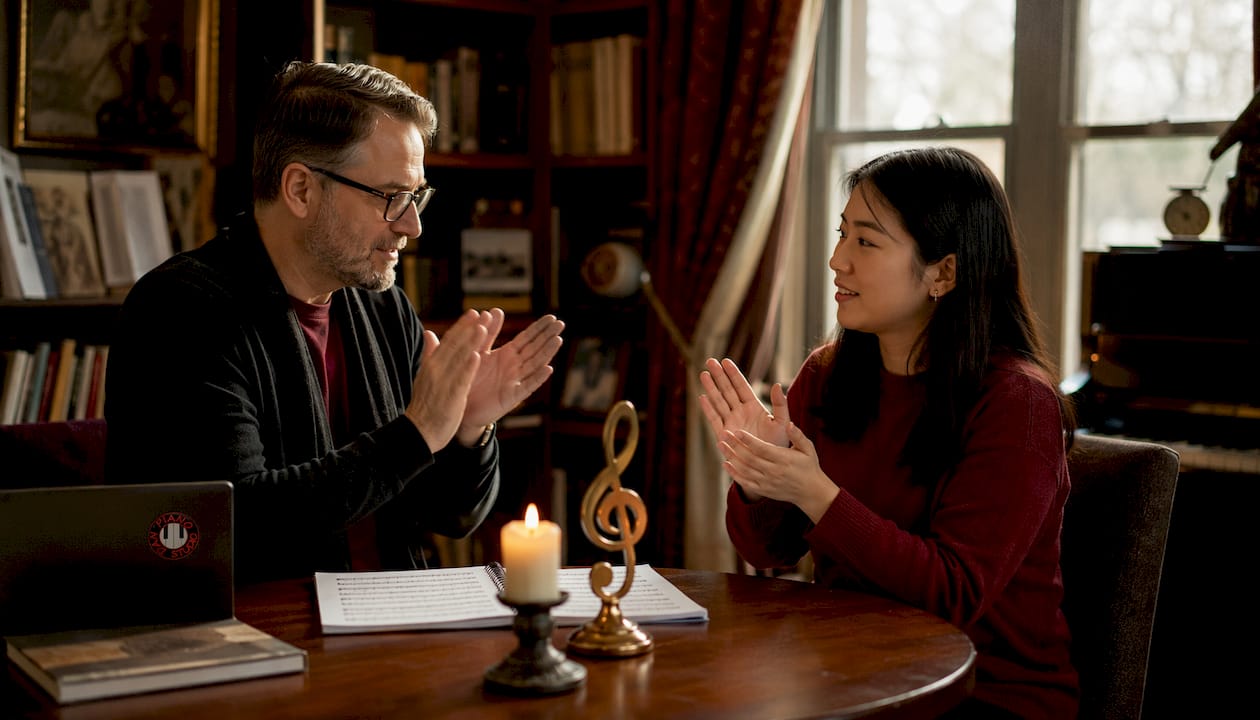
Here is what typically happens in that first session:
A short conversation about your goals and musical tastes
Keyboard orientation: black-key patterns, high and low sounds
Bench height and posture set-up
A simple rhythm or clapping activity
A short playable piece or pattern, taught by ear
One small, clear home task to practise before next time
Exam pathways such as ABRSM and Trinity College London are usually mentioned briefly, but they are a conversation for later, once you and your teacher have a sense of direction.
Table of Contents
What actually happens in your first piano lesson?
The sequence below is what most experienced teachers follow, though the pacing shifts considerably depending on whether the student is five years old or forty-five.
1. Greeting and goals talk (3–5 minutes) The teacher asks what brought you here: a favourite song, a childhood wish, a piece you have always wanted to play. This is not small talk. Knowing your musical world shapes every decision the teacher makes for the next thirty minutes.
2. Keyboard exploration (5 minutes) You look at the black-key groups: clusters of two, then three, repeating across the whole keyboard. Press the two-black-key groups from left to right and notice how the sound rises. Press them right to left and hear it fall. This single activity introduces pitch direction, aural awareness, and the geography of the instrument in one go.
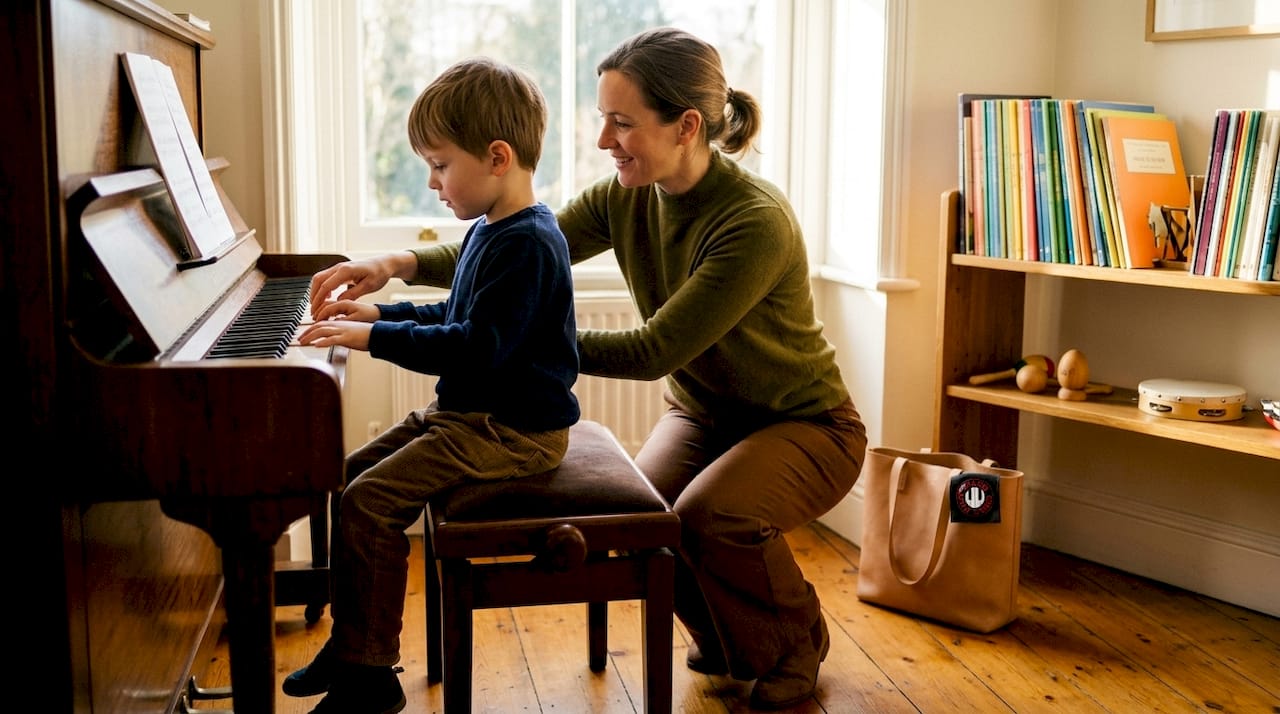
3. Bench height and posture (3 minutes) Hold both arms out in front of you with a gentle fist, as if you are about to do a karate chop, and touch the fallboard (the wooden lid over the keys). If your arms are bent, you are sitting too close; if they are straight and strained, too far. Lower your hands to the keys and open them like a flower. That is correct bench position, and getting it right from lesson one prevents tension and strain later.
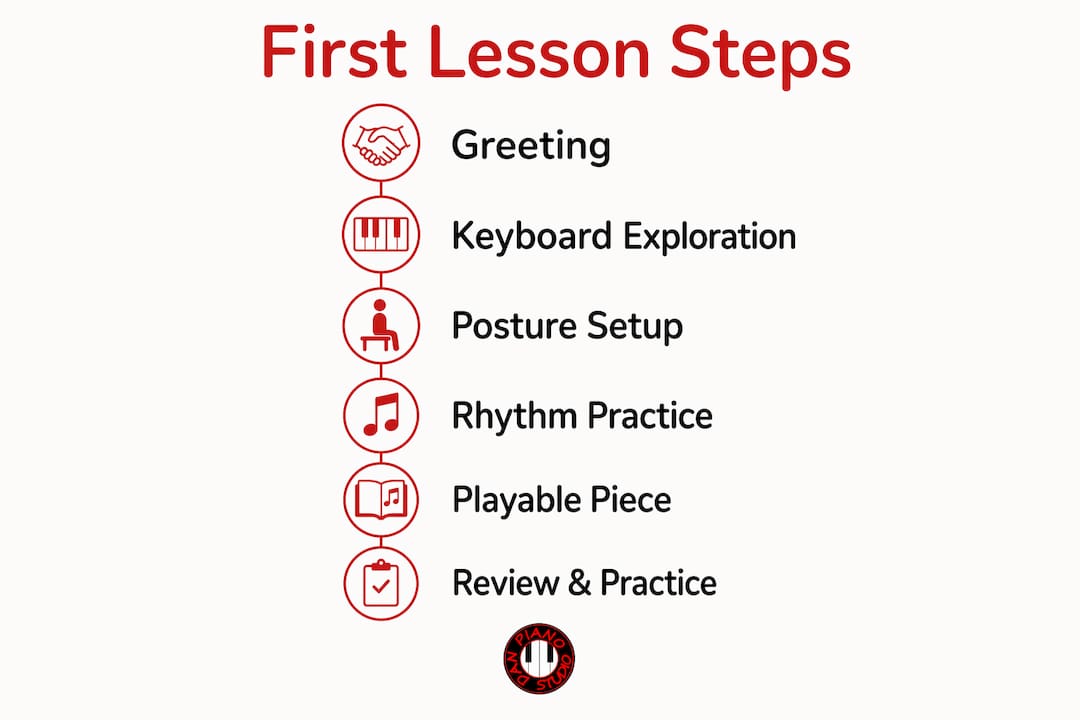
4. Rhythm or ear activity (5 minutes) Clap a simple pattern. The teacher claps; you copy. Or you tap a steady beat while the teacher plays. Young children often do this with animal sounds or a call-and-response game. Adults tend to find this section surprisingly enjoyable once the self-consciousness fades.
5. A short playable piece (10–15 minutes) No notation yet. The teacher shows you a short pattern or song by ear, often using the black keys, and you play it back. Many teachers use Hot Cross Buns or a simple rote-taught piece that produces a real musical result within minutes. For adults, this might be a chord pattern from a song they mentioned at the start.
6. Review and home task (2–3 minutes) The teacher names one specific thing to practise before next time. Not “practise everything we did.” One thing. Find the two-black-key groups. Clap that rhythm. Play that three-note pattern with your right hand. Tiny and specific beats vague and ambitious every time.
How the flow changes for children versus adults
Young children need shorter bursts, more physical movement, and play-based activities: improv on the black keys, finger-number songs, a keyboard scavenger hunt. The lesson feels more like a game than a class, and that is entirely intentional. Adults benefit from an explicit goals conversation and an immediate musical payoff. Connecting the lesson to a favourite song or chord progression removes the “am I too old for this?” anxiety faster than any reassurance.
Sample first-lesson plans you can follow right now
Three ready-made agendas, scaled by time. Use the one that matches your booked slot.
Duration | Format | Best for | Key activities |
20 minutes | In-person or online | Young children (ages 4–7) | Keyboard exploration, one rhythm game, one rote song phrase, one home task |
30 minutes | In-person or online | Children (ages 8–12) or adult beginners | Goals talk, posture, keyboard orientation, rhythm activity, short piece, home task |
45–60 minutes | In-person (preferred) or online | Adult beginners or older children | Full goals discussion, posture, keyboard map, rhythm, a piece or chord pattern, basic note names, home task + written notes |
20-minute plan
0–3 min: Hello, what music do you like?
3–6 min: Black-key groups, press and listen
6–10 min: Clap a rhythm together
10–17 min: Teach a three-note rote song by ear
17–20 min: Set one home task, celebrate what was played
30-minute plan
0–4 min: Goals conversation
4–7 min: Bench and posture check
7–12 min: Keyboard exploration, high/low sounds
12–17 min: Rhythm clapping or call-and-response
17–26 min: Rote piece or short pattern (both hands if ready)
26–30 min: Review, name the home task, confirm next lesson
45–60-minute plan
0–5 min: Goals and musical background
5–8 min: Bench, posture, hand shape
8–15 min: Keyboard map, black-key groups, note-name introduction (C, D, E)
15–22 min: Rhythm activity with notation cards or clapping
22–40 min: Rote piece or chord pattern; explore with both hands
40–50 min: Basic music theory: what is a beat, what is a bar
50–58 min: Home task, written notes for student, next-lesson preview
Pro Tip: For children under seven, cut the goals conversation and the theory block entirely. Replace them with a second play-based activity. Attention spans are short; musical joy is the whole point at this age.
What to bring and how to prepare before you arrive
Most of the preparation happens at home, not at the studio.
For in-person lessons:
Access to a piano or 88-key weighted keyboard at home for practice
A comfortable bench or adjustable stool (kitchen chairs are usually too high)
A notebook or folder for written notes and sheet music
Comfortable clothing that lets your arms move freely
Punctuality: arriving two minutes early beats arriving two minutes late
For online lessons:
Camera positioned to show both hands on the keys and your face
Headphones or a speaker close to the piano so you can hear the teacher clearly
A stable internet connection and a quiet room
Lighting that falls on the keyboard, not behind you
Teacher expectations from new students:
Honesty about your experience level (none is fine)
Willingness to answer a short pre-lesson questionnaire about goals and schedule
Readiness to commit to a small daily home task between sessions
Pro Tip: If you are setting up for online piano lessons, prop your phone or tablet at a slight angle so the teacher can see your hand position from the side. A top-down view of the keys alone is not enough.
How teachers assess you in lesson one and what comes next
No test, no pressure. The assessment in a first lesson is entirely observational, and most students do not even notice it happening.
A teacher watches for:
Basic coordination: can you tap a steady beat while doing something else?
Rhythm sense: do you copy a clapped pattern accurately?
Pitch awareness: do you notice when a sound goes up or down?
Motivation and goals: what do you actually want from lessons, and how committed do you seem?
From those observations, the teacher decides on lesson frequency (usually once a week to start), short-term goals for the next four to six weeks, and whether an exam pathway is worth discussing. ABRSM and Trinity College London both offer graded exams from Grade 1 upwards, and many teachers mention them in the first lesson as a possible structure, not a requirement. Some students thrive with exam targets; others prefer a repertoire-led approach. Both are valid.
On pricing: piano lessons in London range from £20 to £90 per hour depending on teacher experience and lesson type. Outside London, rates are generally lower. A lesson with an experienced teacher in a central London studio typically sits in a moderate price range.
How to practise after your first lesson
Short and consistent beats long and occasional. 10–15 minutes daily produces better results than a single hour at the weekend, particularly for beginners whose hands and ears are building new neural pathways.
For adults:
Focus on the one task your teacher set, nothing more
Connect practice to a song you love: even finding the first three notes of a familiar melody counts
Drop the perfection pressure. Slow and slightly wrong beats fast and stopped
For parents of young learners:
Sit in or nearby for the first few home sessions; your presence matters
Celebrate specific wins (“you found all the two-black-key groups!”) rather than general praise
Avoid pushing for longer sessions. Ten focused minutes is genuinely enough at the start
Pro Tip: The 80/20 principle applies here: roughly 80% of early progress comes from consistent short sessions on a single focused task. A beginner practice routine built around one daily micro-task is more sustainable than a full practice schedule that collapses after a week.
Simple pieces and activities to try at home
These activities build real skills without requiring any sheet music.
Black-key improv: press only the black keys in any order, any rhythm. Everything sounds musical. This builds ear confidence and removes the fear of “wrong notes.”
Hot Cross Buns (rote): three notes, right hand only. E–D–C, hold. E–D–C, hold. C–C–C–C, D–D–D–D, E–D–C. Most beginners can play this in ten minutes.
Finger-number game: tap each finger in order (1 = thumb, 5 = little finger) on a table while saying the number aloud. Builds independent finger awareness before touching the keys.
Keyboard scavenger hunt: find every C on the piano (always to the left of the two-black-key group). Then find every G. Then every F. This teaches note geography through exploration, not memorisation.
Rhythm clapping: clap long and short patterns using the words “ta” (one beat) and “ti-ti” (two quick beats). This is the foundation of reading rhythm notation later.
Each activity targets something specific: improv builds the ear, Hot Cross Buns builds coordination, the finger game builds independence, the scavenger hunt builds note knowledge, and rhythm clapping builds pulse awareness. Together they cover the core skills of a beginner piano class without a single page of sheet music.
For a structured introduction to reading notation, a beginner guide to music reading can complement what your teacher introduces in the early lessons.
Danpianostudio’s sample first-lesson plan (30 minutes)
This is the plan used at Danpianostudio for a typical 30-minute first lesson with a new student.
Time | Activity | Learning outcome |
0–4 min | Welcome, goals conversation, musical background | Teacher understands student’s motivation and tastes |
4–7 min | Bench height and hand-shape check | Correct posture established from lesson one |
7–12 min | Keyboard exploration: black-key groups, high/low sounds | Student understands pitch direction and keyboard layout |
12–17 min | Rhythm clapping: call and response | Student develops basic pulse and rhythmic imitation |
17–26 min | Rote piece: three-note pattern or simple song | Student leaves able to play something real |
26–30 min | Home task set, next lesson confirmed | Student has one clear, achievable task to practise |
What the student leaves with: a short piece they can play, a named home task, and a clear sense of what the next lesson will cover.
Studio policies at Danpianostudio:
Trial lessons are available for new students
Lesson packs offer flexibility for regular booking
Cancellation policies are confirmed at booking
ABRSM and Trinity exam preparation is available from the outset for students who want a structured pathway
Pricing context: Piano lessons in London range from £20 to £90 per hour. Danpianostudio’s rates reflect the Central London location and the tailored, one-to-one format. Contact the studio directly for current pricing.
Key takeaways
The single most important thing to know: a well-structured first piano lesson leaves you playing something real, with one clear task to practise and a teacher who understands your goals.
Point | Details |
Lesson one is about connection | The primary goal is rapport and an immediate playable win, not theory. |
Posture matters from the start | A correct bench height and hand shape prevents strain and builds good habits early. |
Daily practice beats weekly marathons | 10–15 minutes every day produces better results than one long session per week. |
Exam pathways are optional | ABRSM and Trinity are available structures, not obligations; discuss them once goals are clearer. |
Danpianostudio | Offers tailored first lessons in Central London and online, with trial lessons available for new students. |
Why the first lesson is the most important one you will ever take
Most piano teachers spend years perfecting their advanced repertoire coaching. Far fewer think carefully about lesson one. That is a mistake, and one worth naming plainly.
The first lesson sets the emotional template for everything that follows. A student who leaves feeling capable and curious will practise. A student who leaves feeling overwhelmed or confused will quietly stop booking. The research on this is consistent: connection and confidence matter more in lesson one than any technical content.
What I find most teachers underestimate is the power of the immediate win for adult learners specifically. Adults arrive carrying a quiet fear that they have left it too late, that their hands are too stiff, that music is for people who started young. Playing a real chord pattern or a recognisable melody in the first thirty minutes dismantles that fear more effectively than any reassurance. The lesson does not need to be easy. It needs to feel possible.
For parents bringing a child to their first lesson: your job is to be enthusiastic without being pressuring. Children pick up on parental anxiety about progress. The best thing you can do after lesson one is ask “what was your favourite bit?” rather than “did you learn a lot?”
The habit of short, joyful daily practice, built from week one, is worth more than any method book or exam grade. Get that right, and everything else follows.
Start your piano journey with Danpianostudio
Danpianostudio offers something most studios do not: a genuinely tailored first lesson, whether you are booking for yourself or your child, in person in Central London or online from anywhere in the UK.
New students can book a home piano lesson in London or an online lesson with the same structured, confidence-first approach described in this article. Every lesson is one-to-one, planned around your goals, and built to give you a musical win from the very first session. ABRSM and Trinity exam preparation is available whenever you are ready for it.
To book your first lesson or ask a question, visit danpianostudio.com or get in touch directly. Trial lessons are available for new students.
Useful sources and further reading
How to start piano lessons and progress well — Danpianostudio’s overview of what to expect across the first weeks of lessons
Private piano lessons for adults — practical guidance for adult beginners on goals, pacing, and what to expect
Can adults learn piano well? — addresses the most common adult anxieties about starting later in life
When should children start piano lessons? — age-readiness guidance for parents
Beginner piano approaches for new students — a supplementary pedagogical resource covering practical beginner activities
Piano and keyboard courses for beginners — City Lit’s UK-based group course options for adult beginners
For a tailored recommendation on which lesson format suits you or your child, contact Danpianostudio directly. The studio is happy to answer questions before you book.
Recommended


Comments