


Chord inversions piano: the practical player's guide
- Dan Piano Studio
- 6 days ago
- 8 min read

A chord inversion is the same chord with a different note in the bass. That single shift changes how a progression feels, how smoothly your hands move, and how musical your playing sounds. Try these three right now: C/E (C major with E in the bass), C/G (C major with G in the bass), and D/F# (D major with F# in the bass). Play each slowly with both hands and notice which voice moves the least between chords. That stillness is voice leading at work, and it is what chord inversions on piano are designed to create. At Danpianostudio in Central London, inversions appear in lessons from early ABRSM and Trinity grades right through to advanced repertoire work, because they are not an advanced topic — they are a foundational one.
Table of Contents
How do you build chord inversions on the piano?
Start with the notes of the chord, then decide which one sits lowest. That decision defines the inversion.
For triads (three-note chords):
Root position: the root is lowest (C–E–G for C major).
First inversion (I6): move the root up an octave so the third sits in the bass (E–G–C). In D major this gives you D/F# — F# in the bass, A and D above.
Second inversion (I6/4): move the third up too, leaving the fifth at the bottom (G–C–E). In D major: D/A.
For seventh chords (four notes):
Seventh chords add a third inversion. In Cmaj7 (C–E–G–B):
Root position: C in the bass.
First inversion: E in the bass.
Second inversion: G in the bass.
Third inversion: B in the bass (the seventh).
The practical identification method is simple: find the bass note, name the chord, then compare the bass to the root. If the bass is the third, it is first inversion. If it is the fifth, second inversion. If it is the seventh, third inversion. Inversions keep voices close and make progressions easier to voice-lead, which is why they sit at the centre of both comping and accompaniment.
A useful distinction: an inversion is specifically about which chord tone is in the bass. Broader voicing choices — spreading notes across octaves, doubling a note, omitting the fifth — are separate decisions. Inversion and voicing overlap, but they are not the same thing.
Slow drill: play C major through all three positions, hands separately, naming the bass note aloud each time. Then do the same for D major. Two minutes of this daily builds the pattern faster than any amount of passive reading.
How inversions are notated and what they do harmonically
Two notation systems describe the same thing in very different ways, and you will encounter both in exam and repertoire work.
System | Example | Where you see it |
Slash-chord notation | C/E, D/F#, G/B | Pop, jazz, lead sheets, modern scores |
Figured bass | I6 (first inv.), I6/4 (second inv.) | Classical scores, ABRSM/Trinity theory papers |
Roman numeral analysis | I, I6, I6/4, V7/3 | Music theory courses, academic harmony |
Slash-chord notation places the chord name before the slash and the bass note after it. Figured bass uses numbers below the Roman numeral to describe the intervals above the bass. The “6” in I6 tells you there is a sixth above the bass (the root), confirming first inversion. The “6/4” in I6/4 tells you there are a sixth and a fourth above the bass, confirming second inversion.
The cadential 6/4 deserves special attention. This is the second-inversion tonic chord (I6/4) placed just before the dominant (V), most often at a cadence. It sounds like unresolved tension because the fifth in the bass creates a suspension effect against the dominant harmony that follows. The resolution V → I gives classical music much of its sense of arrival. In ABRSM and Trinity sight-reading, spotting a I6/4 before a V chord tells you a cadence is coming — a useful heuristic for both performance and analysis.
In contemporary practice, slash chords are flexible: they can notate a true inversion (C/E) or a non-chord bass note (C/D), giving arrangers quick shorthand for bass motion and texture.
Practice drills that actually build fluency
Progress with inversions follows a clear sequence. Rushing to repertoire before the hand patterns are solid produces sloppy playing that is hard to unlearn.
Progressive drill sequence:
Single inversion, one key. Play C major root position, first inversion, second inversion, root position — slowly, hands separately, then together. Name each bass note aloud.
Inversion cycling within a key. Move through all positions of every diatonic chord in C major: C, Dm, Em, F, G, Am, Bdim. Keep the top voice as smooth as possible.
Chord-scale practice. Play a C major scale in the bass while the right hand holds inversions of the tonic chord above it. This trains the ear to hear bass motion against a fixed harmony.
ii–V–I voice leading. In C major: Dm7 (first inversion, F in bass) → G7 (root position) → Cmaj7 (first inversion, E in bass). The bass moves F → G → E, a near-stepwise line. Common progressions like ii–V–I become far easier to voice-lead once you can choose inversions deliberately.
Repertoire application. Take two bars of Autumn Leaves and comp the changes using inversions to keep the bass moving by step rather than jumping.
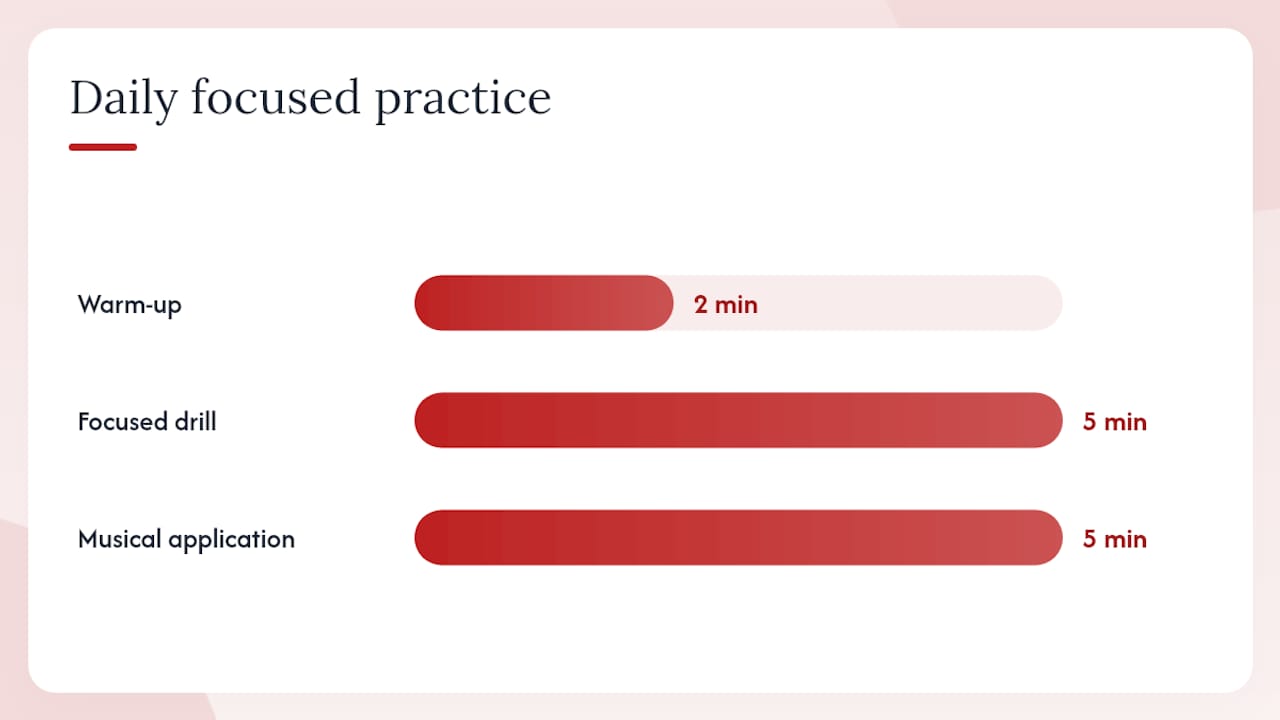
A short daily schedule of focused practice
Warm-up: one inversion cycle in C, hands separately (2 minutes).
Focused drill: ii–V–I in one key, three inversions each chord (5 minutes).
Musical application: apply to a piece you are currently learning (5 minutes).
Small, frequent sessions of this kind build retention faster than less frequent longer sessions. Chord-scale and inversion-cycling drills train both hand patterns and the ear for functional bass movement across repertoire.
Common mistakes and how to fix them
Muddy low register. Playing inversions with the fifth or third in the bass below the C below middle C produces a thick, unclear sound. Move the voicing up an octave.
Doubling the leading tone. In a G7 chord, doubling the B (the seventh degree of C major) in both hands creates parallel motion and harmonic clutter. Omit or rethink the doubling.
Poor spacing. Stacking thirds too close together in the low register muddies the harmony. Keep intervals of a third or second above the bass only in the mid-to-upper register.
Awkward fingering transitions. If you find yourself twisting the wrist between inversions, the fingering choice for the preceding chord is wrong. Slow the passage down and rethink the approach fingering before the problem chord, not during it.
To test your progress, record a short comping phrase and listen back. A smooth bass line with minimal leaps and no muddy low-end means the inversions are working. Anything that sounds bumpy or thick points directly to one of the problems above.
How classical, jazz and pop use inversions differently
Classical. The cadential 6/4 is the signature move: second-inversion tonic before the dominant at a cadence. Beyond that, figured-bass writing uses inversions to create stepwise bass lines and suspensions. A Bach chorale is a masterclass in this — the bass rarely leaps when an inversion can keep it moving by step.
Jazz. Slash chords and voice leading in ii–V–I are the main tools. Jazz pianists use first and second inversions to create close, colourful right-hand voicings and to keep the top voice moving smoothly across chord changes. A Dm7/F → G7 → Cmaj7/E line keeps the bass walking while the harmony shifts.
Pop and folk. Second-inversion bass pedals (staying on the fifth in the bass while the harmony changes above) and passing bass lines are the most common applications. A simple I–V/VII–vi–IV progression uses a descending bass line (C–B–A–F in C major) that makes the whole accompaniment sound more considered with minimal extra effort.
Action prompt: pick one piece you are currently working on and rewrite one bar of the accompaniment using an inversion to smooth the bass motion. One bar is enough to hear the difference.
Which inversion should you choose?
Musical aim | Inversion to use | Example |
Smooth connection between chords | First inversion | C/E moving to Am keeps E as a common tone |
Passing or pedal bass | Second inversion | C/G under a moving melody |
Cadential tension before V | Second inversion (I6/4) | C/G → G7 → C at a perfect cadence |
Chromatic or stepwise bass line | Third inversion (7th chords) | Cmaj7/B → Am7 → Dm7 descends B–A–D |
Close inner voices in ensemble | First inversion, right hand | Pianist drops root, bass player covers it |
The rule of thumb: use first inversion to keep inner voices close, second inversion for a passing or pedal bass effect, and third inversion when you want the seventh driving a chromatic step in the bass. Apply one rule at a time to a four-chord loop and listen for how the bass line changes. The ear learns faster than the eye.
Key takeaways
Chord inversions are a bass-note choice, and that choice controls voice leading, harmonic tension, and how smoothly your hands move across a progression.
Point | Details |
Inversion = bass choice | The same chord sounds different depending on which note sits lowest: root, third, fifth, or seventh. |
Voice leading is the payoff | Choosing inversions to minimise bass leaps produces smoother progressions in every style. |
Notation in two systems | Slash chords (C/E) for pop and jazz; figured bass (I6, I6/4) for classical and exam work. |
Short daily drills work best | Five to fifteen minutes of focused inversion cycling in one key builds retention faster than long unfocused sessions. |
Danpianostudio for guided progress | Lessons at Danpianostudio in Central London cover inversions from basic drills through to ABRSM/Trinity exam repertoire. |
Why inversions reward patient, guided practice
Most students encounter inversions as a theory exercise and never quite connect them to how music actually sounds. That gap is the real problem. You can memorise that C/E is “first inversion” and still play a progression that sounds clunky, because knowing the name and hearing the function are two different skills.
What changes things is practising inversions inside real musical contexts: a ii–V–I, a cadence, two bars of a song you already know. The moment you hear the bass line smooth out because you chose F instead of C in the bass of a Dm7 chord, the concept stops being abstract. It becomes a tool you reach for.
There is also a tendency to over-complicate this. Students sometimes spend weeks on inversion theory before playing a single inverted chord in a piece. The better approach is the reverse: play the inversion first, feel how it sits under the hand, then attach the label. The hand memory and the ear memory come together faster that way, and the theory consolidates around real experience rather than floating above it.
For exam preparation, inversions are not optional. ABRSM and Trinity both test harmonic awareness in sight-reading, viva questions, and accompaniment tasks. A student who can identify a cadential 6/4 on sight and voice it cleanly has a genuine advantage.
Piano lessons with Danpianostudio in Central London
Mastering inversions is faster with a teacher who can hear exactly where your voice leading breaks down and adjust the drill on the spot.

At Danpianostudio, lessons in Central London near King’s Cross and Camden are structured around your current repertoire and exam goals. A typical inversion-focused session starts with a short warm-up cycle, moves into a targeted drill (ii–V–I voice leading or chord-scale practice), and ends by applying the technique directly to a piece you are working on. You leave with a specific homework task, not a vague instruction to “practise inversions.” For students preparing for ABRSM or Trinity grades, that kind of precision matters.
In-person lessons and online sessions are both available, so geography is not a barrier. Get in touch to book a trial lesson and start building inversion fluency with personalised fingering and voicing guidance from the first session.
Useful sources and further reading
Chord inversions — Root, 1st & 2nd position on piano | piano.org
Ultimate guide to chord inversions — The Hooktheory Blog
Chord progressions: Common piano patterns in every key | piano.org
Recommended


Comments