


Jazz Piano: 5 Voicing Rules for 9ths, 11ths & 13ths + 3 Drills

Chord extensions are the 9th, 11th and 13th added on top of a seventh chord, and they change the colour of the chord without changing what it does harmonically. A Cmaj7 stays a Cmaj7 whether you add a 9th, a 13th, or both. Learn how to build and voice these three tensions and your comping, reharmonisation and improvisation all take a step-up in sophistication.
TL;DR:
Most pianists should prioritize voice leading by keeping the 3rd, 7th, and the extension tone on top, while dropping less essential notes like the 5th or root.
Extended chords fit better on major 7th and dominant 7th chords, with alterations like ♭9 or ♯11 used sparingly for maximum musical effect.
Use slow practice across all keys to internalize shapes and rely on deliberate, smooth movement of top notes to keep harmonic lines coherent.
Avoid overloading dominant chords with multiple alterations, as stacking too many tensions often results in noise rather than color.
When improvising, target extensions on strong beats or approach notes, and arpeggiate through the extension tones to integrate them naturally into your lines.
Table of Contents
What are chord extensions on piano, exactly?
Extensions come from stacking thirds past the seventh. Keep piling thirds on a seventh chord and you get a 9th, then an 11th, then a 13th, each one simply a scale degree recycled an octave higher. The 9th is the 2nd an octave up, the 11th is the 4th, and the 13th is the 6th, so if you already know your scale degrees, you already know the raw material.
The distinction that trips up most self-taught players is the difference between an extension chord and an “add” chord. A 9th chord includes the 7th; an add9 chord does not. C9 is C, E, G, Bâ™, D. Cadd9 is C, E, G, D, with no seventh at all. Play them side by side and the difference is obvious: C9 has that dominant pull, Cadd9 sounds bright and open, almost pop-flavoured. Mixing these up on a chart is a common beginner error, and it changes the harmonic function of the passage.
A quick way to read any extended chord symbol:
Find the base chord type first (major7, dominant7, minor7) because it decides which family of extensions will sound “correct.”
Check for the 7th. If the symbol says 9, 11 or 13 with no “add,” the 7th is baked in.
Read left to right. A 13th chord symbol implies the 9th and 11th are theoretically present too, even though you will rarely play all of them.
Watch for alterations (♭9, ♯9, ♯11, ♭13) written next to the extension number. These change the tension’s flavour, not its slot in the stack.
Once that logic clicks, reading a lead sheet full of extended symbols stops feeling like code and starts feeling like ordinary vocabulary.
Which extensions suit which chord type?
Not every extension sits comfortably on every chord. Major 7th chords take the 9th and 13th happily and often the ♯11 for extra brightness, since the natural 11 clashes against the major 3rd. Dominant 7th chords are the most flexible family, accepting 9, 13, and the full range of altered tensions because dominant chords are already built to create tension before resolving. Minor 7th chords welcome the 9th and 11th freely, since there’s no major 3rd to fight with, and take a 13th more cautiously, usually in a minor ii chord heading somewhere specific.
The natural 11th clashes with the major 3rd a semitone apart, which is why a plain “Cmaj11” voiced literally sounds muddy and indecisive rather than lush. Three standard fixes solve this:
Sharpen the 11th (maj7♯11), which turns the clash into a Lydian-flavoured colour tone instead.
Drop the 3rd entirely, letting the 11th function almost like a suspended tone.
Skip the 11th altogether and jump straight to the 13th, which sits a comfortable major 6th above the root with no such conflict.
Here’s the compatibility rundown worth memorising:
Voicing extended chords without turning them to mud
A full 13th chord on paper has seven notes stacked from root to 13th, but nobody with working ears plays all seven at once on a piano. Pianists normally omit notes, dropping the 5th first and the root when a bassist or bass note already covers it, keeping the sound clear instead of clustered.
The rule of thumb that gets you 90% of the way there:
Keep the 3rd. It defines major versus minor and can’t be sacrificed.
Keep the 7th. It defines the chord’s function (major7 sound versus dominant pull) and disappears at your peril.
Keep the named extension. If someone wrote C13, the 13th is the point of the chord. Losing it defeats the purpose.
Drop the 5th first if you need to lose a note. It rarely adds anything the ear misses.
Drop the root if a bassist has it covered. Your left hand is freed up for a richer voicing higher up the keyboard.
A common shell shape for comping is 3rd and 7th in the left hand, close together in the middle of the keyboard, with the extension and maybe one more colour tone in the right hand an octave or so above. This keeps the muddy low register clear and puts the interesting tension where it can actually be heard. Another workable split: root and 7th low, then 3rd, extension, and a top note voiced as a two or three-note cluster in the right hand, spaced roughly a fourth or fifth apart so nothing crowds into mush.
Register matters more than most players realise. Extensions voiced below middle C tend to blur together with the bass frequencies of the chord. Move them up an octave and the same notes suddenly read as sparkle rather than sludge.
Pro Tip: When you’re deciding which note to put on top, pick whichever extension creates the smoothest connection to the next chord’s top note. A half-step or whole-step move between chord tops sounds intentional and singable; a big leap sounds accidental, even if the harmony underneath is correct.
How do you use extensions in a ii–V–I progression?
The clearest way to hear what extensions actually do is to take a progression you already know and dress it up gradually, one chord at a time.
Start with the plain version. Dm7 to G7 to Cmaj7, in root position or a basic shell voicing. This is your baseline.
Add one extension per chord. Dm7 becomes Dm9, G7 becomes G13, Cmaj7 becomes Cmaj9. Nothing about the function of the progression changes, but the colour deepens noticeably.
Track the top note across the three chords. In the plain version, the top note might jump around by a fourth or fifth. With extensions chosen deliberately, the top voice can move by a step or stay put entirely, which is what makes extended voicings sound “smoother” than triads even though there are more notes involved.
Try a small reharmonisation. Over a static Cmaj7 in a slow ballad, substitute Cmaj9 for the first two beats then Cmaj13 for the last two. The chord hasn’t changed on paper, but the movement inside the harmony gives a static bar somewhere to go.
This is the real payoff of extensions in a ii–V–I: they turn three separate chords into one continuous, connected line at the top of your voicing, rather than three isolated blocks. A guide to jazz piano harmony covers more reharmonisation moves if this is the part of the puzzle you want to go deeper on, and practising the underlying shapes in six chord progressions every piano player should learn first will make the ii–V–I feel automatic before you start decorating it.
When should you use altered extensions like ♭9 or ♯11?
Altered extensions live almost entirely on dominant chords, and each one has a distinct emotional colour worth learning by ear, not just by name. A ♭9 sounds tense and slightly dark, common in minor key resolutions. A ♯9 sounds gritty and bluesy, a texture you’ll recognise from soul and funk as much as jazz. A ♯11 on a dominant chord sounds bright and modern, almost floating. A ♭13 sounds brooding, often paired with a ♭9 for maximum tension before a resolution.
The practical rule: use one, maybe two alterations at a time. Stack every possible alteration onto one chord and you get noise instead of colour. Keep the other chord tones (3rd, 7th) clear and unaltered so the ear has something stable to anchor to, and resolve the tension into a stable, unaltered chord tone on the next change.
Scale choices map directly onto these tensions. The altered scale implies ♭9, ♯9, ♯11 and ♭13 simultaneously, useful when a dominant chord wants maximum tension. Lydian dominant leans into the ♯11 for a brighter, less resolved sound. Diminished scales work well over dominant chords resolving to minor. None of this needs to be memorised as abstract theory first; play the chord, try the scale over it, and let your ear confirm the pairing.
What exercises help you internalise extensions?
Reading about extensions gets you halfway. The rest comes from repetition across keys until the shapes stop needing conscious thought.
The add-one-extension drill. Take a ii–V–I and add exactly one extension per chord, as described above. Run it through all twelve keys at a slow, steady tempo, roughly four bars per key, before speeding up.
The shell-and-extension split. Left hand plays a shell voicing (3rd and 7th only), right hand adds the extension, then invert the right-hand voicing three or four ways so your ear hears the same tension in different registers.
The drone ear-training drill. Hold a single bass note or fifth as a drone (a sustain pedal or a second hand works fine), then play a 9th, 11th and 13th against it in turn and name each one before you look at your hands.
Once those feel natural, apply them to real material: ballads for slow-moving extended chords, blues changes for dominant alterations, and any standard with long static chords for reharmonisation practice. The jazz piano chords explained for beginners guide is worth revisiting if any of the underlying seventh chord shapes feel shaky before you extend them.
Pro Tip: Practise extensions at a tempo slow enough that you never guess. Speed hides sloppy voicings; slow practice exposes exactly which note you’re unsure of.
Where do chord extensions in jazz actually come from?
Extended harmony didn’t arrive with bebop, though that’s where most piano students first meet it seriously. Ninth chords were already common in French Impressionist writing from composers like Debussy and Ravel decades earlier, and stride and swing pianists borrowed that colour for their own left-hand voicings through the 1920s and 1930s.
Bebop pianists in the 1940s pushed further, treating 9ths, 11ths and 13ths as standard vocabulary rather than occasional decoration, partly because faster harmonic movement demanded richer chords to keep the ear engaged between changes. By the modal and post-bop era of the late 1950s and 1960s, extensions and altered tensions had become inseparable from how jazz harmony was taught and heard, feeding directly into how pianists like those associated with the modal school voiced static chords over long stretches.
From there, extended chords spread well beyond jazz. Gospel piano leans on 9ths and 13ths for its lush, churchy sound. Neo-soul and R&B built entire genres partly on extended and altered dominant voicings borrowed straight from jazz harmony. Extended chords now appear across jazz, neo-soul, gospel and R&B, which is why learning them properly pays off well beyond a jazz-specific repertoire. If you play in a church band, write pop songs, or improvise over almost anything harmonically interesting, the same 9ths and 13ths you learn for a jazz standard show up again in a different context.
Why do tensions need to resolve, and do they always?
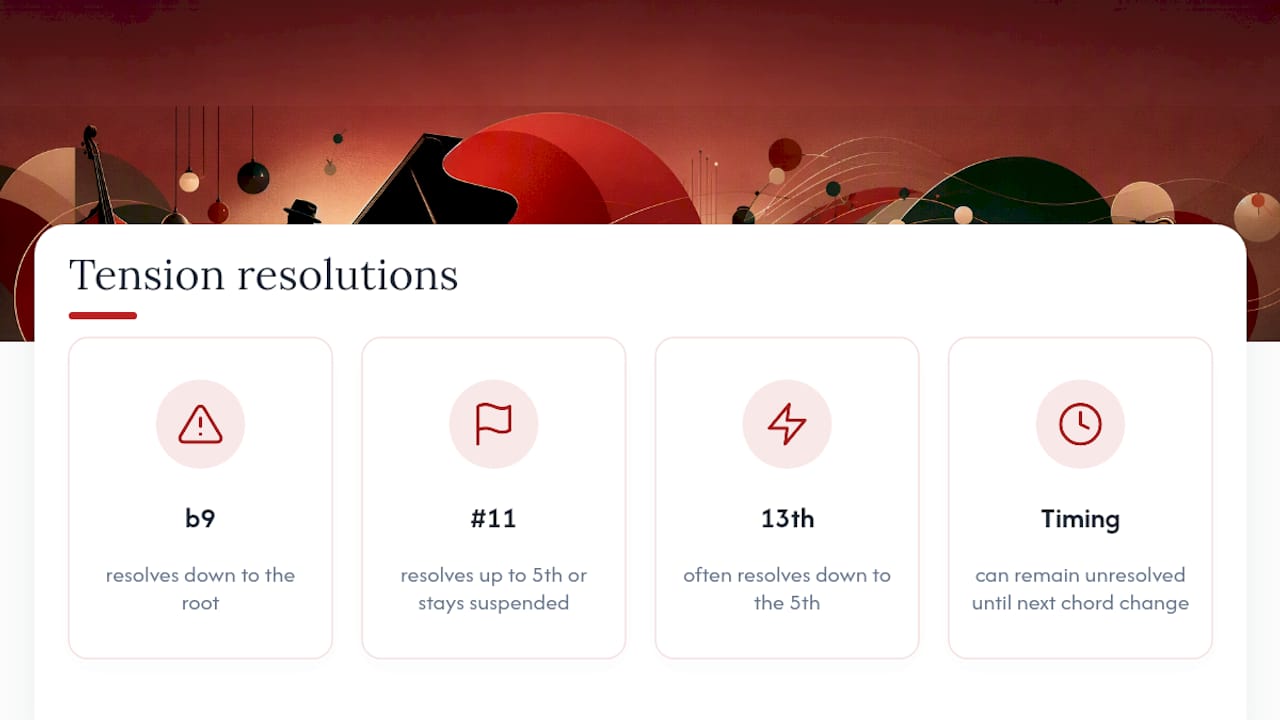
A tension is any note that sits a step away from a chord tone it wants to resolve into, and that pull toward resolution is what makes extended harmony feel alive rather than static. A ♭9 wants to fall to the root. A ♯11 often resolves up to the 5th, or simply stays suspended if the harmony doesn’t move. The 13th, sitting a whole step above the 5th, frequently just resolves down onto the 5th when the chord changes.
Not every tension needs to resolve immediately, and this is where a lot of theory explanations oversimplify. In modal jazz and in a lot of contemporary harmony, a tension can sit unresolved for an entire bar or longer, especially over a static chord, because the ear tolerates suspended colour far longer than classical voice-leading rules suggest. The resolution still happens eventually, usually at the next chord change, but the timeline is elastic.
What matters practically is contrast. A chord voiced with no tension at all, right after several bars of thick extended harmony, reads to the ear as a release, almost a full stop. That contrast is a compositional tool in its own right: build tension across a phrase using stacked extensions, then resolve into a plain triad or simple seventh chord at the phrase’s end, and the simplicity itself becomes expressive because of what came before it. Extensions aren’t decoration layered onto otherwise unchanged harmony; they’re the mechanism that gives a progression somewhere to travel from and somewhere to arrive.
How do you bring extensions into your improvised lines?
Extensions aren’t just for the chords under your left hand. The same 9ths, 11ths and 13ths that colour your voicings can shape a melodic line, and this is where a lot of players who understand the theory still sound stiff when they solo.
The simplest entry point is targeting extensions on strong beats. Instead of landing every downbeat on the root, 3rd or 5th, aim a phrase deliberately at the 9th or 13th of the current chord, then resolve it a beat or two later into a chord tone. This single habit alone makes improvised lines sound more harmonically aware without requiring any new scales.
Approach notes work well from extensions too. A half-step below the 9th, held briefly and resolved up, creates the same kind of tension-and-release inside a single-note line that a voiced ♭9 creates in a chord. Borrow that vocabulary and lines start to sound like they understand the harmony underneath them, rather than running scales over the top of it.
Arpeggiating the extended chord itself, root through to the 9th or 13th rather than stopping at the 7th, is another direct route in. It sounds obvious written down, but very few developing improvisers actually practise arpeggios that go past the seventh, so the extension becomes an unfamiliar reach mid-solo rather than a rehearsed shape. Practising chord inversion techniques across the full extended arpeggio, not just the basic triad, closes that gap quickly.
What mistakes do pianists make with extensions?
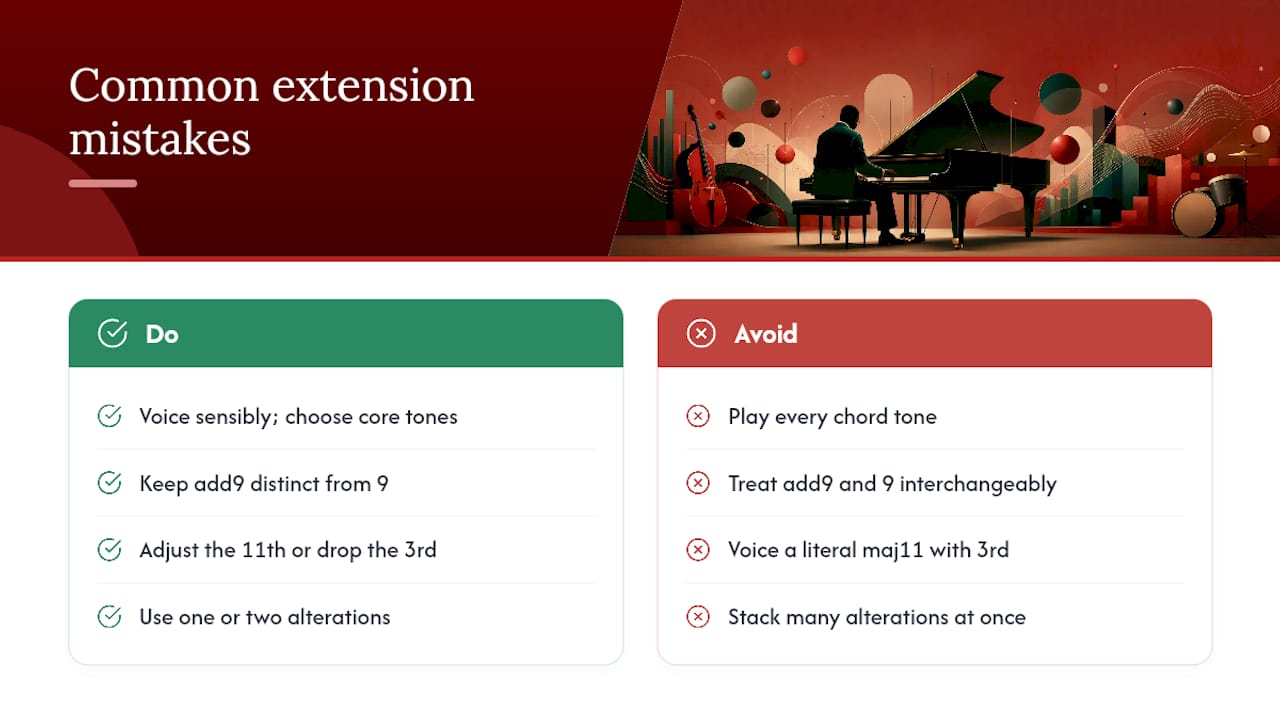
The single most common mistake is playing every note in the chord symbol literally. A written C13 does not mean seven simultaneous notes; it means the 13th is the top tension worth hearing, built on a foundation you’re expected to voice sensibly, not a instruction to cram every scale degree into two hands.
A second frequent error is confusing add chords with extension chords, treating Cadd9 and C9 as interchangeable when they carry a completely different function, one lacking the 7th entirely. Mixing these up on a chart changes the harmonic direction of the passage without the player realising it.
Ignoring the natural 11 clash is another classic trap. Plenty of self-taught players voice a literal maj11 with the 3rd, 7th and 11th all present and wonder why it sounds wrong; the fix, sharpening the 11th or dropping the 3rd, is simple once you know it’s needed.
Overloading alterations causes the fourth common problem. Stacking a ♭9, ♯9 and ♭13 onto one dominant chord all at once, hoping more tension equals more sophistication, usually just produces noise. Restraint, one or two alterations at most, almost always sounds more musical than maximalism.
Finally, many players learn extensions in isolation, drilling C9 and C13 as static shapes, but never practise them inside a moving progression. A chord voicing that sounds great held still often falls apart the moment it needs to connect smoothly to the next one, which is exactly why progression-based practice matters more than isolated chord drilling. Jazz piano voicings for beginners walks through several of these shapes inside real progressions rather than in isolation, which is where the habit actually needs to form.
Dan’s teaching perspective: how lessons turn these rules into progress
Most players learn the theory behind extensions faster than they learn to hear them, making Trumpet Basics a useful complementary skill for cross-instrument ensemble awareness. That gap, between knowing a C13 chord on paper and actually reaching for it instinctively while comping, is what one-to-one lessons close far quicker than solo study. At Danpianostudio, jazz piano, improvisation and theory are taught alongside exam preparation for ABRSM and Trinity, so the sequencing tends to follow a deliberate ladder: solid seventh chords first, then 9ths in familiar progressions, then 11ths and altered dominants once the ear has caught up with the hands.
The most common sticking point students hit isn’t the theory. It’s timing: reaching for the right voicing at performance speed rather than working it out note by note. Slow, structured repetition across keys fixes that faster than any amount of reading.
If you’d rather work through extensions with feedback in real time than puzzle them out alone, home piano lessons in Central London, Camden and King’s Cross cover exactly this ground, and online lessons offer the same structured path wherever you’re based.
— Dan
Sources
Recommended



Comments