


Build confidence, not exam speed: piano lessons for autistic children

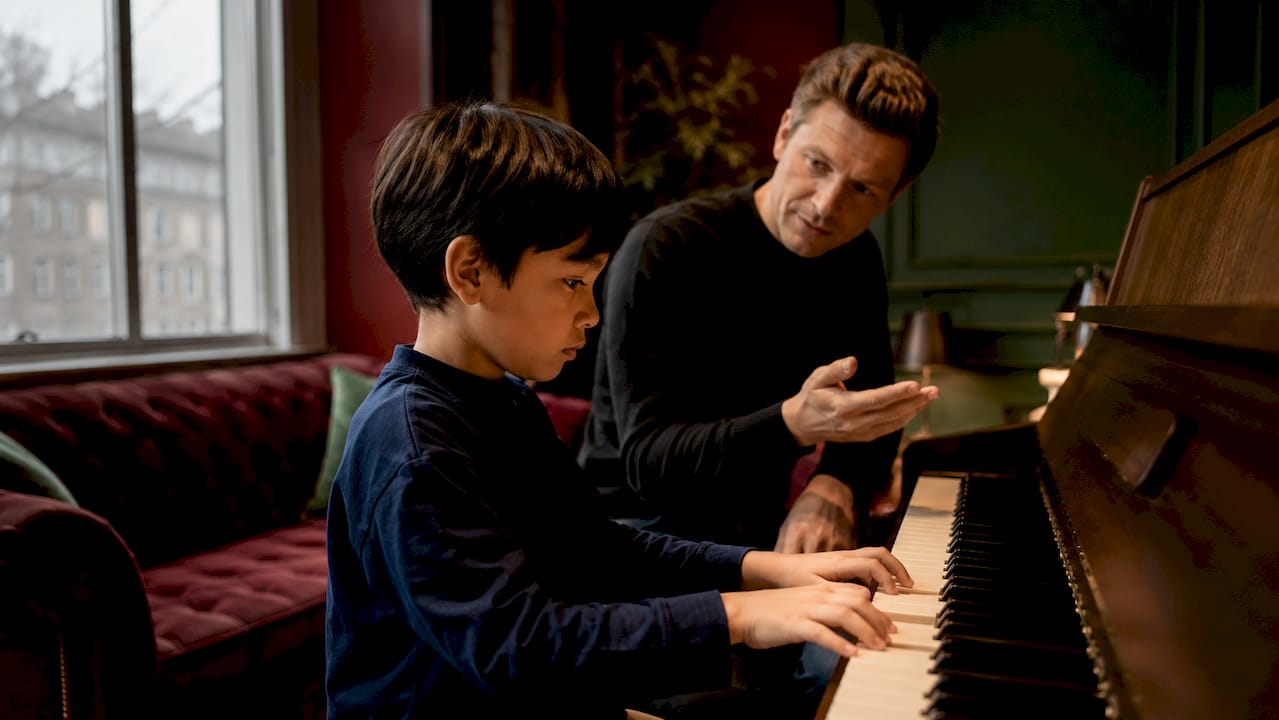
Yes. With straightforward, neurodiversity-aware adjustments, piano lessons can build musical skill, motor control, and genuine confidence in autistic children. The priorities are routine, sensory comfort, visual scaffolds, and valuing engagement over speed. Start with a short trial lesson that includes a clear welcome ritual and a visual schedule, then adjust from there.
TL;DR:
Routine and visual scaffolds are essential for building trust and reducing unpredictability during lessons for autistic children.
Breaking skills into tiny, manageable steps and adjusting sensory environments support effective learning and prevent shutdowns.
Short, consistent lessons that combine warm-up, targeted skill work, free choice, and predictable closure yield better engagement over time.
Parental involvement through brief, frequent practice sessions and using visual logs enhances retention and comfort between lessons.
Progress should be measured by engagement and independence in playing, rather than exam speed or traditional performance metrics.
Table of Contents
Common learner traits that change how you teach piano to autistic children
Every autistic student is different, but certain patterns show up often enough to plan around. Recognising them before the first lesson saves both teacher and pupil a lot of frustration.
Communication style is usually the first thing to notice. Many autistic learners process language literally, so “play it lightly” means far less than “press the keys gently, like you’re stroking a cat.” Instructions need to be short, concrete, and consistent from week to week.
Sensory sensitivity matters just as much. A metronome click, a squeaky piano stool, or the hum of a fluorescent light can be genuinely distressing rather than mildly annoying, and it will show up as a shutdown or a refusal to sit down.
Motor coordination varies widely too. Some students struggle with independent finger movement or with the fine adjustments needed for dynamics, which means technical goals often need pacing that has nothing to do with musical intelligence.
Literal language processing: give exact, concrete instructions rather than metaphorical ones.
Sensory sensitivities: watch for reactions to volume, touch, lighting, or texture (piano keys, bench fabric).
Motor planning differences: independent finger control and posture may need extra scaffolding.
Movement and stimming: rocking, hand flapping, or pacing between phrases is often part of processing, not a sign of disinterest.
Reframing stimming is worth dwelling on. Studio experience suggests that letting a child rock gently or flap between hands, rather than forcing complete stillness, tends to support learning rather than block it.
Practical strategies and accommodations that work from lesson one
The fastest way to lose an autistic student’s trust is unpredictability. The fastest way to earn it is a lesson that looks and feels the same, week after week, until the child has enough security to tolerate change.
Build a predictable routine first. Open every lesson with the same greeting, the same seating ritual, and a visual schedule (a strip of laminated cards showing warm-up, task, choice time, goodbye) that the student can physically move through as each activity ends. Predictability is not a soft accommodation. Yamaha’s educator guidance lists flexible lesson length and visual schedules among its core recommendations for teaching students on the spectrum, and studio-level case evidence shows that pairing structured scaffolding with steady relational support improves on-task attention over sustained periods of instruction.
Set the visual scaffolding. Use coloured key stickers matched to simplified notation, picture cards for hand shapes, and a stepwise task card for each new skill.
Break every task into tiny steps. Rather than “play the C major scale,” teach one relation at a time: note name, then key location, then sound. Equivalence-based instruction has been shown to help learners generalise from a handful of trained relations to playing full sequences, which cuts down the repetition needed later.
Adjust the sensory environment. Lower the piano’s master volume if possible, offer a softer bench cushion, allow noise-cancelling headphones during louder passages, and schedule a short movement break every 10 to 15 minutes rather than waiting for a meltdown.
Keep communication short and literal. Model the movement yourself before asking the student to copy it, use single-step spoken instructions, and add a hand signal or picture cue alongside anything verbal.
Loop in carers and therapists early. If a student already works with an occupational therapist or speech and language therapist, ask what cues and reinforcement strategies already work at home or school, and reuse them at the piano.
Pro Tip: Keep a laminated “calm corner” card on the music stand. If a student points to it, that is the cue for a 60 second break, no explanation needed from either side.
A lesson template and 6 to 12 week plan for piano lessons for autistic children
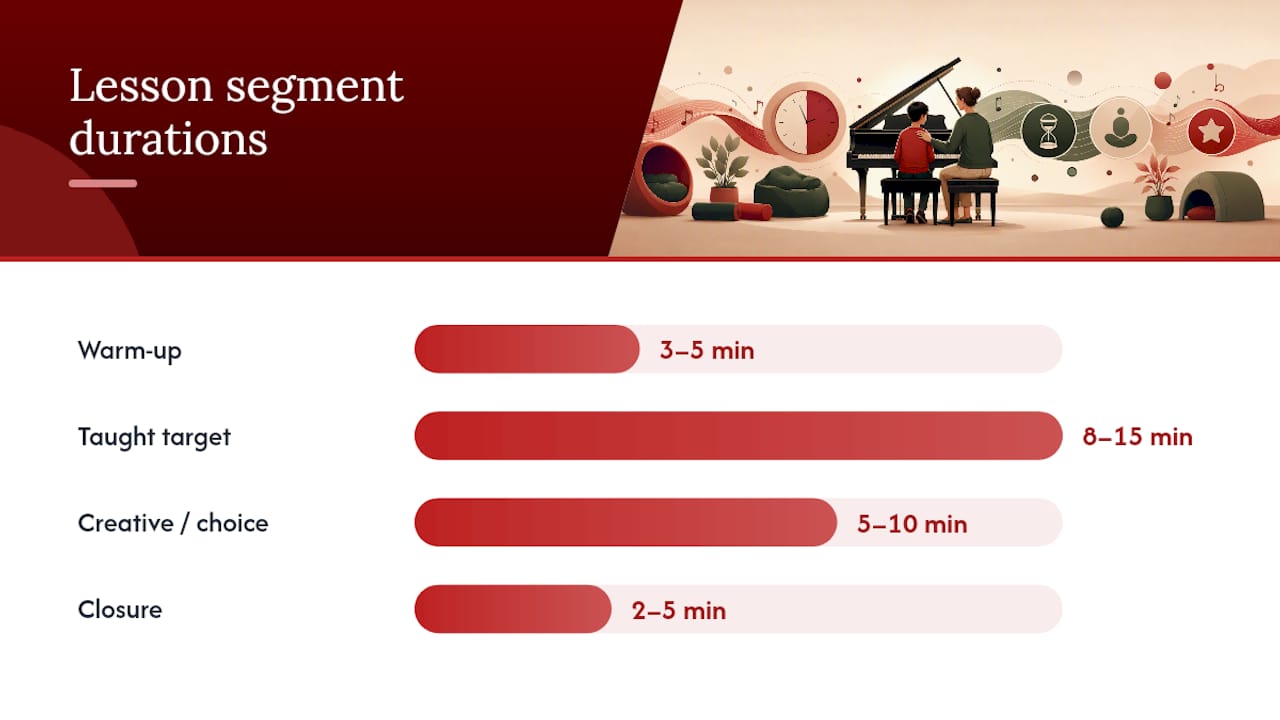
Lesson length should flex with tolerance, not with the clock. A 20 minute lesson that ends calmly beats a 45 minute lesson that ends in a shutdown.
A workable structure runs like this:
Warm-up (3 to 5 minutes). Same greeting song or hand-stretch routine every week, using the visual schedule to signal the start.
Taught target (8 to 15 minutes). One new relation or skill, broken into the smallest teachable step, using picture cards or coloured stickers.
Creative or choice time (5 to 10 minutes). Let the student pick between two pre-approved activities, such as playing a favourite tune or improvising on the black keys.
Closure (2 to 5 minutes). Recap using the visual schedule, mark the session as finished, and end with the same goodbye ritual every time.
Over 6 to 12 weeks, a sensible progression moves from imitation and single-key accuracy (weeks 1 to 3), to two-hand coordination and short phrases (weeks 4 to 7), to a simple, recognisable piece or aural pattern the student chose themselves (weeks 8 to 12). If progress stalls for two consecutive weeks, slow the step size rather than pushing forward. Small, consistent adjustments to lesson length and instruction style tend to outperform a complete overhaul of the teaching plan.
Home-support strategies parents and carers can use between lessons
Practice at home works best in short, frequent bursts rather than one long weekly session, and it should never turn into a battle of wills.
Aim for 5 to 10 minute micro-practice sessions, two or three times a day, with a simple visual chart the child can tick off.
Lead with a preferred, already-mastered song to build willingness, then introduce one small unfamiliar element at a time.
Cue and model rather than taking over the keyboard. Point, gesture, or hum the next note instead of playing it for the child.
Note anything unusual (mood, tolerance for a new task, which prompts worked) and pass it to the teacher before the next lesson.
A tool as simple as a shared practice log or a sticker chart, discussed in more detail in guidance on sensory play and child development, often does more for consistency than any amount of parental persuasion.
Measuring progress: goals that actually matter
Skip the exam clock at the start. The markers that matter early on are simpler: can the child sustain a short tune to the end, use more than one finger independently, follow a three-step instruction sequence, or stay engaged at the piano for longer than they did last month?
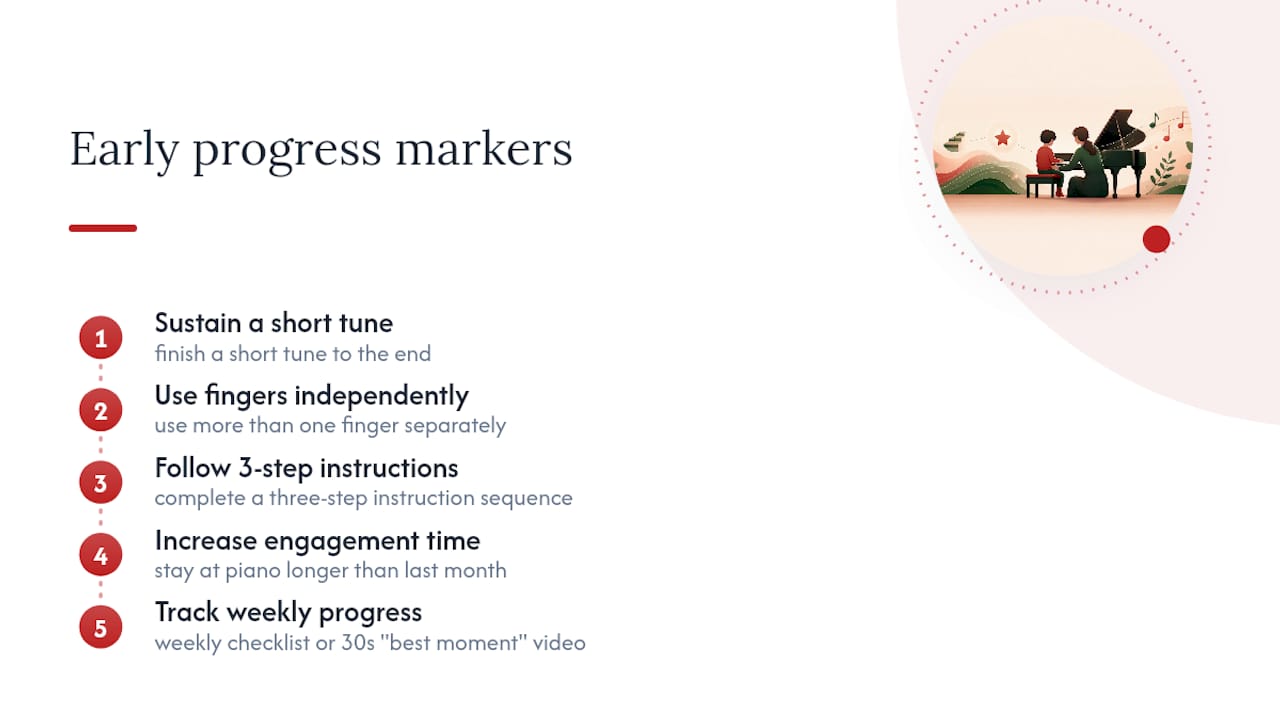
A brief weekly checklist or a 30-second phone video of the “best moment” of the lesson gives more useful data than a formal assessment. Music-based interventions show measurable, if modest, gains in social interaction and engagement across multiple studies and meta-analyses, and a meta-analysis of eight randomised trials covering 608 participants found modest but significant improvements in social reactions. Confidence and sustained attention are the real prize here, not exam speed.
Dan’s perspective: what actually happens in the room
Theory only goes so far until you are sat next to a child who has just discovered the piano can be loud in a way they didn’t expect. What works, repeatedly, is treating the parent as a co-teacher rather than a bystander, keeping lesson length genuinely flexible week to week, and never assuming a non-exam pathway is a lesser one. Piano practice appears to support imitation and joint attention in ways that go beyond finger technique, and that is worth remembering when a lesson feels slower than the syllabus suggests it should be.
Movement during lessons rarely needs correcting. A student rocking gently between phrases or flapping after a good attempt is usually processing, not misbehaving, and forcing stillness tends to cost more focus than it saves.
— Dan
Book a piano lesson built around your child, not a syllabus
Danpianostudio’s advantage for families of autistic children is simple: lessons are shaped around the child’s routine and sensory needs from the first session, not adjusted after something goes wrong. That means flexible lesson lengths, a genuine choice between exam pathways (ABRSM, Trinity) and non-exam, confidence-led routes, and lessons available at home, in Central London, Camden, or King’s Cross, or online for families who prefer lessons at the kitchen table.
Before a first consultation, it helps to have a few things ready: your child’s usual daily routine, any known sensory sensitivities (sound, touch, lighting), and any current therapy or school supports worth mentioning. From there, home piano lessons can be arranged with a trial session that starts with a clear welcome ritual and a visual schedule, so your child knows exactly what to expect before a single key is pressed. Get in touch through Dan Piano Studio to arrange that first lesson.
Sources
Recommended


Comments