


Adult beginner piano: start playing real songs fast

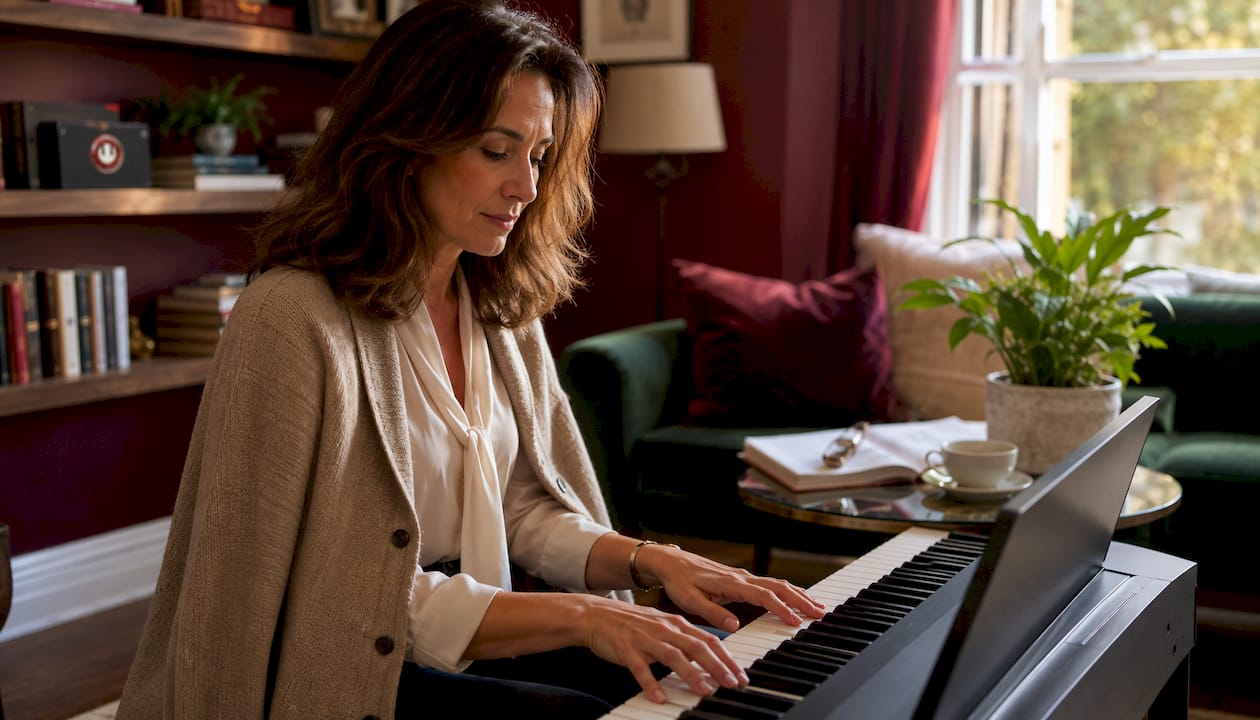
Yes, adults can absolutely learn piano, and most beginners are playing recognisable songs within the first few weeks when they follow a method built for adult learners. The fastest next step is simple: sit down tonight for 20–30 minutes at a weighted digital piano, or book a trial lesson at a local studio. That is genuinely all it takes to begin.
A few things worth knowing before you dive in:
Short daily sessions of a moderate duration, repeated most days of the week, build muscle memory faster than occasional long sessions.
UK private lesson costs typically run £20–£60 per hour, with Central London typically in the £45–£60 per hour range.
Both ABRSM and Trinity offer graded piano exams for adults, giving you a clear progression ladder if you want formal milestones.
A full-size weighted digital piano is the practical starting point for most London adults: quiet with headphones, no tuning required, and available at entry-level prices that suit beginners.
Table of Contents
Why adults often learn piano faster than you think
Adults bring something to the piano that children simply cannot: a reason. You are not sitting at the keyboard because a parent told you to. That intrinsic motivation, as Robert Estrin at Living Pianos argues, is the single largest accelerator for adult learners. Modern neuroscience backs this up: the adult brain retains neuroplasticity throughout life, and adults can acquire motor skills at comparable rates to children when the instruction matches how adults actually think and learn.
Adult learners also bring self-organisation, financial independence, and a faster grasp of music theory. A seven-year-old needs years to understand why a chord resolves a certain way. You can grasp it in a single lesson.
The challenges are real but manageable. Time is the main one: a busy adult schedule leaves little room for practice, which is exactly why short daily sessions work better than weekend marathons. Finger dexterity takes a few weeks to develop, but consistent warm-up exercises fix that reliably. Perfectionism is the subtler trap: adults want to play things correctly immediately, and the frustration of early mistakes can stall progress. The antidote is measuring progress in weeks, not days.
Pro Tip: Keep a short voice note or video of yourself playing at the end of each week. Progress feels invisible day-to-day but becomes obvious when you compare week one to week four.
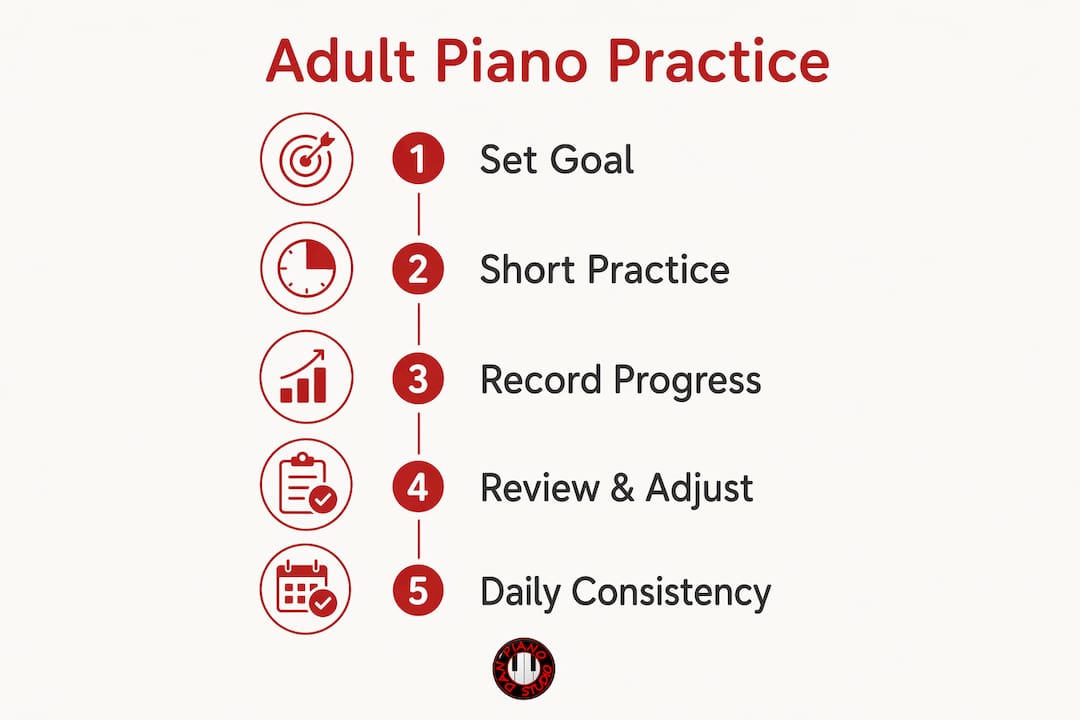
A realistic timeline for most adult beginners looks like this: by the end of week four, you will have a simple song or two under your fingers. By month six, you will be playing hands together across several pieces. After a year of consistent weekly lessons and daily practice, a comfortable intermediate repertoire is within reach, and many students are ready to sit a graded exam if they choose.
What lesson format suits you as an adult beginner?
The right format depends on what you are optimising for. Speed of progress points towards one-to-one lessons. Social motivation suits group classes. Flexibility and cost point towards online. Here is how each format stacks up:
Format | Best for | Price shape | Availability | Styles covered | Exam support |
One-to-one in person | Fast progress, exam prep, bespoke curriculum | £45–£60/hr in Central London | Central London studios, home visits | Classical, jazz, pop, improvisation | ABRSM and Trinity |
Group class | Social learners, lower budget | £10–£20/session | Community colleges, music centres | Classical, pop basics | Limited |
Online one-to-one | Flexible schedules, UK-wide access | £20–£60 per hour | Anywhere with broadband | Classical, jazz, pop | ABRSM and Trinity |
Intensive workshop | Rapid starter boost, holiday learners | Varies by provider | London and major cities | Pop, chords, basics | Rarely |
One-to-one lessons, whether in person or online, consistently produce the fastest progress for adult beginners because the teacher can adapt every session to your specific sticking points. Online piano lessons work well when paired with structured material and occasional feedback; they are not a lesser option, just a different one. Group classes suit adults who find the social element motivating and who are not in a hurry to reach a specific standard.
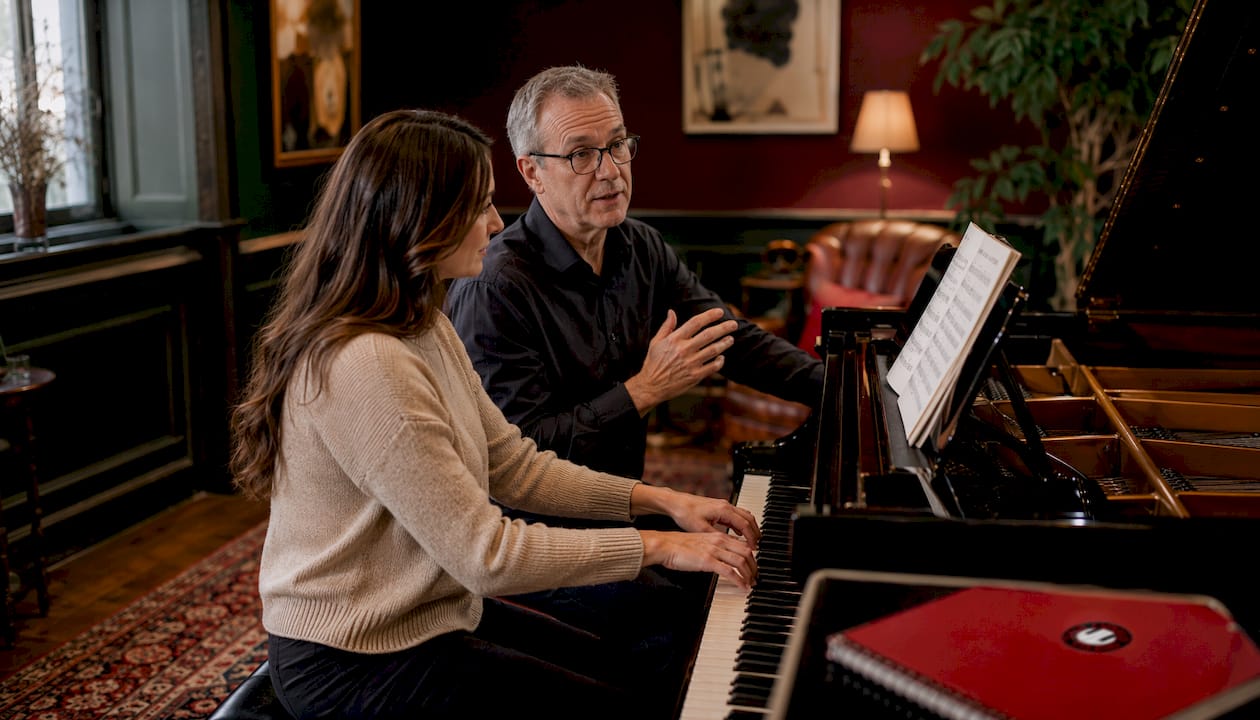
The decision hint: if you have a specific goal (an exam grade, a wedding piece, a particular song), one-to-one is worth the extra cost. If you are exploring whether you enjoy playing at all, a group class or a single trial lesson is a lower-risk starting point. Private lessons for adults offer the kind of tailored curriculum that group formats simply cannot replicate.
Which piano should you buy, rent, or start on?
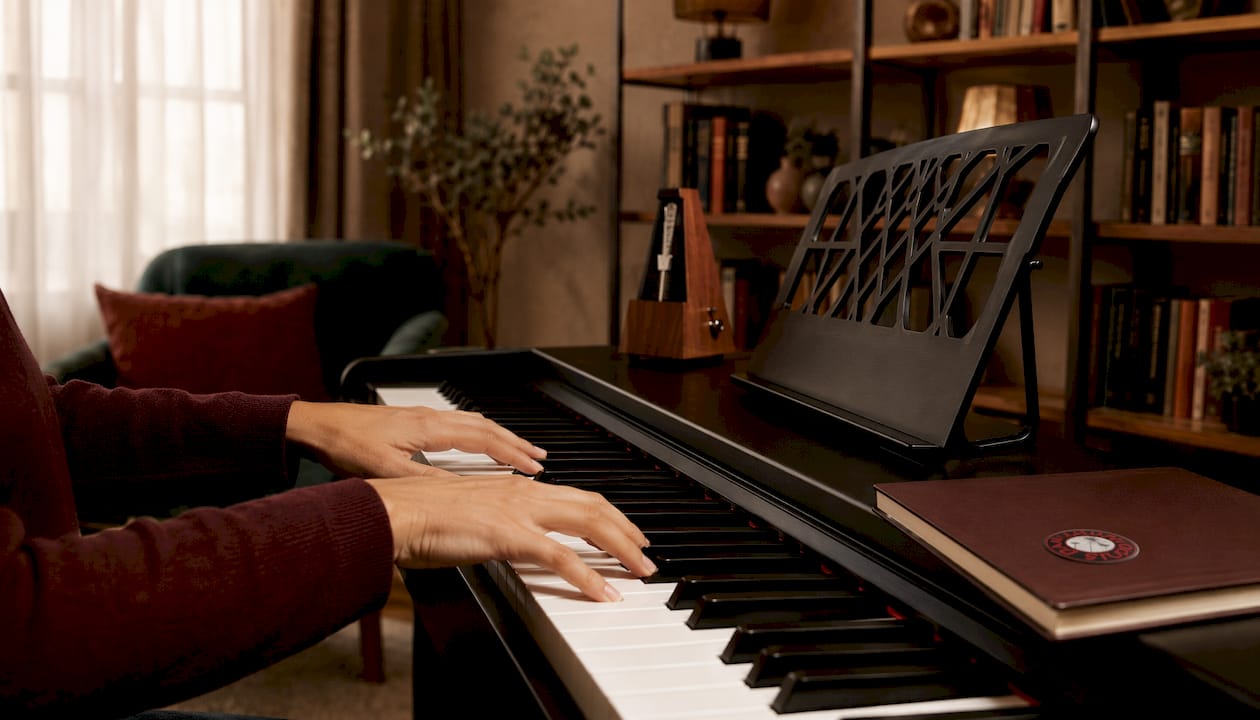
Most adult beginners in London are best served by a full-size weighted digital piano. It is compact enough for a flat, quiet enough for neighbours, and close enough in feel to an acoustic piano that the technique you build transfers directly. Weighted keys and a full 88-key range are the two non-negotiable features; everything else is secondary.
Feature | Weighted digital piano | Acoustic upright |
Touch and feel | Good to excellent (weighted action) | Authentic hammer action |
Cost (new) | £300–£600 for beginner models | — |
Maintenance | None | Tuning twice yearly (~£60–£80 each) |
Space required | Compact; fits most rooms | Significant footprint |
Headphone practice | Yes | No |
Portability | Moderate | Not practical |
For UK starter budgets, the £300–£600 range covers entry-level weighted digitals from brands such as Yamaha (P-45, P-145), Roland (FP-30X), and Casio (PX-S series). These all offer 88 weighted keys and a headphone output. The £600–£1,200 range buys noticeably better key action and sound, which matters more as your technique develops.
Acoustic uprights are worth considering if you have the space and budget, and if you are serious about classical technique from the start. The hammer action of an acoustic piano is still the gold standard for developing touch sensitivity. Renting is a sensible option for the first three to six months: several London music shops offer rental-with-option-to-buy schemes that let you test your commitment before spending.
Pro Tip: Before buying, visit a music shop and play several models back-to-back. The difference in key weight and response between a £350 and a £700 digital piano is immediately obvious when you sit at both.
The best beginner books and courses for adult learners
The method book you use matters more than most beginners realise. Books written for children will frustrate you within weeks: the repertoire is patronising, the pacing assumes unlimited practice time, and the theory explanations skip the conceptual depth adults actually want. The four books below are the ones adult beginners consistently finish.
Adult Piano Adventures (Nancy and Randall Faber): The most widely used adult method in the UK and US. Book 1 covers technique, theory, and repertoire in a single volume, with online video and audio support. The pacing is generous without being slow, and the song choices are genuinely enjoyable. Available new from most UK music retailers and on Amazon; a second-hand copy works perfectly well.
It’s Never Too Late To Play Piano (Pam Wedgwood): A British publication, which means the cultural references and musical examples feel immediately familiar. Wedgwood’s approach is warm and encouraging, and the book moves quickly to recognisable tunes. Particularly good for adults who feel self-conscious about starting late.
Vivace Piano Course (Emily Howell): Structured around a clear progression with theory woven in throughout. Slightly more rigorous than the Wedgwood, which suits adults who want to understand the why behind what they are playing, not just the how.
Play It Again Piano (Melanie Spanswick): Aimed at returning adult pianists rather than complete beginners, but works well for any adult who wants a structured, musically satisfying path. Spanswick’s writing is clear and the repertoire choices are excellent.
Structured courses and method books consistently outperform unstructured YouTube learning for adults because they eliminate the gaps that accumulate when you pick up skills randomly. The best approach is to pair one of these books with weekly lessons: the book provides the framework, and the teacher fills in the gaps and keeps technique honest.
A note on UK availability: all four titles are stocked by Musicroom, Presto Music, and Amazon UK. City Lit in London also runs structured piano and keyboard courses for adults that use similar materials in a group setting.
How to choose the right piano teacher as an adult beginner
The single most important quality in a teacher for an adult beginner is experience teaching adults specifically. Teaching a motivated 35-year-old is a fundamentally different job from teaching a reluctant eight-year-old, and not every qualified pianist makes the transition well.
Here is a practical checklist to use when making first contact:
Ask directly: “Do you regularly teach adult beginners?” A teacher who mostly works with children will often default to child-focused materials and pacing.
Check the curriculum: Does the teacher have a clear learning pathway for adults, or will they hand you whatever book they happen to have on the stand?
Confirm lesson format options: Can you do 45-minute lessons rather than the standard 30 or 60? Flexibility here signals adult-focused thinking.
Ask about exam support: If ABRSM or Trinity grades interest you, confirm the teacher has experience preparing adult students, not just children.
Clarify the cancellation policy: Adult lives are unpredictable. A rigid 48-hour cancellation rule with no exceptions is a red flag.
Ask about a trial lesson: Any confident teacher will offer one. It is your chance to assess chemistry, communication style, and whether the session feels tailored to you.
Ask about lesson packs: Many teachers offer a small discount for booking a block of lessons, which also signals they expect a longer-term relationship.
Check price and what it includes: Does the quoted rate include materials, or are books extra?
Red flags to watch for: a teacher who immediately hands you a children’s method book, one who insists on a rigid classical-only repertoire when you want to play pop or jazz, and one who cannot explain what you will be able to play after three months of lessons. A good teacher for an adult beginner will have a clear answer to “what will I be playing in six months?”
What do piano lessons actually cost in the UK?
Private piano lesson prices in the UK typically range from £20 to £60 per hour, with Central London typically in the £45–£60 per hour range. A qualified, experienced teacher in Camden or King’s Cross usually charges rates near the top of this scale.
A few practical points on cost and structure:
Lesson length: 30-minute lessons suit complete beginners and younger children. Most adult beginners progress faster with 45 or 60-minute sessions, which allow time for warm-up, technique work, and repertoire without feeling rushed.
Frequency: Weekly lessons with daily practice between sessions produce the most reliable progress. Fortnightly lessons work if weekly is not feasible, but the gap between sessions means more time is spent re-covering ground.
Lesson packs: Many London teachers offer a discount of 10–15% for booking five or ten lessons upfront. This also gives you a commitment structure, which helps with consistency.
Group and community options: City Lit and similar adult education providers offer group piano courses at significantly lower per-session costs, typically £10–£20 per session. The trade-off is less individual attention.
Online lessons: Often £5–£15 per hour cheaper than equivalent in-person rates, with no travel time on either side.
What to expect at three, six, and twelve months: at three months with weekly lessons, most adult beginners can play several simple pieces hands together and read basic sheet music. At six months, a comfortable repertoire of five to ten pieces and a solid grasp of common chords. At twelve months, many students are ready for ABRSM Grade 1 or 2, or have a personal repertoire they are genuinely proud of.
A simple practice plan for adult beginners
Short, consistent sessions of 20–30 minutes, six days a week, beat infrequent long sessions every time. The reason is physiological: muscle memory and neural pathways build through repetition over time, not through volume in a single sitting. Think of it like going to the gym: daily moderate effort beats one exhausting weekly session.
A practical daily session for the first 90 days:
Minutes 1–5: Warm-up. Scales in C and G major, or a simple five-finger exercise. Play slowly and evenly; this is not performance, it is preparation. The best beginner exercises focus on evenness and relaxed wrist position.
Minutes 6–20: Focused work. Pick one specific thing: a chord transition that is not clean, a four-bar passage that keeps going wrong, or a new piece you are learning. Work it slowly, then at tempo.
Minutes 21–30: Play for pleasure. Run through something you already know reasonably well, or improvise freely over a simple chord pattern. This is the part that makes practice feel like music rather than homework.
Milestones to look for:
Week 2: Both hands playing a simple melody, even if slowly.
Week 6: One complete short piece from start to finish, both hands together.
Week 12: Three or four pieces in your repertoire; reading simple sheet music with growing confidence.
Week 24: A small personal repertoire of six to eight pieces; beginning to sight-read new material independently.
Pro Tip: Set a micro-goal at the start of every session: “Today I am going to nail the transition from bar 4 to bar 5.” Vague practice produces vague results. Specific targets produce measurable ones.
The 80/20 principle applies here: roughly 80% of your early progress will come from 20% of the skills you practise, specifically chord transitions, left-hand stability, and clean fingering on the trickiest bars. Identify those bars and spend disproportionate time on them rather than always playing pieces from the beginning.
What to expect in your first lessons
The first lesson is not an audition. A good teacher will spend it assessing where you are, explaining posture and hand position, and getting you to make actual music as quickly as possible. You will not spend 45 minutes on theory before touching the keys.
A practical starter checklist for your first month:
Before lesson one: Have access to an instrument with at least 61 keys (88 weighted keys preferred). Bring a notebook for teacher notes and a pencil for marking scores.
Lesson one topics: Correct sitting position and bench height; keyboard layout and note names; a simple chord (C major is almost universal); a short two-hand pattern or melody.
Between lessons: 20–30 minutes of daily practice on what the teacher assigned. Do not skip ahead; consolidate what you have.
By lesson four: You should be playing a short piece with both hands, even if slowly. If you are not, ask your teacher to adjust the pacing.
First month goal: One complete short piece, both hands, at a slow but steady tempo.
A rough template for what a well-structured first lesson looks like in practice: ten minutes on posture, keyboard geography, and hand position; ten minutes learning a simple chord or short melody; ten minutes on goals, questions, and what to practise before the next session. Good posture from the start prevents the tension and wrist problems that plague self-taught players later.
For sight-reading, short and frequent exposure works far better than long sessions. A beginner sight-reading guide will typically recommend five minutes of new material per session rather than attempting to read through whole pieces.
Why adult-focused teaching produces better results
Teaching designed specifically for adults produces higher retention and faster satisfaction than repurposed children’s curricula. The difference is not just repertoire: it is sequencing, pacing, and the way concepts are explained.
A chord-first approach gets adults playing two-hand music within days rather than weeks. When you can play a recognisable song in your first or second lesson, the motivation to continue is immediate and concrete. Sheet-reading can be introduced alongside this without blocking early musical progress; the two skills reinforce each other rather than competing.
At Danpianostudio, lessons for adult beginners are structured around exactly this principle. The curriculum starts with chords and real songs, introduces theory as it becomes relevant rather than front-loading it, and adapts to each student’s goals, whether that is playing a favourite piece, preparing for an ABRSM or Trinity exam, or simply enjoying music for its own sake. Dan teaches classical piano, jazz, improvisation, and music theory, and has worked with adult beginners across a wide range of starting points and ambitions.
Students working towards ABRSM or Trinity grades benefit from a teacher who knows the syllabi in detail, including the 2027 and 2028 ABRSM Piano Practical Grades specification. Exam preparation for adults is different from children’s prep: adults tend to need more work on performance nerves and less on basic note-reading, and a good teacher adjusts accordingly.
Key takeaways
Adults who start piano with a method built for adult learners, consistent short daily practice, and a teacher experienced with adult beginners can reach a satisfying intermediate level within twelve months.
Point | Details |
Daily practice beats long sessions | Twenty to thirty minutes six days a week builds muscle memory faster than occasional long sessions. |
Chord-first methods work best | Starting with chords gets adults playing recognisable songs within days, sustaining motivation through the early weeks. |
Weighted digital piano is the practical start | A full-size weighted digital piano (from around £300) gives you the right feel without the cost or space of an acoustic. |
UK lesson costs vary by location | Private lessons run £20–£60 per hour nationally; Central London typically sits at £45–£60 per hour. |
Danpianostudio offers adult-focused lessons | In-person lessons in Central London and online lessons are available, covering classical, jazz, improvisation, and ABRSM/Trinity exam prep. |
The thing most adult beginners get wrong
The conventional wisdom says adults struggle to learn piano because their brains are less plastic or their fingers less flexible. That is not really the problem. The adults I see stall are not held back by biology; they are held back by an approach designed for someone else.
A child’s piano method assumes unlimited time, no self-consciousness, and a teacher who sets the agenda entirely. Adults need something different: a clear reason to practise tonight, a song they actually want to play, and a teacher who treats them as an intelligent person who happens to be new to the instrument. When those conditions are met, the progress is often startling.
The other thing worth saying: perfectionism is the enemy of progress at the piano, and adults are more prone to it than children. A child will bash through a wrong note and keep going. An adult will stop, wince, and restart from the beginning. The habit of stopping at every mistake is one of the most common things a good teacher will work to break in the first few weeks. Playing through imperfectly, then going back to fix the rough spots, is how music actually gets learned.
If you are waiting until you have the perfect instrument, the perfect schedule, or the perfect moment to start, you are waiting for something that will not arrive. Twenty minutes tonight, on whatever keyboard you have access to, is worth more than a perfect plan that begins next month.
Piano lessons in Central London and online, built for adults
If you are ready to move from reading about piano to actually playing it, Danpianostudio offers lessons designed specifically for adult beginners in Central London and online across the UK. The difference from a general music school is the curriculum: every lesson is built around your goals, your schedule, and the music you actually want to play, whether that is a Bach prelude, a jazz standard, or a pop song you have always loved.
Lessons cover classical piano, jazz, improvisation, and music theory, with ABRSM and Trinity exam preparation available for students who want a formal progression pathway. In-person lessons run from the studio near Camden and King’s Cross; home visits are available across Central London for students who prefer to learn at home. Online lessons are available UK-wide, with the same structured adult curriculum and the same teacher. Lesson packs are available, and a trial lesson lets you experience the teaching style before committing to a block. To book your trial lesson or ask about availability, visit danpianostudio.com.
Useful sources and further reading
Danpianostudio: private piano lessons for adults — how one-to-one lessons are structured for adult learners.
Danpianostudio: beginner piano learning guide — a longer study plan for the first six months.
Danpianostudio: can adults learn piano well? — addresses the most common doubts about starting as an adult.
Danpianostudio blog — articles on technique, practice, and repertoire for adult learners.
ABRSM Piano Practical Grades specification 2027–2028 — the official syllabus for graded piano exams in the UK.
City Lit: piano and keyboard courses in London — group adult piano courses at a community college in Central London.
Markson Pianos: how much do piano lessons cost in the UK? — realistic pricing guidance for UK private lessons.
Living Pianos: why adults learn piano faster than children — the neuroplasticity and motivation argument for adult learners.
Klangscout: learning piano as an adult — a thorough guide to adult advantages and common challenges.
Sight-reading for beginner pianists — a structured guide to building reading fluency from scratch.
Where to buy the recommended method books in the UK: Adult Piano Adventures, It’s Never Too Late To Play Piano, Vivace Piano Course, and Play It Again Piano are all available from Musicroom, Presto Music, and Amazon UK. Second-hand copies of most titles appear regularly on eBay and AbeBooks at a fraction of the new price. Many public libraries also stock beginner piano methods; it is worth checking before buying. Whichever book you choose, prioritise one written for adults rather than adapting a children’s method, as the difference in pacing and repertoire is significant.
Recommended


Comments