


ABRSM aural tests: grade-by-grade practice guide

Use the official ABRSM Aural Trainer alongside specimen papers and targeted teacher-led drills to prepare efficiently for Grades 1–8. That combination covers every test element, gives you authentic audio examples, and replicates the live exam experience no app can fully replicate on its own.
Start here:
Download the ABRSM Aural Trainer (Grades 1–5 or Grades 6–8, depending on your current grade) and run a 15-minute solo drill session this week.
Book a weekly teacher-led simulation where your teacher reads the examiner script aloud and marks your responses against the rubric.
Work through one specimen paper per month under timed conditions, using the official audio.
Danpianostudio offers structured ABRSM exam preparation in Central London and online, making it a practical choice for teacher-led aural practice alongside the resources below.
Key takeaways
The most effective preparation for ABRSM aural tests combines the official Aural Trainer for daily solo drills, specimen papers for authentic exam simulation, and teacher-led sessions to catch the habits no app can identify.
Point | Details |
Download the Aural Trainer | Get the Grades 1–5 or 6–8 app and run a focused 15-minute drill at least three times a week. |
Work one specimen paper monthly | Use official audio and examiner rubrics to simulate the real exam under timed conditions. |
Book weekly teacher simulations | A teacher reading the examiner script catches phrasing and timing errors the app misses. |
Use E–Music Maestro for free runs | Free sample tests at e-musicmaestro.com are ideal for paced practice without cost. |
Danpianostudio for structured prep | Danpianostudio offers one-to-one ABRSM aural preparation in Central London and online. |
Table of Contents
What are the best resources for ABRSM aural tests?
Three resources do most of the work. The table below maps each one to grade range, cost, and the specific use case it handles best.
Resource | Grade coverage | Cost | Platform | Best for | Extras |
Grades 1–5 | One-off app purchase | iOS app, self-marking | Solo drill, interval training, progress tracking | Pulse, echoes, melodic/rhythmic repetition, interval trainer, progress log | |
Grades 6–8 | One-off app purchase | iOS app, self-marking | Solo drill for cadences, chords, modulations | Advanced sight-singing, chord identification, modulation exercises | |
Grades 1–8 | Free samples; subscription for full access | Browser-based | Timed exam simulations, weekly practice runs | Analytics, ABRSM and Trinity coverage | |
Grades 1–8 | One-off book purchase | Printed book + downloadable audio | Exam simulation, teacher-guided warm-up | Examiner rubrics, official audio, score copies |
The Aural Trainer is the go-to for repeatable solo drills. E–Music Maestro fills the gap for timed, browser-based runs without needing a teacher present. Specimen papers are the closest thing to the real exam: they use official question phrasing, authentic audio, and the same rubrics examiners work from.
Pro Tip: ABRSM itself notes that the Aural Trainer is designed to supplement teacher-led practice, not replace it. Use the app for daily repetition, but save at least one session a week for a teacher who can replicate the examiner’s script and catch habits the app cannot flag.
How to practise each aural element effectively
Solo drills with the Aural Trainer
A focused 10–20 minute solo session works best when you target one element at a time rather than cycling through everything. Open the Grades 1–5 app and spend the first five minutes on pulse and echoes, then move to melodic repetition. The app’s progress tracker shows where accuracy is dropping, so you know exactly where to return next session. For Grades 6–8, the separate app covers cadences, chords, and modulations with the same drill-and-review structure.
For pulse and metre, pairing the app with a metronome app sharpens the physical sense of beat before you move to the listening tasks.
Teacher-led drills for echoes and sight-singing
Echoes and sight-singing are the two elements where teacher-led work pays off most. A teacher can vary the tempo, adjust the accompaniment, and replicate the examiner’s exact phrasing, which is something no app can do. A simple teacher script: play a four-bar phrase at the piano, ask the student to sing it back on a neutral syllable, then repeat with the printed score visible so the student can connect what they heard to what they see.
For sight-singing, build fluency in three steps: read the rhythm aloud first, then add pitches on a neutral syllable, then refine the intervals. Short daily repetitions of this sequence produce faster results than one long weekly session.
Pro Tip: Integrate ear training into the last five minutes of every piano practice session. Play a chord, name it, then sing the top note. Play a short phrase, then sing it back before looking at the score. Small, frequent repetitions build the kind of automatic recognition that holds up under exam pressure.
What changes between grade groups?
Understanding the grade bands helps you avoid drilling skills you do not yet need, or missing the ones the examiner will actually test. For a fuller picture of how expectations shift across all grades, the guide to piano exam grades is worth reading alongside this.
Grades 1–3
Pulse and simple echoes are the core tasks; accuracy of beat and basic pitch matching matter most.
Melodic and rhythmic repetition use short, stepwise phrases in simple keys.
Musical feature questions focus on obvious contrasts: loud versus quiet, fast versus slow.
Master these before moving on: steady pulse, confident clapping back of a four-beat rhythm, singing a five-note phrase in tune.
Grades 4–5
Interval recognition widens; students need to identify and sing intervals beyond a third.
Basic cadences (perfect and imperfect) appear; students should be able to name them by ear.
Sight-singing passages become longer and include more varied rhythms.
Musical feature descriptions require more precise vocabulary: articulation, phrasing, dynamics with nuance.
Check these before sitting: cadence identification by ear, sight-singing a one-octave melody, describing at least four musical features accurately.
Grades 6–8
Chord identification (major, minor, diminished, dominant seventh) and modulation recognition are tested.
Sight-singing extends to longer passages, sometimes with accidentals or modulations.
Score reading and deeper musical analysis are expected: students comment on structure, texture, and harmonic movement.
Before the exam: identify all common chord types by ear, name a modulation to the dominant or relative minor, and sight-sing a passage with at least one accidental.
How do you build an efficient weekly practice routine?
Consistency matters more than marathon sessions. A realistic weekly structure for most students looks like this:
Monday, Wednesday, Friday (15 minutes each): — Solo app session using the ABRSM Aural Trainer. Target one or two elements per session rather than running through everything.
Self-marking works well for objective tasks like cadence identification and rhythmic echoes. For sight-singing and musical feature descriptions, teacher feedback is more reliable because the examiner’s marking has a qualitative dimension the app cannot replicate.
Pro Tip: When running a specimen paper as an exam simulation, set the room up properly: sit away from the piano, use headphones or a speaker at a consistent volume, and do not pause the audio. Practising under realistic conditions reduces the surprise factor on exam day far more than extra drilling in a relaxed setting.
Understanding how marks are allocated also sharpens your practice focus. The ABRSM marking scheme guide explains exactly what examiners are looking for in each element.
Where can you get the materials in the UK?
ABRSM Aural Trainer Grades 1–5: available on the App Store as a one-off purchase for iOS devices.
ABRSM Aural Trainer Grades 6–8: separate App Store listing, also a one-off purchase.
E–Music Maestro: free sample tests are available immediately at e-musicmaestro.com with no registration required; a subscription unlocks the full test bank and analytics.
ABRSM specimen aural tests: printed books with downloadable audio are sold through the ABRSM shop and major music retailers including Musicroom and Amazon UK. Each book covers a specific grade range and includes examiner rubrics.
On cost: the two Aural Trainer apps are one-off purchases, making them the most cost-effective long-term option for solo drill work. E–Music Maestro’s free tier is genuinely useful for weekly timed runs; the subscription adds analytics and a larger question bank, which is worth considering for students working through multiple grades. Specimen paper books are a one-off cost and the closest thing to sitting the real test.
Why teacher support accelerates aural progress
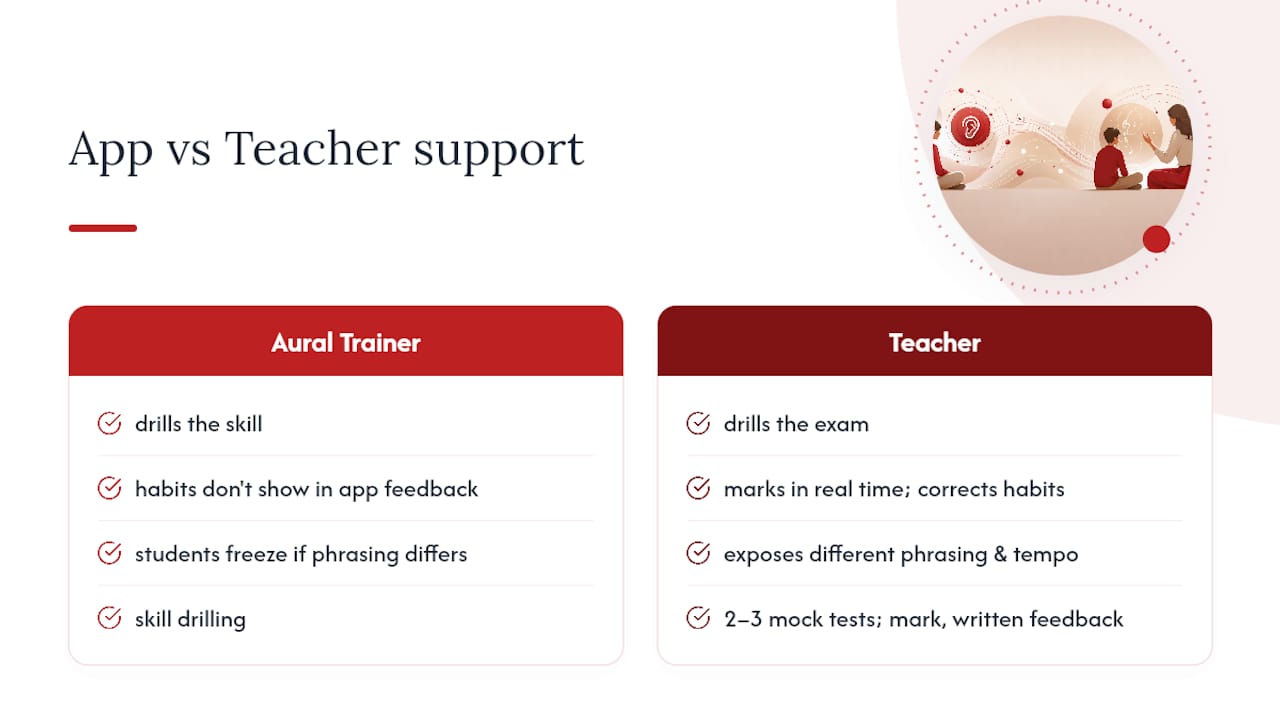
Most students who struggle in aural tests are not struggling because they lack musical ability. They are struggling because they have never heard the examiner’s exact phrasing before, and they freeze when the question sounds slightly different from what the app said.
The app drills the skill. The teacher drills the exam. Those are different things, and conflating them is the most common preparation mistake I see. A student can identify a perfect cadence reliably in the Aural Trainer and still hesitate in the exam room because the teacher played the extract at a different tempo, or the question was phrased as “what kind of cadence ends the phrase?” rather than the wording they had practised.
The habits that cost marks are almost always correctable: singing back a phrase too quietly, rushing the rhythmic echo, or describing dynamics with a single word when the examiner expects a phrase. None of those show up in app feedback. They show up when a teacher is sitting across from you, marking in real time, and can say “do that again, but this time commit to the pitch.”
For teachers, the most useful thing you can do before a student’s exam is run two or three full mock aural tests using the specimen paper audio, mark them against the rubric, and give written feedback. Students who have done that arrive in the exam room having already heard the worst version of their own performance. The real thing rarely feels harder.
Aural test preparation with Danpianostudio
Preparing for ABRSM aural tests with a teacher who knows the exam inside out is a different experience from solo app practice. Danpianostudio offers one-to-one piano lessons in Central London (Camden and King’s Cross) and online, with dedicated sessions for ABRSM aural preparation built into the lesson structure.
Each lesson can include a full mock aural test, targeted drills on the elements where a student is losing marks, and sight-singing work that builds fluency across the grade. Online lessons work just as well for aural prep: the teacher plays the extract, asks the questions, and marks responses in real time over video. Whether you are working towards Grade 1 or Grade 8, lessons are tailored to where you actually are, not a generic syllabus.
Book a home piano lesson in Central London, or start with an online lesson if you are preparing remotely. Contact Danpianostudio to arrange your first session.
Useful sources and official materials
Recommended



Comments